

Fastest Growing Cities in India 2026: Top Cities Leading in Infrastructure, Jobs & Real Estate
-
By Ayush Oswal
- July 10, 2026
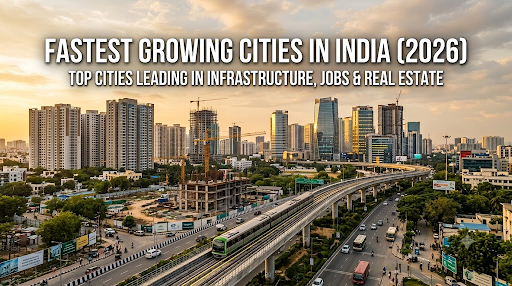
India is witnessing one of the fastest urban transformations in the world. Rapid industrialisation, infrastructure development, smart city initiatives, metro rail expansion, IT parks, manufacturing hubs, and improved connectivity have accelerated the growth of several cities across the country. These cities are not only attracting businesses and investments but are also becoming preferred destinations for homebuyers, working professionals, students, and investors.
The fastest growing cities in India are expanding beyond traditional metropolitan boundaries. Tier-1 and Tier-2 cities alike are experiencing rising property values, better employment opportunities, improved civic infrastructure, and increased demand for residential and commercial real estate.
In this blog, we explore the fastest growing cities in India, the factors driving their growth, and why these cities are becoming hotspots for real estate investment.
Also Read:- Best Cities to Invest in Property in India 2026
What Makes a City Grow Quickly?
A city’s growth depends on multiple economic, social, and infrastructure-related factors. Some of the most important growth indicators include:
Infrastructure development
Metro rail projects
IT and technology parks
Industrial corridors
Manufacturing investments
Population growth
Employment opportunities
Airport and highway connectivity
Smart City projects
Rise in residential and commercial real estate
Cities that perform well across these parameters generally witness faster economic development and higher property appreciation.
Also Read:- Why Homebuyers Are Leaving Metro Cities for Tier-2 Towns in 2026
Top Fastest Growing Cities in India
Bengaluru, Karnataka
Bengaluru continues to remain India’s technology capital. Bengaluru is expanding rapidly due to its thriving IT sector, startup ecosystem, Global Capability Centres (GCCs), and continuous infrastructure improvements.
Major growth drivers include:
Expansion of metro rail
Peripheral Ring Road
IT corridors
International investments
High demand for premium housing
Strong rental market
Hyderabad, Telangana
Hyderabad has become one of India’s biggest real estate success stories. Affordable property prices compared to other metro cities, excellent infrastructure, and strong IT growth have attracted thousands of professionals.
Growth factors include:
IT expansion
Financial district development
Outer Ring Road
Metro connectivity
Pharmaceutical industry
Large residential townships
Also Read:- Cheapest Cities to Buy a Home in India 2026 | Housiey
Pune, Maharashtra
Pune has transformed into one of India’s fastest-growing cities because of its IT sector, automobile industry, educational institutions, and improving infrastructure.
Reasons behind Pune’s growth include:
IT parks
Manufacturing industries
Metro expansion
Growing startup ecosystem
High student population
Ahmedabad, Gujarat
Ahmedabad continues to emerge as a major business destination supported by industrial growth and modern infrastructure.
Growth drivers include:
GIFT City proximity
Manufacturing
Textile industries
Expressways
Metro Rail
Commercial development
Also Read:- Step-by-Step Guide for NRIs to Buy Property in India
Chennai, Tamil Nadu
Chennai remains one of India’s strongest industrial and technology centres. The city has diversified across automobile manufacturing, electronics, healthcare, and IT services.
Major factors include:
Industrial corridors
IT parks
Port connectivity
Metro expansion
Strong employment market
Also Read:- First Home Buyer? 10 Costly Mistakes That Can Ruin Your Dream Home Purchase
Surat, Gujarat
Surat has evolved beyond its traditional diamond and textile industries. Modern infrastructure and industrial expansion continue to fuel its growth.
Reasons for rapid growth:
Diamond industry
Textile manufacturing
Smart City projects
Metro development
Improved road infrastructure
Increasing housing demand
Noida, Uttar Pradesh
Noida has become one of North India’s fastest-growing urban centres because of infrastructure, technology companies, and excellent connectivity with Delhi.
Growth highlights:
Jewar International Airport
Noida-Greater Noida Expressway
Metro connectivity
IT companies
Commercial developments
Luxury residential projects
Also Read:- Mumbai, Bengaluru or Hyderabad: Which City Is the Best to Buy Property in 2026?
Gurugram, Haryana
Gurugram continues to attract multinational companies, startups, and financial institutions, making it one of India’s strongest commercial markets.
Growth factors:
Corporate offices
High-end residential projects
Rapid Metro
Dwarka Expressway
Global businesses
Indore, Madhya Pradesh
Indore has emerged as one of India’s fastest-growing Tier-2 cities. Excellent civic administration, industrial growth, and educational institutions continue attracting investments.
Major growth drivers:
Industrial development
IT parks
Smart City Mission
Clean city initiatives
Educational hubs
Affordable real estate
Also Read:- What Are the Best Living Room Decor Ideas for 2026?
Kochi, Kerala
Kochi is rapidly becoming a preferred investment destination in southern India because of its port infrastructure, IT development, and tourism.
Growth contributors:
Metro Rail
Smart City project
IT parks
Port expansion
Tourism
Commercial real estate
Lucknow, Uttar Pradesh
Lucknow has witnessed remarkable urban growth with the development of metro connectivity, expressways, and new residential townships.
Key reasons include:
Defence Corridor
Metro expansion
IT City
Expressways
Government investments
Growing housing demand
Also Read:- 10 Home Decor Trends Taking Over Indian Homes in 2026
Bhubaneswar, Odisha
Bhubaneswar has developed into a major education, IT, and infrastructure hub in eastern India.
Growth factors:
Smart City Mission
IT parks
Educational institutions
Airport development
Planned urban expansion
Affordable housing
Coimbatore, Tamil Nadu
Coimbatore is emerging as an important manufacturing and technology city with growing residential demand.
Growth drivers:
Engineering industries
Healthcare
Textile sector
IT expansion
Airport upgrades
Industrial investments
Also Read:- 8 Number Numerology: Home Decor | Benefits | And Many More
Nagpur, Maharashtra
Nagpur’s central location and logistics advantages have accelerated its economic growth.
Key developments include:
MIHAN project
Metro Rail
Industrial parks
Expressways
Logistics hub
Growing commercial activity
Visakhapatnam, Andhra Pradesh
Visakhapatnam continues to strengthen its position as an industrial and port city while attracting investments in IT and manufacturing.
Growth highlights:
Port infrastructure
Steel industry
IT sector
Tourism
Industrial corridors
Housing development
Also Read:- 7 Vastu Tips That Can Bring Wealth, Health and Happiness to Your Home
Why Are These Cities Growing So Fast?
Several common factors are driving growth across these cities.
Improved transport infrastructure is reducing travel time and encouraging new residential developments.
Government-backed infrastructure projects are creating employment and attracting private investments.
The rapid expansion of the IT and startup ecosystem has increased housing demand.
Industrial corridors and manufacturing clusters are generating large-scale employment.
Growing educational institutions continue attracting students and professionals.
Higher disposable incomes are boosting demand for better housing and commercial spaces.
Impact on the Real Estate Market
Rapidly growing cities generally experience steady appreciation in property values. As infrastructure improves, new residential projects, office spaces, retail centres, and integrated townships continue to emerge.
For homebuyers, these cities offer better employment opportunities and modern lifestyles. For investors, they provide strong long-term appreciation potential, rental demand, and expanding commercial markets. However, investment decisions should always be based on location quality, infrastructure progress, legal verification, and future development plans rather than short-term price trends.
Also Read:- Easy Small Pookalam Designs: Simple &; Beautiful Ideas by Housiey
How to Choose the Right Fast-Growing City for Investment
Before investing, evaluate:
Employment opportunities
Infrastructure projects
Metro connectivity
Industrial growth
Population trends
Rental demand
Future government projects
Developer reputation
Legal approvals
Long-term appreciation potential
A city showing balanced economic and infrastructure growth usually offers more stable returns over time.
Conclusion
India’s urban landscape continues to evolve rapidly, with both metropolitan and Tier-2 cities contributing significantly to the country’s economic growth. Cities such as Bengaluru, Hyderabad, Pune, Ahmedabad, Noida, Gurugram, Surat, Indore, Kochi, Lucknow, Bhubaneswar, Coimbatore, Nagpur, Chennai, and Visakhapatnam are leading this transformation through investments in infrastructure, technology, manufacturing, and real estate.
For buyers, these cities offer improved quality of life and employment opportunities, while investors benefit from expanding property markets and long-term appreciation prospects. Choosing the right city based on infrastructure, connectivity, and economic fundamentals can help maximise the value of a real estate investment.
Key Takeaways
Rapid infrastructure development is one of the biggest reasons behind the growth of Indian cities.
IT, manufacturing, logistics, and startup ecosystems continue to drive urban expansion.
Tier-2 cities are emerging as strong alternatives to traditional metropolitan areas.
Metro rail, expressways, airports, and Smart City projects significantly influence property demand.
Growing cities generally offer better employment opportunities and stronger rental markets.
Real estate investments should always be based on long-term growth potential rather than short-term trends.
Sources
Ministry of Housing and Urban Affairs (MoHUA)
National Institution for Transforming India (NITI Aayog)
Reserve Bank of India (RBI)
Ministry of Road Transport and Highways (MoRTH)
National Highways Authority of India (NHAI)
Department for Promotion of Industry and Internal Trade (DPIIT)
Smart Cities Mission
Department of Economic Affairs
Census of India
Ministry of Statistics and Programme Implementation (MoSPI)
State Government Urban Development Departments
Airport Authority of India (AAI)
Delhi Metro Rail Corporation (DMRC)
State Metro Rail Corporations
FAQs
Bengaluru is widely regarded as one of India’s fastest-growing cities because of its technology sector and infrastructure development. Hyderabad and Pune also rank among the top rapidly expanding cities.
Better infrastructure, affordable housing, and increasing employment opportunities are driving their growth. Many businesses are also expanding beyond traditional metro cities.
Cities like Hyderabad, Bengaluru, Noida, Pune, and Ahmedabad continue to show strong long-term real estate potential. Growth depends on infrastructure, employment, and future development plans.
Growing cities often offer better appreciation and rental demand over time. Investors should still verify legal documents and market conditions before purchasing.
Bengaluru remains India’s largest IT hub. Hyderabad, Pune, Chennai, and Noida are also major technology centres.
Infrastructure, employment growth, connectivity, and population expansion are major contributors. Demand and limited land supply also influence prices.
Several cities including Hyderabad, Bengaluru, Ahmedabad, Noida, and Lucknow are witnessing significant infrastructure improvements. Continuous investments are supporting long-term development.
Yes, improved civic amenities and infrastructure often increase buyer interest. These developments can positively influence real estate markets over time.
Pune, Ahmedabad, Indore, Lucknow, and Coimbatore offer relatively affordable housing options. Buyers should compare budgets, connectivity, and employment opportunities.
Hyderabad has experienced exceptional growth in recent years. However, Bengaluru continues to lead in terms of technology employment and startup activity.
Large infrastructure projects, metro connectivity, and the upcoming international airport have boosted its growth. Commercial expansion has also increased housing demand.
Bengaluru, Hyderabad, Pune, Noida, and Gurugram generally offer strong rental demand. Actual rental returns depend on location and property type.
Chennai, Ahmedabad, Surat, Nagpur, and Coimbatore have strong manufacturing sectors. Industrial growth contributes significantly to urban expansion.
Not always. Several Tier-2 cities still provide comparatively affordable housing despite rapid development.
Properties near metro stations often experience higher demand and improved accessibility. This may contribute to better long-term appreciation.
Bengaluru, Gurugram, Hyderabad, Noida, and Pune remain attractive commercial investment destinations. Demand is driven by office expansion and business growth.
Cities investing heavily in infrastructure and employment generation generally have better future prospects. Hyderabad, Noida, Ahmedabad, Lucknow, and Bengaluru are among the leading examples.
Buyers should verify legal approvals, connectivity, infrastructure plans, builder credibility, and future growth potential. Proper due diligence reduces investment risks.
Prices often increase with sustained infrastructure and employment growth. However, market conditions and economic factors also influence appreciation.
Yes, many Tier-2 cities are becoming strong long-term investment destinations. Continued government investments and expanding industries support their growth.

Ayush Oswal is an SEO Executive at Housiey, specializing in optimizing real estate content for better visibility and engagement. With a strong understanding of SEO strategies and the property market, he ensures that every blog helps homebuyers make informed decisions while performing well on search engines.
Related Stories