
General Pool Residential Accommodation (GPRA) Scheme: Everything You Need to Know
-
 By L. Sadriwala
- June 23, 2026
Introduction :
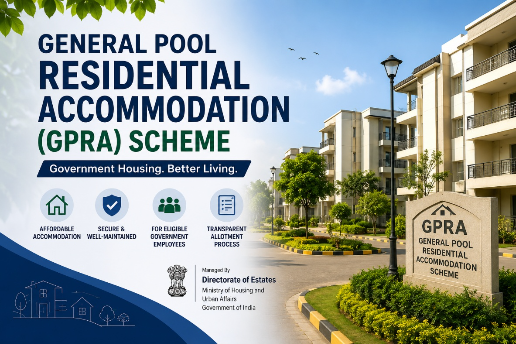
Finding suitable housing in metropolitan cities like Delhi can be challenging, especially for government employees who are frequently transferred between cities. To ensure that eligible government servants have access to affordable, well-maintained residential accommodation, the Government of India introduced the General Pool Residential Accommodation (GPRA) Scheme.
The scheme has played a significant role in providing secure housing to thousands of government employees working in various ministries and departments. Instead of relying entirely on private rental markets, eligible officials can occupy government-owned residential units located across major cities.
However, many people still have questions regarding who is eligible, how allotment works, what types of houses are available, how licences are charged, and what happens after retirement or transfer.
This detailed guide explains everything you should know about the General Pool Residential Accommodation Scheme, including its objectives, eligibility criteria, allotment process, rules, benefits, limitations, and recent digital initiatives.
Also Read:- First-Time Buyer? Government Schemes That Can Save You ₹2.67 Lakh on a Home Loan
Quick Answer
The General Pool Residential Accommodation (GPRA) Scheme is a government housing initiative managed by the Directorate of Estates under the Ministry of Housing and Urban Affairs (MoHUA). It provides residential accommodation to eligible Central Government employees, Members of Parliament, judges, and certain other categories of government officials based on eligibility, pay level, entitlement, and availability of houses.
Market Snapshot
|
Particular |
Details |
| Scheme Name | General Pool Residential Accommodation (GPRA) |
| Managed By | Directorate of Estates |
| Ministry | Ministry of Housing and Urban Affairs (MoHUA) |
| Purpose | Government residential housing |
| Beneficiaries | Eligible Central Government employees and notified categories |
| Housing Type | Government-owned residential quarters |
| Allotment Basis | Eligibility, entitlement, seniority, and availability |
| Major Cities Covered | Delhi and several notified stations across India |
| Charges | Licence Fee as prescribed by the Government |
| Application Mode | Online through the Directorate of Estates portal |
What is the General Pool Residential Accommodation (GPRA) Scheme?
The General Pool Residential Accommodation (GPRA) Scheme is a government housing programme that provides residential quarters to eligible Central Government employees and other approved categories of occupants.
These residential properties are owned and maintained by the Government of India. Instead of purchasing or renting houses in the private market, eligible employees receive accommodation based on predefined rules.
The Directorate of Estates is responsible for:
- Managing government residential colonies
- Allocating accommodation
- Maintaining housing inventory
- Collecting licence fees
- Handling transfers and cancellations
- Monitoring occupancy
The primary objective is to provide decent residential accommodation close to workplaces while ensuring efficient management of government housing assets.
Also Read:- What Are the Eligibility Criteria for the DDA Housing Scheme 2026?
Objectives of the GPRA Scheme
The scheme has several important objectives.
- Provide Affordable Government Housing
Government employees receive quality accommodation at prescribed licence fees that are generally much lower than prevailing market rentals.
- Reduce Housing Burden
Employees transferred to expensive cities can avoid the financial stress associated with finding suitable rental accommodation.
- Improve Administrative Efficiency
Officials living closer to government offices often experience shorter commute times, allowing them to perform their duties more effectively.
- Ensure Standardised Housing
The scheme offers housing that follows government standards for safety, infrastructure, utilities, and maintenance.
- Better Utilisation of Government Assets
The government can efficiently utilise its residential properties through a structured allotment system.
Also Read:- UHUDA Scheme: Online | New Scheme | Registration
Who Can Apply Under the GPRA Scheme?
Eligibility depends on government rules, service status, and specific categories notified by the Government of India.
Generally, eligible applicants include:
- Central Government employees
- Officers working under eligible ministries
- Members of Parliament
- Judges of certain courts
- Constitutional authorities
- Employees of specific autonomous organisations where permitted
- Certain retired officials under approved provisions
- Other categories notified from time to time
Eligibility is always subject to applicable government rules and availability.
Also Read:- What Are the Benefits of the NPS Vatsalya Scheme?
Types of Residential Accommodation Available
Government residential quarters are categorised according to the employee’s entitlement.
These categories generally include:
Type I
- Suitable for employees in lower entitlement categories.
Type II
- Allocated to employees in slightly higher pay levels.
Type III
- Larger accommodation with additional living space.
Type IV
- Designed for senior government officials.
Type V
- Allocated to higher-ranking officers.
Type VI
- Premium government residences for senior administrative officers.
Type VII
- Large bungalows meant for very senior officials.
Type VIII
- Reserved for the highest constitutional authorities and select top government officials.
- The exact entitlement depends upon the applicable government rules and pay level.
Also Read:- Jharkhand State Housing Board Scheme in 2026 – Housiey
How Does the GPRA Allotment Process Work?
The allotment process follows a transparent system.
Step 1: Employee Registration
- Eligible employees submit an online application through the Directorate of Estates portal.
Step 2: Verification
- The concerned department verifies employment details and eligibility.
Step 3: Determining Entitlement
- The employee’s pay level, service status, and category determine the type of accommodation they are eligible for.
Step 4: Waiting List
- Applications are placed in the appropriate waiting list depending on priority and availability.
Step 5: House Allocation
- Whenever an eligible house becomes vacant, allotment is made according to applicable rules.
Step 6: Acceptance
- The applicant accepts the allotment within the prescribed period.
Step 7: Occupation
- After completing formalities, possession of the residence is handed over.
Also Read:- What Are the Benefits of the NPS Vatsalya Scheme?
What Facilities Are Usually Available?
Most GPRA residential colonies provide several common facilities.
These may include:
- Water supply
- Electricity connections
- Internal roads
- Parks
- Community centres
- Security arrangements
- Parking areas
- Public transport connectivity
- Schools nearby
- Healthcare facilities in surrounding areas
- Local shopping complexes
- Maintenance services
Facilities vary depending on the colony and location.
Licence Fee Under the GPRA Scheme
Unlike private rental housing, GPRA accommodation is allotted on payment of a licence fee.
The fee depends upon:
- Type of accommodation
- Government notifications
- Applicable rules
- Employee category
The licence fee is periodically revised by the Government of India.
Maintenance Responsibilities
The government undertakes maintenance of common infrastructure and structural repairs through designated agencies.
Residents are generally expected to:
- Maintain cleanliness
- Avoid unauthorised construction
- Prevent misuse of government property
- Report repairs promptly
- Follow housing regulations
- Vacate accommodation when required
Can Employees Retain GPRA Accommodation After Transfer?
In certain situations, employees may retain government accommodation after transfer for a specified period, subject to applicable rules and payment of prescribed licence fees.
Retention depends upon:
- Nature of transfer
- Posting location
- Government guidelines
- Permission granted by competent authorities
Also Read:- DDA Housing Scheme 2026: Key Details | Registration Online | Price
What Happens After Retirement?
Normally, employees are required to vacate government accommodation after retirement within the period permitted under applicable rules.
If accommodation is retained beyond the authorised period without approval, penal or damage charges may become applicable.
Digital Transformation of the GPRA Scheme
The government has significantly modernised housing management.
Several services are now available online:
- Online registration
- Digital allotment
- Status tracking
- Licence fee information
- Occupancy management
- Estate services
- Complaint registration
- Maintenance requests
These digital initiatives have improved transparency and reduced paperwork.
Also Read:- CIDCO News Freehold Scheme Brings Big Relief to Navi Mumbai Homeowners
Benefits of the GPRA Scheme
Affordable Living
- Government licence fees are generally lower than private market rentals.
Better Security
- Government residential colonies usually have organised security arrangements.
Reliable Infrastructure
- Residents often benefit from planned infrastructure and regular maintenance.
Convenient Location
- Many colonies are situated close to government offices and public transport.
Financial Stability
- Employees can avoid unpredictable rental increases commonly seen in private housing markets.
Transparent Allocation
- A structured allotment process reduces arbitrary decision-making.
Limitations of the GPRA Scheme
- Although beneficial, the scheme also has certain limitations.
Limited Availability
- Demand for government housing frequently exceeds supply.
Waiting Periods
- Applicants may need to wait before accommodation becomes available.
Category Restrictions
- Employees cannot generally choose any house outside their entitlement category.
Transfer-Related Challenges
- Frequent transfers may require relocation from one government residence to another.
Occupancy Rules
- Strict regulations govern occupancy, retention, and vacation of government accommodation.
Important Rules Every Applicant Should Know
Applicants should carefully understand the applicable housing rules before accepting an allotment.
Some important aspects include:
- Eligibility verification is mandatory.
- False information may result in cancellation.
- Houses cannot be sublet without permission.
- Licence fees must be paid regularly.
- Government property should not be altered without approval.
- Occupants must vacate the accommodation after the authorised retention period.
- Misuse may invite disciplinary action.
Why the GPRA Scheme Remains Important
Government housing continues to be an essential employee welfare measure. In cities where property prices and rents are exceptionally high, the GPRA Scheme offers financial relief while ensuring that government employees have access to safe and functional accommodation.
The structured allotment process, transparent eligibility criteria, and continuous digital improvements have strengthened the scheme over the years. While challenges such as limited housing inventory remain, GPRA continues to serve as one of India’s most significant government residential housing programmes for eligible public servants.
Conclusion
The General Pool Residential Accommodation Scheme is much more than a housing programme—it is an important support system for thousands of Central Government employees across the country. By providing affordable, well-maintained residential accommodation, it helps employees focus on their professional responsibilities without the added pressure of securing housing in expensive urban markets.
As the government continues to digitise services and improve estate management, the scheme is becoming increasingly transparent and efficient. For eligible employees, understanding the rules, entitlement categories, application procedures, and occupancy conditions is essential to making the most of this valuable benefit.
If you are planning to understand different government housing schemes, residential policies, or real estate opportunities in India, Housiey keeps you informed with reliable, simplified, and updated property insights.
Key Takeaways
- The GPRA Scheme provides government-owned residential accommodation to eligible Central Government employees and notified categories.
- The scheme is administered by the Directorate of Estates under the Ministry of Housing and Urban Affairs.
- Accommodation is allotted according to eligibility, pay level, entitlement, seniority, and availability.
- Government housing is provided on payment of a prescribed licence fee rather than market rent.
- Multiple categories of residential quarters are available based on employee entitlement.
- Online application and allotment systems have improved transparency and convenience.
- Occupants must comply with government housing rules regarding maintenance and occupancy.
- Retention of accommodation after transfer or retirement is governed by specific rules.
- Demand for GPRA housing often exceeds available inventory, resulting in waiting periods.
- The scheme continues to play an important role in supporting government employees working across India.
Sources
- The information in this blog has been compiled and verified using publicly available and authoritative sources, including:
- Government of India – Ministry of Housing and Urban Affairs (MoHUA)
- Directorate of Estates
- General Pool Residential Accommodation Rules and related government notifications
- Central Public Works Department (CPWD)
- Department of Personnel and Training (DoPT)
- Government of India Office Memorandums relating to residential accommodation
- Relevant Gazette Notifications issued by the Government of India
- Parliamentary questions and official government publications relating to GPRA
FAQs
- It is a government housing scheme that provides residential accommodation to eligible Central Government employees and other notified categories. The scheme is administered by the Directorate of Estates under the Ministry of Housing and Urban Affairs.
- The Directorate of Estates is responsible for managing the scheme. It oversees allotment, maintenance, licence fee collection, and overall estate administration.
- Eligibility mainly includes Central Government employees and other approved categories notified by the Government of India. The exact eligibility depends on applicable rules and service conditions.
- Accommodation is allotted based on entitlement, eligibility, seniority, and availability of residential units. The process follows government-prescribed allotment rules.
- Yes, eligible applicants can submit their applications online through the Directorate of Estates portal. Digital services have simplified the registration and allotment process.
- A licence fee is the amount occupants pay for using government accommodation. It is determined according to government rules and revised periodically.
- No, applicants are generally entitled only to accommodation that matches their prescribed category. Availability also plays a major role in allotment.
- No, GPRA accommodation is available only in notified locations where the Government maintains residential housing. Availability varies from one city to another.
- No, allotted accommodation cannot normally be transferred to another individual without government approval. Occupancy is governed by strict rules.
- Employees may be allowed to retain accommodation for a limited period depending on applicable rules. Thereafter, they may need to vacate or seek fresh allotment at the new posting.
- Retired employees may retain accommodation only for the authorised period permitted under government rules. Beyond that period, they are generally required to vacate the premises.
- Yes, structural maintenance and common infrastructure are generally maintained by designated government agencies. Residents are expected to report repair requirements promptly.
- Major alterations usually require prior government approval. Unauthorised construction or structural changes are generally prohibited.
- Many colonies provide roads, parks, water supply, electricity, parking, and community facilities. Amenities may differ depending on the location and age of the colony.
- No, subletting government accommodation is generally prohibited under the applicable housing rules. Violations may lead to cancellation and disciplinary action.
- The consequences depend on the prevailing allotment rules and specific circumstances. Applicants should carefully review the applicable guidelines before declining an allotment.
- Yes, waiting lists are maintained when demand exceeds available housing. Allotments are made as suitable residences become vacant.
- It provides affordable accommodation, reliable infrastructure, and greater housing security for eligible government employees. It also reduces dependence on costly private rentals.
- Applicants generally need employment-related details and other documents specified by the concerned authorities. Requirements may vary depending on the applicant’s category.
- Knowing the rules helps applicants understand their rights, responsibilities, and eligibility. It also reduces the chances of future disputes regarding occupancy or retention.
L. Sadriwala is the Editor-in-Chief at Housiey, with a professional writing career spanning since 2015. Coming from a family of real estate developers, her deep-rooted industry understanding naturally shaped her focus on real estate content, where she combines domain knowledge with clear, reader-first writing.
She specializes in simplifying complex property concepts — from housing policies and market trends to builder reviews and project insights — into accurate, easy-to-understand guidance for homebuyers and investors.
At Housiey, every article by L. Sadriwala is built on thorough research and verified facts. Her goal is straightforward: to empower homebuyers and investors with reliable, trustworthy information that helps them make confident property decisions.
Related Stories