

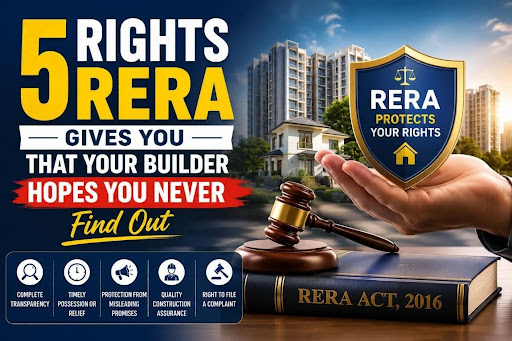
5 Rights RERA Gives You That Your Builder Hopes You Never Find Out
-
By Ayush Oswal
- June 23, 2026
Introduction
Buying a home is one of the biggest financial decisions a person makes. For many families, it represents years of savings, dreams, and future security. Unfortunately, before the introduction of RERA, homebuyers often faced delayed possession, misleading advertisements, unexplained cost escalations, poor construction quality, and little accountability from developers. Buyers had limited legal protection and frequently struggled to obtain justice.
The Real Estate (Regulation and Development) Act, 2016, commonly known as RERA, transformed India’s real estate industry by bringing transparency, accountability, and fairness into property transactions. Today, developers are legally obligated to follow specific rules regarding project registration, disclosures, delivery timelines, construction quality, and financial discipline.
However, despite RERA being in force for several years, many homebuyers remain unaware of the powerful rights the Act grants them. In many cases, buyers unknowingly accept unfair terms, unnecessary delays, or illegal demands simply because they do not know what the law actually says.
This lack of awareness benefits dishonest builders far more than informed buyers.
In this article, we will explore five powerful rights that RERA gives every eligible homebuyer. Understanding these rights can help you make informed decisions, avoid unnecessary financial losses, and confidently protect your investment whenever required.
Also Read: How to File a RERA Complaint and Win Against Your Builder Step by Step
Quick Answer
The Real Estate (Regulation and Development) Act, 2016 (RERA) empowers homebuyers with several legal rights that protect them from project delays, misleading advertisements, unfair builder practices, hidden charges, and poor construction quality. Knowing these rights allows buyers to demand transparency, claim compensation, seek refunds, and file complaints before the appropriate RERA Authority if a builder violates the law.
Market Snapshot Table
| Particular | Details |
|---|---|
| Governing Law | Real Estate (Regulation and Development) Act, 2016 |
| Applicable To | Residential and Commercial Real Estate Projects |
| Primary Objective | Protect homebuyers and regulate the real estate sector |
| Regulatory Authority | State RERA Authorities |
| Registration Requirement | Mandatory for eligible real estate projects before marketing or selling |
| Major Buyer Benefits | Transparency, Accountability, Timely Delivery, Legal Protection |
| Complaint Platform | Concerned State RERA Authority |
| Compensation Available | Yes, depending on the nature of the violation |
| Refund Rights | Available under specified circumstances |
| Defect Liability Period | Five years from possession for structural defects and certain workmanship issues |
Why Was RERA Introduced?
Before understanding your rights, it is important to understand why RERA came into existence.
The real estate sector was once largely unregulated. Homebuyers commonly experienced:
- Project delays extending for several years
- False promises regarding amenities
- Misleading brochures and advertisements
- Diversion of buyer funds to other projects
- Hidden charges during possession
- Poor construction quality
- Lack of transparency regarding approvals
To address these concerns, the Government of India enacted the Real Estate (Regulation and Development) Act, 2016.
The Act seeks to:
- Protect homebuyers
- Regulate developers
- Increase transparency
- Ensure timely project completion
- Create accountability
- Provide an effective dispute resolution mechanism
Today, RERA serves as one of the strongest consumer protection laws in India’s real estate sector.
Also Read: RERA vs Non-RERA Projects: Which One Should You Buy and Why?
Why Every Homebuyer Should Know Their RERA Rights
Many buyers assume that once they sign the Agreement for Sale, the builder has complete control over the transaction.
That assumption is incorrect.
The Agreement for Sale cannot override several statutory protections available under RERA. Even if certain contract clauses appear one-sided, buyers may still be entitled to legal remedies under the Act.
Knowing your rights enables you to:
- Make informed purchasing decisions.
- Detect unfair practices early.
- Avoid illegal demands.
- Seek compensation where applicable.
- Hold developers accountable.
- Protect your long-term investment.
Now let’s understand the five important rights many buyers still do not fully know about.
Right 1: You Have the Right to Complete Project Transparency
One of the biggest changes introduced by RERA is mandatory transparency.
Every eligible registered project must disclose important information on the respective State RERA website.
This includes:
Project registration details
Buyers can verify whether the project is legally registered.
Land ownership information
Developers must disclose ownership documents and legal title.
Government approvals
Necessary approvals and permissions should be available for buyer verification.
Construction progress
Builders are expected to provide periodic updates regarding project progress.
Completion timelines
The promised completion date becomes an important reference point under RERA.
Financial disclosures
Developers must comply with financial disclosure requirements under the Act, including maintaining designated project accounts as applicable.
Why this matters
Without transparency, buyers cannot make informed decisions.
RERA allows buyers to independently verify project information instead of relying solely on sales executives or marketing brochures.
Right 2: You Can Demand Timely Possession or Claim Relief
Project delays were once among the biggest problems in Indian real estate.
RERA significantly strengthened buyer protection in this area.
If the builder fails to deliver possession as promised without lawful justification, buyers may have legal remedies under the Act.
Depending on the circumstances, buyers may be entitled to:
- Continue with the project and claim interest for delayed possession.
- Seek refund along with applicable interest.
- Claim compensation where legally justified.
Every case depends on its facts, applicable state rules, and orders of the concerned RERA Authority.
Why this right is powerful
Builders can no longer indefinitely delay projects without legal consequences.
The promised possession timeline carries legal significance.
Right 3: You Can Challenge Misleading Advertisements and False Promises
Many buyers purchase homes based on brochures, advertisements, sample flats, or verbal assurances.
Before RERA, builders often modified layouts or reduced promised amenities without much accountability.
RERA changed this.
Developers are expected to ensure that advertisements and project representations accurately reflect the approved project.
If buyers suffer losses because of false representations or misleading information, legal remedies may be available.
Examples include:
- Amenities removed later
- Clubhouse not constructed
- Layout substantially altered without following legal requirements
- False possession timelines
- Incorrect project specifications
Why this right matters
Marketing material is not merely promotional content.
Representations made to buyers may carry legal consequences under RERA and other applicable laws.
Right 4: You Have the Right to Quality Construction Even After Possession
Many buyers believe that once possession is handed over, the builder’s responsibility ends.
That is not true.
RERA introduced an important safeguard through the defect liability provision.
If structural defects or certain defects in workmanship, quality, or services are reported within five years from possession, the developer is generally required to rectify them within the prescribed time without additional cost, subject to the provisions of the Act.
Examples include:
Structural defects
- Foundation problems
- Major cracks
- Beam failures
- Load-bearing issues
Construction quality defects
- Serious waterproofing failures
- Poor plumbing work
- Electrical defects
- Major leakage due to defective workmanship
If the builder fails to rectify eligible defects as required, the buyer may seek relief under RERA.
Why this right is valuable
Your legal protection does not automatically end on possession day.
The law continues to protect buyers against qualifying defects for the specified period.
Right 5: You Have the Right to File a Complaint Against the Builder
Many buyers believe legal action requires years of court proceedings.
RERA provides a dedicated regulatory mechanism for addressing disputes covered under the Act.
Homebuyers can approach the concerned State RERA Authority regarding eligible grievances.
Common complaints include:
- Delay in possession
- Refund disputes
- Interest claims
- False advertisements
- Agreement violations
- Unauthorized changes
- Construction quality issues
- Non-compliance with RERA provisions
Depending on the nature of the dispute, complaints may also involve the Adjudicating Officer for compensation-related matters where applicable.
Why this right matters
Instead of feeling helpless, buyers have a dedicated legal forum designed specifically for real estate disputes.
Buyer Insights
Understanding your legal rights before booking a property is just as important as checking its location, price, or amenities. Many disputes arise not because buyers lack valid claims, but because they are unaware of the protections available under RERA. Verifying project registration, reviewing disclosed documents, keeping written records of communications, and preserving payment receipts can significantly strengthen your position if a dispute arises. An informed buyer is far less likely to fall victim to unfair practices.
Common Mistakes Buyers Make Despite Having RERA Protection
Even with strong legal safeguards, many buyers weaken their own case by making avoidable mistakes.
Some common examples include:
Not checking RERA registration before booking
Always verify whether the project is registered with the applicable State RERA Authority.
Relying only on verbal promises
Ensure every important commitment is documented.
Ignoring the Agreement for Sale
Read every clause carefully before signing.
Not preserving documents
Maintain copies of receipts, emails, brochures, advertisements, and payment records.
Waiting too long to raise issues
Report construction defects, delays, or contractual violations promptly.
Assuming every dispute is automatically covered
Each matter depends on the facts, contractual terms, and applicable legal provisions.
Why Buyers Choose Housiey
Purchasing a home becomes much easier when buyers have access to accurate project information and expert guidance. Housiey simplifies the property search process by helping buyers connect directly with reputed developers without sharing their contact details with multiple brokers. From exploring verified projects to understanding pricing, amenities, floor plans, and legal aspects, Housiey aims to make the home-buying journey more transparent, informed, and hassle-free.
Conclusion
RERA has fundamentally changed the relationship between builders and homebuyers in India. It has shifted the balance by introducing greater transparency, accountability, and legal safeguards throughout the property-buying process. Whether it is the right to verify project details, receive timely possession, challenge misleading claims, demand quality construction, or file a complaint against a defaulting builder, these protections are designed to safeguard buyers’ interests.
However, legal rights are effective only when buyers are aware of them and know how to exercise them responsibly. Before investing in any property, always verify the project’s RERA registration, review all disclosures, maintain proper documentation, and understand the terms of your Agreement for Sale. Staying informed can help you avoid unnecessary disputes and make better decisions throughout your home-buying journey.
A well-informed buyer is not just purchasing a property, they are protecting one of the most significant investments of their lifetime.
Key Takeaways
- RERA provides legal protection against several unfair builder practices.
- Buyers have the right to access transparent project information before investing.
- Delayed possession may entitle buyers to interest, refunds, or other relief, depending on the circumstances.
- Builders are accountable for certain structural defects and workmanship issues for five years after possession.
- Misleading advertisements and false project representations can have legal consequences.
- Homebuyers can approach the concerned State RERA Authority for eligible disputes.
- Maintaining proper documentation strengthens a buyer’s legal position.
- Verifying RERA registration before booking a property is an essential first step.
Sources
- The Real Estate (Regulation and Development) Act, 2016
- Ministry of Housing and Urban Affairs (MoHUA)
- Central Advisory Council under RERA
- Maharashtra Real Estate Regulatory Authority (MahaRERA)
- Karnataka Real Estate Regulatory Authority
- Uttar Pradesh Real Estate Regulatory Authority
- Gujarat Real Estate Regulatory Authority
- Delhi Real Estate Regulatory Authority
- Official notifications issued by various State RERA Authorities
- Consumer Affairs Department, Government of India
FAQs
- RERA is a law enacted to regulate India’s real estate sector and protect homebuyers. It promotes transparency, accountability, and timely project delivery.
- Not every project requires registration, as certain categories may be exempt under the Act. Buyers should verify the registration status of the project before investing.
- Yes. Registered project details are generally available on the respective State RERA Authority’s website for public access.
- You may have legal remedies under RERA depending on the circumstances of the delay. The available relief can include interest, refund, or other remedies as permitted by law.
- Yes, refunds may be available in certain situations provided under the Act. The outcome depends on the facts of the case and the applicable legal provisions.
- Misleading advertisements or inaccurate representations may attract legal consequences. Buyers can seek appropriate remedies under the applicable provisions.
- Major changes generally require compliance with the provisions of RERA and other applicable laws. Buyers should carefully review any proposed modifications.
- It is the period during which qualifying structural defects and certain workmanship-related issues can be reported. The developer is generally required to rectify eligible defects without additional cost.
- Yes. Eligible complaints can be filed before the concerned State RERA Authority following the prescribed procedure.
- A lawyer is not mandatory in every case. However, legal assistance may be helpful depending on the complexity of the dispute.
- If the charges violate the agreement or applicable legal provisions, buyers may challenge them. Each matter is examined on its individual facts.
- Yes, certain responsibilities continue even after possession, including obligations related to qualifying defects under the Act. Other contractual obligations may also remain applicable.
- Maintain copies of booking forms, payment receipts, agreements, brochures, emails, and correspondence. These documents can be valuable if a dispute arises.
- Registered developers are required to provide periodic project updates on the applicable RERA portal. Buyers should review these updates regularly.
- Yes, the Act also applies to eligible commercial real estate projects. The registration requirements depend on the nature and size of the project.
- Eligible projects generally cannot be marketed or advertised before obtaining RERA registration. Buyers should always verify registration before booking.
- The Authority regulates registered projects, addresses eligible complaints, and promotes transparency in the real estate sector. It also monitors compliance with the Act.
- Compensation may be available in appropriate cases under the provisions of the Act. The decision depends on the facts, evidence, and applicable law.
- The duration varies depending on the complexity of the matter and the concerned Authority. Some disputes may be resolved faster than traditional civil litigation.
- Knowing your rights helps you make informed decisions and identify unfair practices early. It also enables you to take timely legal action if your rights are violated.

Ayush Oswal is an SEO Executive at Housiey, specializing in optimizing real estate content for better visibility and engagement. With a strong understanding of SEO strategies and the property market, he ensures that every blog helps homebuyers make informed decisions while performing well on search engines.
Related Stories