
Pune Metro Guide: Timings, Routes, Fares, Stations & Best Areas to Live Nearby
-
 By L. Sadriwala
- May 13, 2026
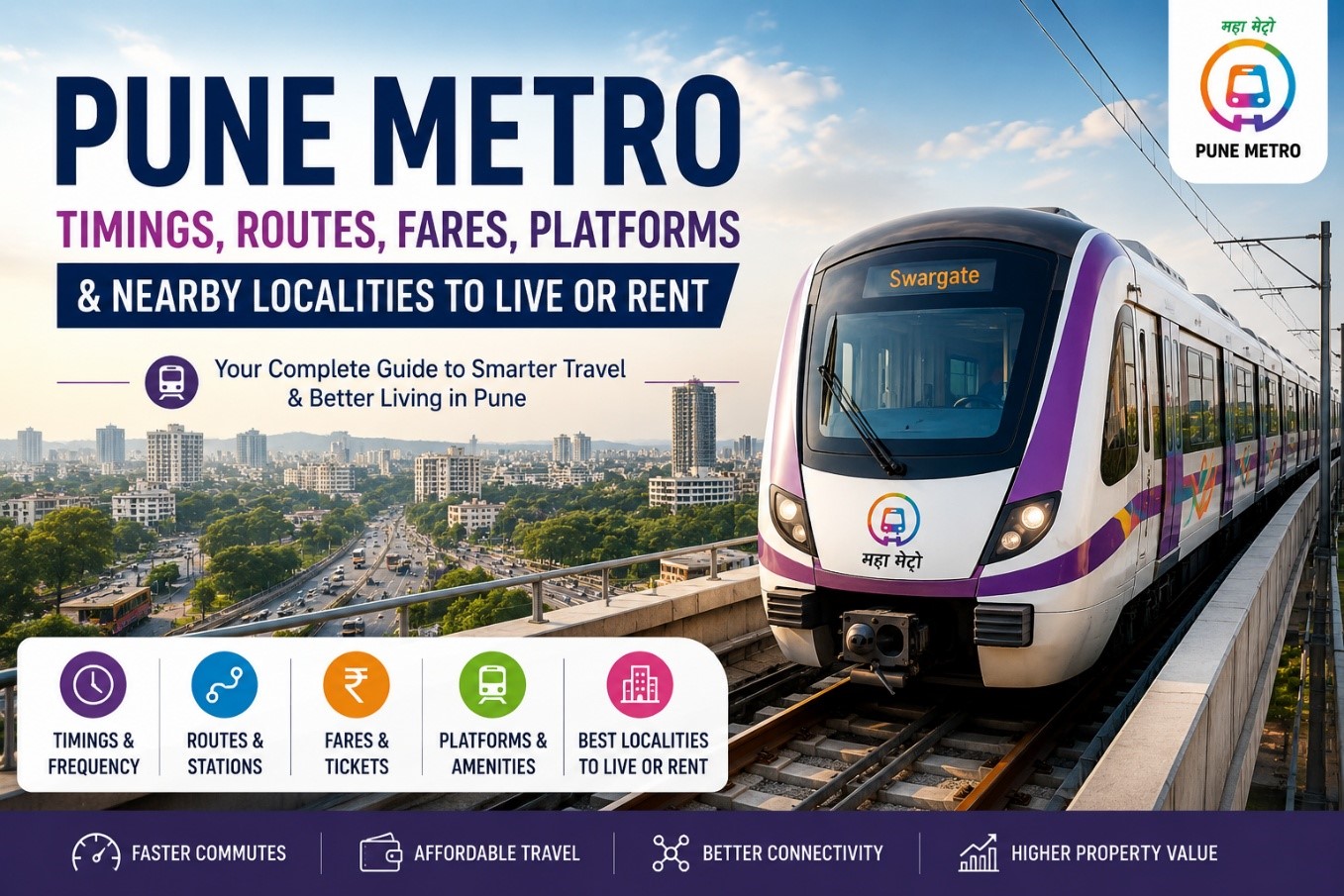
Rush hour in Pune doesn’t have to mean crawling traffic and long, unpredictable commutes anymore. Imagine stepping into a clean, air-conditioned train, skipping road congestion entirely, and reaching key parts of the city in a fraction of the usual time, that’s exactly the shift Pune Metro is bringing. Seamlessly connecting Pune with Pimpri-Chinchwad, this growing network is redefining everyday travel while also influencing how people choose homes, offices, and investments across the city. Operated by Maharashtra Metro Rail Corporation Limited, the system combines speed, affordability, and reliability, making it a preferred option for students, professionals, and families alike.
In this detailed guide, you’ll find everything you need to navigate the Pune Metro with confidence. From updated timings, routes, and fare structures to a breakdown of each operational line and upcoming expansions, this blog covers it all. You’ll also discover station highlights, connectivity with other transport modes, and the latest developments shaping the network’s future. If you’re considering relocating or investing, we’ve included some of the best residential areas near metro stations, helping you make smarter real estate decisions. Whether you’re a daily commuter or simply exploring Pune’s evolving infrastructure, this guide is designed to give you a complete, practical understanding of the Pune Metro system.
Also Read:- Discover Pune’s Top Residential Projects with Housiey
Quick Overview of Pune Metro
| Category | Details |
| Operator | Maharashtra Metro Rail Corporation Limited |
| Launch Date | March 6, 2022 |
| Lines Running | Purple & Aqua |
| Upcoming Line | Pink Line (Line 3) |
| Total Operational Length | 33.1 km |
| Planned Expansion | 66.27 km |
| Number of Stations | 24 |
| Train Timings | 6:00 AM – 11:00 PM |
| Frequency | 7 mins (peak), 10–15 mins (non-peak) |
| Fare Range | ₹10 – ₹35 |
| Interchange Station | Civil Court |
Pune Metro Routes Explained
Purple Line (PCMC to Swargate)
The Purple Line connects the northern industrial belt to central Pune. Stretching roughly 14.6 km, it passes through key areas like PCMC, Dapodi, Shivajinagar, and Mandai before ending at Swargate.
Civil Court station acts as a major interchange, making it easy to switch lines. Future extensions toward Katraj are expected to further boost connectivity in the southern parts of the city.
Also Read:- Pune Inner Ring Road Map: Village List | Status | Completion Date
Aqua Line (Vanaz to Ramwadi)
Running east–west, the Aqua Line covers around 14 km and connects residential and commercial hubs like Kothrud, Deccan, PMC, and Kalyani Nagar.
This corridor is especially popular among office commuters and students due to its access to educational institutions and business districts.
Pink Line (Hinjawadi to Shivajinagar – Upcoming)
The upcoming Pink Line will link Hinjawadi’s IT hub with central Pune. Spanning over 23 km with 23 stations, this corridor is expected to significantly cut travel time for tech professionals.
Once operational (targeted around 2026), it will become one of the most important routes in the network.
Pune Metro Timings & Frequency
Metro services run consistently across both operational lines:
- Start Time: 6:00 AM
- End Time: 11:00 PM
- Peak Frequency: Every 7 minutes
- Non-Peak Frequency: Every 10–15 minutes
Travel durations average 30–40 minutes end-to-end, depending on the line.
Also Read:- Pune Inner Ring Road Map: Village List | Status | Completion Date
Fare Structure & Ticket Options
The Pune Metro is priced to remain accessible:
|
Distance |
Fare |
| Up to 1 km | ₹10 |
| 1–2 km | ₹15 |
| 2–4 km | ₹20 |
| 4–8 km | ₹25 |
| 8–16 km | ₹30 |
| Above 16 km | ₹35 |
Ticketing options include:
- Paper QR tickets
- Mobile QR tickets
- Smart cards
- Student passes (with discounts)
Also Read:- Property Tax Pune Municipal Corporation: Online | Receipt | News
Facilities & Passenger Amenities
Commuters benefit from a well-equipped system featuring:
- Escalators and lifts
- Clean restrooms
- CCTV surveillance
- Drinking water stations
- Disabled-friendly access
- Parking at major stations
Connectivity with Other Transport
The metro integrates smoothly with:
- PMPML buses
- Railway stations
- Auto-rickshaws and taxis
- App-based rides like Uber/Ola
Major hubs like Shivajinagar and Civil Court make transfers quick and efficient.
Latest Developments
Recent upgrades have improved the metro experience:
- Extended operations till 11 PM (since 2025)
- Progress toward driverless train systems
- Approval of new expansion corridors
- Planning of additional routes for underserved areas
Future Expansion Plans (2026–2027)
Pune Metro’s next phase focuses on growth and better coverage:
- Swargate–Katraj underground stretch
- Hinjawadi–Shivajinagar IT corridor
- Proposed airport connectivity line
- Seven new routes under Phase 2
These projects aim to reduce congestion and improve sustainability.
Also Read:- How To Check RERA Registered Projects In Pune In 2026 | Housiey
Best Areas to Live Near Pune Metro
Paud Road
- Affordable and well-connected, ideal for families and professionals. Close to Vanaz station.
Model Colony
- Peaceful, green, and close to Shivajinagar—perfect for students and working professionals.
Bibwewadi
- A growing residential hub with good connectivity and balanced lifestyle amenities.
Koregaon Park
- Premium locality near Ruby Hall station, known for lifestyle, cafes, and connectivity.
Sadashiv Peth
- Cultural heart of Pune with strong metro access and traditional charm.
Also Read:- Pune Airport: Terminal | Lounge | Connectivity & Nearest Hotels
Key Takeaways
- Pune Metro offers fast, reliable, and affordable urban transport
- Two major lines (Purple & Aqua) are operational, with more coming
- Timings from 6 AM to 11 PM suit most commuters
- Property values near metro stations are rising steadily
- Expansion plans will significantly improve city-wide connectivity
Conclusion
Pune Metro is not just improving travel, it’s reshaping how people choose where to live. With better connectivity, reduced commute times, and rising infrastructure, areas near metro stations are becoming prime residential hotspots.
If you’re planning to rent or invest near Pune Metro, platforms like Housiey can help you discover the best properties with ease, backed by expert insights and verified listings.
FAQs
- The metro runs from 6:00 AM to 11:00 PM daily. Timings are consistent across both operational lines.
- Fares range between ₹10 and ₹35. The cost depends on distance travelled.
- Trains run every 7 minutes during peak hours. During non-peak hours, frequency is 10–15 minutes.
- Currently, Purple and Aqua lines are running. The Pink Line is under construction.
- Civil Court station is the main interchange. It connects both major lines.
- Yes, it is budget-friendly for daily commuters. Even long-distance fares remain under ₹40.
- Yes, smart cards are available for regular users. They help save time and offer convenience.
- Yes, parking is available at major stations. Facilities vary by location.
- Yes, Pune Railway Station is connected via the metro. This makes intercity travel easier.
- Yes, students can avail discounted passes. These provide savings on regular travel.
- Metro trains can reach up to 80 km/h. This ensures quick travel across the city.
- Yes, stations include lifts and ramps. They are designed for inclusive accessibility.
- Areas near stations like Shivajinagar and Kothrud benefit greatly. Property demand is higher there.
- Yes, CCTV and security staff ensure safety. Stations are monitored continuously.
- Yes, multiple expansion projects are planned. These include new lines and extensions.
- It is expected around 2026. It will connect Hinjawadi to Shivajinagar.
- Yes, ticketing is simple and signage is clear. It’s convenient for visitors.
- Yes, it helps reduce road congestion. More people are shifting to metro travel.
- The upcoming Pink Line will connect major IT areas. This will benefit professionals.
- Properties near metro stations see higher demand. Prices have increased in such areas.
L. Sadriwala is the Editor-in-Chief at Housiey, with a professional writing career spanning since 2015. Coming from a family of real estate developers, her deep-rooted industry understanding naturally shaped her focus on real estate content, where she combines domain knowledge with clear, reader-first writing.
She specializes in simplifying complex property concepts — from housing policies and market trends to builder reviews and project insights — into accurate, easy-to-understand guidance for homebuyers and investors.
At Housiey, every article by L. Sadriwala is built on thorough research and verified facts. Her goal is straightforward: to empower homebuyers and investors with reliable, trustworthy information that helps them make confident property decisions.
Related Stories