

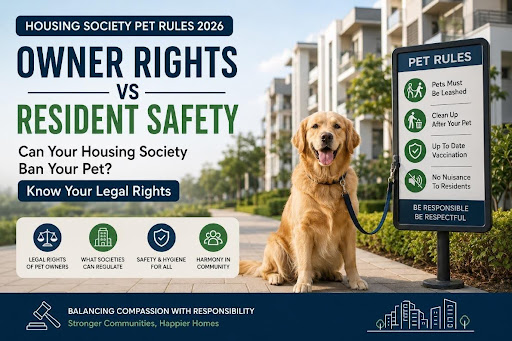
Housing Society Pet Rules 2026: Owner Rights vs Resident Safety – Can Your Housing Society Ban Your Pet?
-
By Ayush Oswal
- July 17, 2026
Introduction
Pet ownership in India has grown significantly over the past few years, but so have disputes between pet owners and housing societies. Common issues such as pets using common areas, barking, leash requirements, elevator usage, and complaints from other residents often create unnecessary conflicts. Many residents also wonder whether a housing society can legally ban pets or impose heavy penalties on pet owners.
The answer is straightforward: No housing society has the legal authority to impose a complete ban on keeping pets if the pet is legally owned. However, pet owners also have responsibilities to ensure that their pets do not create genuine nuisance or safety concerns for other residents.
This guide explains the latest Housing Society Pet Rules 2026, the legal rights of pet owners, the responsibilities they must follow, and how societies can maintain a balance between resident safety and animal welfare.
Also Read:- Easy Small Pookalam Designs: Simple &; Beautiful Ideas by Housiey
Quick Answer
A housing society cannot legally prohibit residents from keeping pets simply because other members dislike animals. However, societies can create reasonable rules regarding hygiene, leash usage, waste disposal, and safety, provided those rules do not violate the legal rights of pet owners.
Market Snapshot Table
| Particular | Details |
|---|---|
| Topic | Housing Society Pet Rules |
| Updated For | 2026 |
| Governing Laws | Prevention of Cruelty to Animals Act, 1960 |
| Regulatory Support | Animal Welfare Board of India (AWBI) Guidelines |
| Can Society Ban Pets? | No |
| Can Society Regulate Common Areas? | Yes, with reasonable rules |
| Can Fines Be Arbitrarily Imposed? | Generally No |
| Pet Owner Responsibility | Hygiene, control, vaccination, waste disposal |
| Resident Responsibility | Avoid cruelty or harassment toward pets |
Can a Housing Society Ban Your Pet?
The simple answer is No.
Neither apartment associations nor cooperative housing societies can force a resident to remove their legally owned pet simply because some residents object to animals. The Animal Welfare Board of India has repeatedly clarified that pet ownership is a legal right and cannot be prohibited through society by-laws.
Also Read:- Latest Modern Balcony Grill Design For Your House 2026
What Legal Rights Do Pet Owners Have?
Pet owners enjoy several legal protections.
| Pet Owner Right | Legal Position |
|---|---|
| Keeping pets at home | Permitted |
| Using common areas | Allowed with reasonable restrictions |
| Using elevators | Cannot be prohibited completely |
| Walking pets | Allowed |
| Receiving visitors with pets | Cannot be completely banned |
| Protection from harassment | Available under animal welfare laws |
These rights exist alongside the owner’s responsibility to ensure the pet behaves safely.
What Rules Can a Housing Society Legally Make?
Although societies cannot ban pets, they can frame reasonable rules that apply equally to everyone.
Examples include:
| Permitted Society Rules | Purpose |
|---|---|
| Pets must be leashed | Safety |
| Mandatory waste cleanup | Hygiene |
| Vaccination records | Health protection |
| No aggressive behavior | Resident safety |
| Noise complaints to be investigated | Peaceful living |
Such rules must remain reasonable and should never amount to an indirect ban on pets.
Also Read:- Number 7 House Numerology as per Vastu: Home Decor | Benefits | Pros &; Cons
Responsibilities of Pet Owners
Owning a pet comes with legal and social responsibilities.
Responsible pet owners should ensure regular vaccinations, proper grooming, timely veterinary care, waste disposal, leash control in common areas, and adequate training. Respecting neighbours’ comfort helps create a harmonious residential environment.
Rights of Other Residents
Residents who do not own pets also have valid concerns.
If a pet repeatedly attacks people, creates excessive noise, or its owner neglects hygiene, residents can raise complaints before the society. However, complaints should focus on the owner’s conduct rather than demanding removal of the pet itself.
Can Societies Fine Pet Owners?
Societies cannot impose arbitrary penalties simply for owning a pet.
Any action should be based on genuine violations such as repeated nuisance, damage to property, or failure to comply with reasonable community rules. Blanket fines against all pet owners generally lack legal backing.
Also Read:- Main Entrance Modern Door Design:- 30 Best Home Door Design
Common Pet Disputes and Practical Solutions
| Common Issue | Practical Solution |
|---|---|
| Barking | Behaviour training and supervision |
| Pet waste | Immediate cleanup by owner |
| Fear of dogs | Maintain leash and safe distance |
| Elevator concerns | Wait if necessary and cooperate |
| Children near pets | Responsible supervision by both parties |
Most disputes are resolved through communication rather than legal action.
What Should You Do If Your Society Harasses You?
If your society attempts to illegally ban pets or intimidates pet owners, begin by discussing the matter with the managing committee and requesting the applicable rules in writing. If the issue continues, you may approach the appropriate cooperative authorities or rely on applicable animal welfare guidelines for assistance.
Why Choose Housiey?
Buying a home is about more than location and amenities—it is also about finding a community where every family member, including pets, feels welcome. Housiey helps homebuyers discover verified residential projects, compare communities, and make informed decisions with complete transparency. With expert guidance, RERA-verified options, and zero brokerage for buyers, Housiey simplifies your journey to finding a home that truly suits your lifestyle.
Conclusion
As pet ownership continues to increase across India, housing societies are gradually adopting more balanced and practical policies. The law supports responsible pet ownership while also recognising the importance of maintaining hygiene, safety, and peaceful community living.
The ideal approach is cooperation rather than conflict. When pet owners fulfil their responsibilities and societies frame fair, legally compliant rules, residential communities become safer, friendlier, and more inclusive for everyone.
Key Takeaways
- Housing societies cannot legally impose a complete ban on keeping pets.
- Reasonable rules regarding hygiene, leash usage, vaccinations, and waste disposal are generally permitted.
- Pet owners have legal rights but must ensure responsible ownership.
- Residents can report genuine nuisance but cannot demand removal of pets solely based on personal dislike.
- Communication and compliance with lawful guidelines remain the best solution for avoiding disputes.
Sources
- National Commission for Protection of Animal Rights (guidelines and advisories)
- Animal Welfare Board of India (AWBI)
- Prevention of Cruelty to Animals Act, 1960
- Relevant Cooperative Housing Society Guidelines
- Municipal Corporation Pet Ownership Guidelines
- Indian judicial decisions relating to housing societies and pet ownership
- Legal commentaries on cooperative housing and resident welfare regulations
FAQs
No, a housing society cannot legally impose a blanket ban on keeping pets. Pet ownership is protected under applicable laws and animal welfare guidelines.
Yes, pets can use elevators with their owners. Societies cannot permanently prohibit their use of lifts.
Generally, arbitrary extra maintenance charges only because a resident owns a pet are not legally justified. Charges should relate only to genuine services or damages where applicable.
Keeping dogs on a leash in common areas is considered a responsible and widely accepted practice. It helps protect both residents and pets.
No, neighbours cannot stop you from walking your pet in common areas. Pet owners should, however, follow reasonable society rules.
Yes, societies generally cannot impose a complete prohibition on visitors bringing pets. Reasonable safety rules may still apply.
No, fines simply for owning a pet are generally not valid. Penalties should relate to actual violations of reasonable rules.
Owners should take reasonable steps to manage excessive barking. Persistent nuisance complaints may require corrective action.
Yes, asking for vaccination records is generally considered a reasonable health and safety measure. Responsible owners should keep them updated.
Society rules may regulate how pets use gardens while remaining reasonable. A complete prohibition without justification may lead to disputes.
Yes, pet owners should always clean up after their pets. Proper waste disposal is an important responsibility.
Societies cannot illegally relocate or harm stray animals. Appropriate authorities should be contacted whenever necessary.
A blanket breed ban generally has no legal basis. Behaviour and responsible ownership are more important than breed alone.
The owner may be responsible for compensating genuine damage. Each case should be assessed fairly based on evidence.
Yes, but both children and pets should be properly supervised. Responsible behaviour helps prevent accidents.
No, registration requirements may vary between local authorities. Residents should verify the applicable municipal regulations.
Yes, provided the tenancy agreement permits it. Tenants must also comply with reasonable society rules.
First, seek written clarification from the society regarding the rule being relied upon. If necessary, approach the appropriate authorities for further assistance.
Societies cannot completely prohibit lawful feeding of community animals. Feeding should be carried out responsibly without causing inconvenience.
Clear communication and reasonable rules help prevent most conflicts. Mutual respect between pet owners and other residents creates a better community.

Ayush Oswal is an SEO Executive at Housiey, specializing in optimizing real estate content for better visibility and engagement. With a strong understanding of SEO strategies and the property market, he ensures that every blog helps homebuyers make informed decisions while performing well on search engines.
Related Stories