
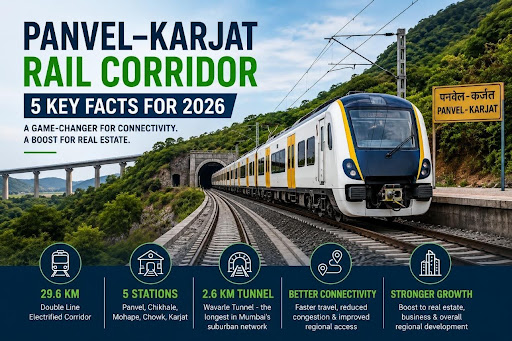
Panvel-Karjat Rail Corridor: 5 Key Facts for 2026
-
By Ayush Oswal
- July 17, 2026
Introduction
Infrastructure has always played a major role in shaping real estate demand, and few projects have generated as much attention in the Mumbai Metropolitan Region as the Panvel-Karjat Rail Corridor. Designed to create a direct suburban railway connection between Navi Mumbai and Karjat, this corridor is expected to improve daily commuting while opening up new opportunities for residential and commercial development.
For homebuyers, investors, and daily commuters alike, understanding the latest status of the project is important. Here are five key facts about the Panvel-Karjat Rail Corridor in 2026.
Also Read: Virar Alibaug Corridor: Road Map | Status | Village List | Latest News
Quick Answer
The Panvel-Karjat Rail Corridor is one of the most significant suburban railway infrastructure projects in the Mumbai Metropolitan Region (MMR). Spanning approximately 29.6 km with five stations, the corridor is expected to improve connectivity between Navi Mumbai and Karjat, reduce travel time, ease congestion on existing rail routes, and support real estate growth across Panvel, Chowk, Mohape, and Karjat. As of 2026, the project has crossed major construction milestones, with final works focusing on track laying, signalling, stations, and safety approvals before operations begin.
Market Snapshot
| Particular | Details |
|---|---|
| Project Name | Panvel-Karjat Rail Corridor |
| Length | Approximately 29.6 km |
| Number of Stations | 5 |
| Executing Agency | Mumbai Rail Vikas Corporation (MRVC) |
| Project Under | Mumbai Urban Transport Project (MUTP Phase III) |
| Track Type | Double Electrified Broad Gauge |
| Expected Benefit | Faster suburban connectivity and improved regional development |
| Current Status (2026) | Final stages of construction and system integration before commissioning |
1. The Corridor Will Strengthen Connectivity Across MMR
The Panvel-Karjat Rail Corridor is being developed to connect Panvel directly with Karjat through a dedicated suburban railway line. Instead of depending solely on the existing route via Kalyan, commuters will have a more efficient suburban connection.
The project forms an important part of the long-term expansion of Mumbai’s suburban railway network and is expected to support the growth of emerging residential locations in Raigad district.
Also Read: Thane Internal Ring Metro Project: Route Map | Station | Status | Tenders
2. It Includes Modern Engineering Features
The corridor is much more than a simple railway line. It includes modern engineering works such as long railway tunnels, multiple bridges, rail flyovers, and advanced signalling infrastructure.
One of its biggest highlights is the 2.6-km Wavarle Tunnel, the longest tunnel built for Mumbai’s suburban railway network. Along the alignment, dozens of bridges and other civil structures have also been completed to improve safety and operational efficiency.
3. Five Stations Will Serve Emerging Growth Corridors
The new suburban corridor will include five stations:
| Station | Importance |
|---|---|
| Panvel | Major transport hub |
| Chikhale | Supports expanding residential areas |
| Mohape | Improves suburban accessibility |
| Chowk | Connects developing growth centres |
| Karjat | Gateway to Raigad and Pune region |
These stations are expected to improve last-mile connectivity while encouraging planned urban development around each location.
4. The Project Is Expected to Boost Real Estate Development
Improved railway infrastructure often leads to increased demand for nearby housing, commercial spaces, and supporting infrastructure.
Areas including Panvel, Chowk, Mohape, and Karjat have already attracted attention due to improving connectivity, upcoming infrastructure projects, and comparatively affordable property prices. Better rail access could further strengthen their appeal for both end-users and long-term investors.
Also Read: Navi Mumbai Metro Line: Route Map | Stations List | Opening Date | Latest News
5. Final Construction Activities Are Underway in 2026
By 2026, most major civil engineering work including tunnels and bridges, has been completed. Current work is focused on track laying, signalling systems, station finishing, electrification, and mandatory safety inspections before passenger operations begin.
Project updates indicate that the corridor will undergo trial runs and final approvals before being opened for suburban services.
Expected Benefits of the Panvel-Karjat Rail Corridor
| Benefit | Expected Impact |
|---|---|
| Faster Commute | Reduced travel time between Panvel and Karjat |
| Better Connectivity | Direct suburban railway access |
| Reduced Congestion | Less pressure on existing railway routes |
| Property Appreciation | Improved demand in nearby locations |
| Economic Growth | Supports residential, commercial, and industrial expansion |
| Future Development | Better integration with regional infrastructure projects |
Why This Project Matters for Homebuyers
The Panvel-Karjat Rail Corridor is not just a transport project, it is expected to influence how people choose homes across the Mumbai Metropolitan Region.
Improved connectivity generally makes emerging suburbs more attractive by reducing commuting time, improving accessibility, and encouraging better civic infrastructure. Buyers looking at long-term investment opportunities often keep a close watch on such infrastructure developments before making purchase decisions.
Why Choose Housiey?
Buying a home involves much more than selecting a property, it requires expert guidance throughout the journey. Housiey helps buyers discover verified residential projects, compare options across locations, and make informed decisions based on their budget and lifestyle needs. With professional assistance and transparent information, the home-buying process becomes simpler and more convenient.
Conclusion
The Panvel-Karjat Rail Corridor is set to become an important addition to the Mumbai Metropolitan Region’s suburban railway network. By creating a direct and faster connection between Panvel and Karjat, the project is expected to reduce travel time, improve daily commuting, and support the development of emerging locations along the route.
For homebuyers and investors, the corridor adds long-term value to areas such as Panvel, Chikhale, Mohape, Chowk, and Karjat. However, property decisions should still be based on factors such as project approvals, location quality, social infrastructure, developer reputation, and actual construction progress. As the corridor moves closer to commissioning, it is likely to play a major role in shaping connectivity and real estate demand across Navi Mumbai and Raigad.
Key Takeaways
- The Panvel-Karjat Rail Corridor is approximately 29.6 km long and forms part of the Mumbai Urban Transport Project Phase III.
- The corridor will feature five suburban railway stations connecting Panvel and Karjat.
- Major construction work, including tunnels and bridges, has largely been completed.
- Final work in 2026 focuses on signalling, track installation, station development, and safety approvals.
- The project is expected to improve commuting while supporting long-term real estate growth across Navi Mumbai and Raigad.
Sources
- Mumbai Rail Vikas Corporation (MRVC)
- Indian Railways
- Central Railway
- Mumbai Urban Transport Project (MUTP)
- Ministry of Railways
- Government infrastructure project updates
- Official project progress reports and public announcements
FAQs

Ayush Oswal is an SEO Executive at Housiey, specializing in optimizing real estate content for better visibility and engagement. With a strong understanding of SEO strategies and the property market, he ensures that every blog helps homebuyers make informed decisions while performing well on search engines.
Related Stories