
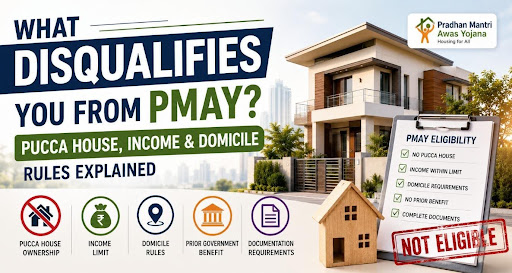
What Disqualifies You From PMAY? Pucca House, Income & Domicile Rules Explained
-
By Ayush Oswal
- July 18, 2026
Introduction
The Pradhan Mantri Awas Yojana (PMAY) has helped millions of Indian families achieve the dream of owning a home. By offering interest subsidies and financial assistance to eligible beneficiaries, the scheme has made affordable housing more accessible across urban and rural India.
However, not everyone qualifies for PMAY benefits. Many homebuyers assume that simply meeting the income criteria guarantees eligibility, but the scheme also considers factors such as property ownership, family status, previous government housing assistance, and documentation. Understanding these rules before applying can save time and prevent application rejection.
This guide explains what disqualifies you from PMAY, the role of pucca house ownership, income limits, domicile-related requirements, and other important eligibility conditions every applicant should know.
Also Read :- Har Ghar Bijli Yojana in Bihar: Login | Registration | Status | Bill
Quick Answer
You may be disqualified from PMAY if you or any member of your family already owns a pucca house anywhere in India, have previously received housing assistance from the Central or State Government, exceed the prescribed income limits for your chosen category, fail documentation requirements, or do not meet other scheme-specific eligibility conditions.
PMAY Eligibility Snapshot
| Criteria | Requirement |
|---|---|
| Existing Pucca House | Applicant or family should not own one |
| Previous Government Housing Benefit | Not allowed |
| Income Category | Must fall within applicable limits |
| Aadhaar | Mandatory for most applications |
| Family Definition | Includes spouse and unmarried children |
| Property Type | Must comply with PMAY guidelines |
| Documentation | Complete and valid documents required |
| Domicile | Must satisfy state or implementing authority requirements where applicable |
Also Read:- PM Surya Ghar Yojana: Login | Registration | Apply | Subsidy
Owning a Pucca House Can Make You Ineligible
The biggest reason for PMAY rejection is ownership of a pucca house.
Under PMAY guidelines, neither the applicant nor any member of the beneficiary family should own a permanent residential house anywhere in India. A beneficiary family generally includes:
- Husband
- Wife
- Unmarried children
If any one of them already owns a pucca house, the family generally becomes ineligible for PMAY benefits.
What is a Pucca House?
A pucca house is a permanent structure built using durable materials such as:
| Pucca House | Kutcha House |
|---|---|
| Brick walls | Mud walls |
| RCC roof | Thatched roof |
| Cement construction | Temporary materials |
| Permanent structure | Temporary structure |
Previous Government Housing Assistance
PMAY is designed for first-time beneficiaries.
You may be disqualified if you or your family has already received financial assistance under any housing scheme offered by:
- Central Government
- State Government
- Local Urban Bodies
- Housing Boards
The objective is to ensure that government housing benefits reach families who have never received housing assistance before.
Also Read:- Jan Sadharan Awaas Yojana in 2026: Login | Apply Online | Registration
Income Limit Violations
Income plays a major role in determining PMAY eligibility.
Different categories have different income ceilings.
| PMAY Category | Annual Household Income |
|---|---|
| EWS | Up to ₹3 lakh |
| LIG | ₹3 lakh–₹6 lakh |
| MIG-I | ₹6 lakh–₹12 lakh |
| MIG-II* | ₹12 lakh–₹18 lakh (subject to applicable scheme provisions) |
If your household income exceeds the applicable limit under the scheme available at the time of application, you may not qualify for benefits.
Incorrect Family Declaration
Many applicants believe they can apply individually despite their spouse already owning a home.
PMAY considers the beneficiary family as one unit. If a spouse owns a qualifying pucca house, the entire family may become ineligible, regardless of whose name appears on the application.
Also read:- How to Apply for Gharkul Yojana in 2026 in Maharashtra
Multiple PMAY Applications
Only one eligible beneficiary family can receive PMAY benefits.
Submitting multiple applications using different family members or attempting to claim benefits more than once can result in rejection during verification.
Incomplete or Incorrect Documentation
Your application may be rejected if documents are missing or contain inconsistencies.
Common issues include:
| Common Mistake | Possible Result |
|---|---|
| Aadhaar mismatch | Verification failure |
| Incorrect income proof | Rejection |
| Invalid property documents | Delay or rejection |
| Wrong bank details | Benefit processing issues |
| Missing declarations | Application may remain incomplete |
Property Not Meeting Scheme Conditions
Not every residential property automatically qualifies under PMAY.
The property should satisfy applicable scheme requirements, local regulations, and technical norms prescribed by the implementing authority. Non-compliant properties may not receive benefits.
Domicile and Local Eligibility Requirements
A common misconception is that PMAY requires a universal domicile certificate.
While PMAY is a Central Government scheme, certain states, Union Territories, or implementing agencies may prescribe residence-related documentation or local eligibility requirements for processing applications. Applicants should always verify the latest rules applicable in their location.
Also Read:- PM Surya Ghar Muft Bijli Yojana Scheme: Apply Online | Registration | Eligibility
False Information During Verification
Authorities verify applicant information through multiple records.
Providing false declarations regarding income, family ownership, property ownership, or previous government benefits can lead to rejection and may invite legal action.
Failure During Physical or Administrative Verification
Many PMAY applications undergo verification before approval.
Officials may verify:
- Family details
- Property ownership
- Income records
- Address
- Identity documents
Any mismatch found during verification may affect eligibility.
Comparison Table: Eligible vs Disqualified Applicant
| Eligible Applicant | Disqualified Applicant |
|---|---|
| Does not own a pucca house | Already owns a pucca house |
| Meets income criteria | Exceeds applicable income limits |
| First-time beneficiary | Previously received housing assistance |
| Correct documentation | Incomplete or incorrect documents |
| Genuine declarations | False information submitted |
| Single valid application | Multiple benefit claims |
Also Read:- Apply for Pradhan Mantri Awas Yojana Online: Eligibility, Process, and Benefits
Tips Before Applying for PMAY
Before submitting your application:
- Confirm that your family does not own a pucca house.
- Check your applicable income category.
- Ensure Aadhaar and other documents match.
- Keep income and property records updated.
- Verify the latest PMAY guidelines applicable to your state and category.
Why Choose Housiey?
Buying a home involves much more than finding the right property, it also means understanding government schemes, financing options, legal documentation, and eligibility criteria. Housiey simplifies this journey by providing well-researched, reader-friendly guides that help buyers make informed decisions with confidence.
Whether you’re exploring affordable housing, comparing locations, or learning about schemes like PMAY, Housiey brings practical insights that make the home-buying process easier, more transparent, and less overwhelming.
Conclusion
PMAY has transformed homeownership opportunities for eligible families, but the scheme follows strict eligibility rules to ensure benefits reach the right beneficiaries. Ownership of a pucca house, exceeding income limits, previous housing assistance, incorrect family declarations, incomplete documentation, and verification failures are among the most common reasons applications are rejected.
Before applying, carefully review the latest PMAY guidelines, organise your documents, and verify that your family meets every eligibility requirement. A little preparation can significantly improve your chances of a successful application.
Key Takeaways
- PMAY is primarily intended for eligible first-time homebuyers who do not own a pucca house anywhere in India.
- Owning a permanent house by the applicant, spouse, or unmarried children can disqualify the family.
- Receiving benefits under another government housing scheme may make an applicant ineligible.
- Household income must fall within the applicable PMAY category.
- Accurate documentation and truthful declarations are essential for successful verification.
- Some states or implementing agencies may require additional residence-related documentation.
- Property eligibility should always be verified before applying.
- Applicants should review the latest PMAY guidelines because scheme provisions can change over time.
Sources
- Ministry of Housing and Urban Affairs (MoHUA)
- PMAY Urban Official Guidelines
- PMAY Gramin Official Guidelines
- National Housing Bank (PMAY-CLSS Guidance)
- Ministry of Rural Development
- PMAY Frequently Asked Questions and Operational Guidelines
- Government of India Affordable Housing Policy Documents
FAQs
The most common reason is that the applicant or their beneficiary family already owns a pucca house. PMAY is primarily meant for eligible families without permanent residential housing.
Generally, no, because PMAY considers the beneficiary family as one unit. Ownership by a spouse may make the family ineligible.
A pucca house is a permanent structure built using durable materials like bricks, cement, and RCC. Temporary structures are generally not classified as pucca houses.
It can, depending on whether it qualifies as ownership of a pucca house under the scheme. The specific facts and applicable guidelines are important.
If your household income exceeds the applicable limit for the available PMAY category, you may not be eligible. Income verification forms part of the application process.
No, the benefit is generally available only once to an eligible beneficiary family. Multiple claims can lead to rejection.
Yes, Aadhaar is generally required for identification and verification. It helps authorities authenticate beneficiary details.
Not in every case at the Central scheme level. However, certain implementing authorities may ask for residence-related documents as per local requirements.
Yes, incorrect or incomplete documents can delay or reject an application. Accurate documentation is essential.
The accepted documents depend on the applicant’s employment and income type. Authorities verify these documents during processing.
Yes, provided they satisfy all applicable eligibility conditions. They must also submit acceptable income documentation.
Eligibility depends on the specific scheme provisions applicable at the time. Applicants should check the latest official guidelines before applying.
Yes, eligible women can apply subject to the scheme conditions. In many cases, female ownership has been encouraged under PMAY.
Not necessarily, because eligibility depends on several factors rather than land ownership alone. Residential house ownership is generally the primary consideration.
The application undergoes document scrutiny and verification. Approval depends on meeting all eligibility requirements.
Yes, mismatched information discovered during verification can lead to rejection. Authorities verify eligibility before granting benefits.
No, the property must comply with the applicable scheme conditions. Local approvals and technical norms may also apply.
Yes, providing false information may result in rejection and other consequences under applicable rules. Applicants should always submit accurate information.
That depends on the reason for rejection. If the issue is correctable and eligibility requirements are satisfied, a fresh application may be possible where permitted.
Applicants should refer to the official PMAY guidelines and the relevant implementing authority. This helps ensure they follow the latest eligibility requirements.

Ayush Oswal is an SEO Executive at Housiey, specializing in optimizing real estate content for better visibility and engagement. With a strong understanding of SEO strategies and the property market, he ensures that every blog helps homebuyers make informed decisions while performing well on search engines.
Related Stories