
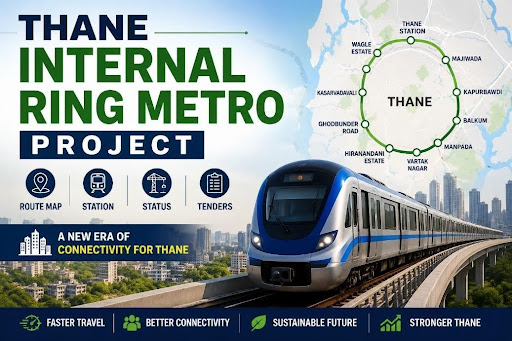
Thane Internal Ring Metro Project: Route Map | Station | Status | Tenders
-
By Ayush Oswal
- July 2, 2026
Introduction
Thane has rapidly transformed into one of the fastest-growing residential and commercial destinations in the Mumbai Metropolitan Region. With increasing population, expanding townships, and rising traffic congestion, the demand for an efficient public transport system has become stronger than ever.
To address these mobility challenges, authorities have proposed the Thane Internal Ring Metro Project, a dedicated metro network aimed at improving intra-city connectivity. The proposed corridor will connect major residential neighbourhoods, business districts, railway stations, and upcoming infrastructure projects, making daily commuting faster and more convenient.
In this blog, let’s understand the Thane Internal Ring Metro Project, including its proposed route map, station details, current status, tender updates, expected benefits, and its impact on the city’s real estate market.
Quick Answer
The Thane Internal Ring Metro Project is a proposed intra-city metro corridor designed to improve east-west and north-south connectivity across Thane. Once completed, the project is expected to connect key residential, commercial, and transport hubs while integrating with existing and upcoming metro corridors in the Mumbai Metropolitan Region (MMR). The project is currently in the planning and approval stages, with detailed reports, alignment studies, and tender-related developments progressing in phases.
Market Snapshot
| Particular | Details |
|---|---|
| Project Name | Thane Internal Ring Metro Project |
| Location | Thane, Maharashtra |
| Project Type | Urban Metro Rail |
| Implementing Authority | Thane Municipal Corporation in coordination with MMRDA |
| Current Stage | Planning and Detailed Project Report (DPR) stage |
| Objective | Improve intra-city connectivity within Thane |
| Integration | Existing railway stations and upcoming metro corridors |
| Beneficiaries | Daily commuters, residents, businesses, and developers |
What is the Thane Internal Ring Metro Project?
The Thane Internal Ring Metro Project is a proposed metro corridor designed to provide seamless connectivity across different parts of Thane city without requiring commuters to depend solely on suburban railway services.
The project aims to:
- Reduce road congestion.
- Improve travel speed.
- Connect residential and commercial zones.
- Strengthen last-mile connectivity.
- Integrate with regional metro networks.
The proposal forms part of the broader transportation vision for the Mumbai Metropolitan Region.
Proposed Route Map
Although the final alignment may undergo revisions before implementation, the proposed metro network is expected to connect several important areas across Thane.
Some of the major locations expected to benefit include:
- Thane Railway Station
- Wagle Estate
- Majiwada
- Kapurbawdi
- Balkum
- Manpada
- Vartak Nagar
- Hiranandani Estate
- Ghodbunder Road
- Kasarvadavali
The objective is to create a circular or ring-like connectivity pattern, allowing commuters to travel efficiently within the city instead of relying on road transport.
Also Read: What Are the New Upcoming New Launch Projects in Mumbai & Thane 2026 List?
Proposed Stations
The final number of stations will be confirmed after project approvals and detailed engineering studies.
Some proposed station locations include:
- Thane Station
- Teen Haath Naka
- Wagle Estate
- Majiwada
- Kapurbawdi
- Balkum
- Manpada
- Vartak Nagar
- Hiranandani Estate
- Ghodbunder Road
- Kasarvadavali
The stations are expected to be strategically located near residential clusters, commercial hubs, hospitals, educational institutions, and major road intersections.
Current Project Status
At present, the Thane Internal Ring Metro Project remains in the planning phase.
Major developments include:
- Preliminary alignment studies have been undertaken.
- Detailed Project Report (DPR) work has been initiated.
- Technical feasibility assessments are under evaluation.
- Government agencies continue to review project viability.
- Funding models and implementation strategies are being examined.
Construction will begin only after all statutory approvals and financial clearances are obtained.
Tender Updates
Many people search for the latest tenders related to the project.
Currently:
- Major civil construction tenders have not yet been awarded.
- Consultancy and DPR-related activities have progressed in phases.
- Additional tenders are expected after project approval.
- Civil works, electrical systems, signalling, and station construction packages are likely to be tendered separately.
Interested contractors should regularly monitor official government procurement portals for future tender notifications.
Also Read: New Launch Projects in Majiwada Thane: Luxury Projects with Carpet Area Details
Expected Benefits
The proposed metro project offers several long-term advantages.
Better Connectivity
Residents will be able to travel across Thane much faster without depending entirely on road traffic.
Reduced Traffic Congestion
A metro network can significantly reduce the number of private vehicles on busy roads.
Faster Daily Commutes
Travel times between residential and commercial areas are expected to reduce considerably.
Improved Public Transport Integration
The project will integrate with suburban rail, existing metro corridors, buses, and future transport infrastructure.
Sustainable Urban Development
Public transport helps reduce pollution, fuel consumption, and overall carbon emissions.
Impact on Real Estate
Infrastructure projects often influence property demand, and the Thane Internal Ring Metro Project is expected to be no exception.
Potential impacts include:
- Increased residential demand near metro stations.
- Better appreciation potential for surrounding properties.
- Improved commercial activity.
- Higher rental demand.
- Enhanced connectivity for upcoming townships.
However, actual price appreciation will depend on project execution and completion timelines
Why the Project Matters
The Internal Ring Metro has the potential to reshape urban mobility within Thane.
Instead of depending solely on suburban trains or congested roads, residents may enjoy:
- Faster city-wide movement.
- Better access to employment hubs.
- Improved connectivity to schools and hospitals.
- Reduced travel stress.
- Better quality of urban life.
As Thane continues to expand, projects like this will play a vital role in supporting sustainable growth.
Conclusion
The Thane Internal Ring Metro Project represents an important step towards strengthening public transportation within one of Maharashtra’s fastest-growing cities. Although the project is still under planning and approval stages, it has the potential to transform daily commuting by connecting major residential, commercial, and transport hubs.
For homebuyers and investors, the project is worth monitoring closely, as future infrastructure developments often influence connectivity, convenience, and long-term property value. Before making investment decisions, always rely on the latest official project updates and approved alignments.
Why Buyers Choose Housiey
Housiey simplifies the home-buying journey by connecting buyers directly with verified builders, ensuring a transparent and hassle-free experience. From project discovery to site visits and expert guidance, Housiey helps buyers make informed real estate decisions with confidence.
Key Takeaways
The Thane Internal Ring Metro Project is proposed to improve intra-city connectivity across Thane. The project is currently in the planning and DPR stage. The proposed alignment is expected to connect major residential and commercial areas. Construction tenders are yet to be issued for the main civil works. The metro is expected to reduce congestion, improve travel time, and positively influence the city’s real estate market over the long term.
Sources
- Mumbai Metropolitan Region Development Authority (MMRDA)
- Thane Municipal Corporation (TMC)
- Maharashtra Government Urban Development Department
- Detailed Project Report (DPR) documents and official planning presentations
- Government tender and procurement portals
- Official transport and infrastructure planning reports
FAQs
- It is a proposed metro corridor designed to improve connectivity within Thane city. The project aims to reduce traffic congestion and provide faster public transport.
- The project is currently undergoing planning, feasibility studies, and approval processes. Final approvals will determine its implementation timeline.
- The project is being planned with the involvement of the Thane Municipal Corporation and MMRDA. Other government agencies may also participate during execution.
- The project is in the planning and DPR stage. Construction has not yet commenced.
- No, large-scale construction work has not started. The project is awaiting necessary approvals and clearances.
- The proposed alignment is expected to cover major parts of Thane city. Final routes will be confirmed after project approval.
- Several important locations such as Thane Station, Wagle Estate, Kapurbawdi, and Ghodbunder Road are expected to be part of the network. The final station list may change before implementation.
- Yes, integration with suburban rail and other metro corridors is part of the project vision. This will improve multimodal connectivity.
- The proposed alignment is intended to provide circular connectivity across the city. This allows easier movement between different localities.
- Major construction tenders are expected after the project receives final approvals. Official notifications will announce the timelines.
- Eligible contractors and infrastructure companies meeting government criteria can participate. Qualification requirements will be specified in each tender document.
- Yes, the metro is expected to shift many commuters from private vehicles to public transport. This can ease congestion on major roads.
- Metro connectivity often improves the attractiveness of nearby locations. Actual appreciation will depend on project completion and market conditions.
- Yes, public transport generally reduces fuel consumption and vehicle emissions. This contributes to more sustainable urban development.
- Current proposals include connectivity towards the Ghodbunder Road corridor. The final alignment will be confirmed after approvals.
- Commuters can expect shorter travel times and better connectivity across the city. The metro may also provide more reliable daily transportation.
- Yes, improved transport infrastructure often encourages residential and commercial growth. It can also attract new investments.
- Yes, proposed routes may change after engineering studies and government approvals. Final plans are released only after project sanction.
- Official announcements are published by the concerned government authorities. Their websites also provide tender and project-related information.
- Improved metro connectivity generally enhances accessibility and convenience. Buyers should, however, evaluate multiple factors before purchasing a property.

Ayush Oswal is an SEO Executive at Housiey, specializing in optimizing real estate content for better visibility and engagement. With a strong understanding of SEO strategies and the property market, he ensures that every blog helps homebuyers make informed decisions while performing well on search engines.
Related Stories