

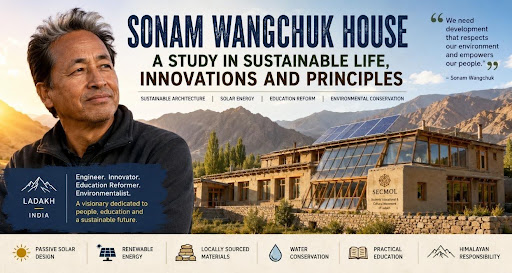
Sonam Wangchuk House: A Study in Sustainable Life, Innovations and Principles
-
By Ayush Oswal
- July 19, 2026
Introduction
Searchers who enter the capacious celebrity house of Sonam Wangchuk, full of luxurious interiors, posh decor and luxurious amenities, should get what they are looking for. But Sonam Wangchuk’s story is quite different.
His life and work in Ladakh are inextricably linked with sustainable architecture, solar energy, education, environmental conservation and the philosophy of living responsibly in a fragile mountain environment.
Sonam Wangchuk is an engineer, innovator, education reformer and environmentalist who has been working together for decades to deliver practical solutions for Ladakh. From starting the Students’ Educational and Cultural Movement of Ladakh (SECMOL) to the Ice Stupa project, his ideas are imbued with a philosophy of finding locally-available solutions to local issues.
While a reliable public record of an individual private residence owned and occupied by Wangchuk is rare, the sustainable campus and buildings associated with his work tell a much more accurate story of his architectural ideals. He believes buildings in the cold of Himalayan regions can harness sunlight, local materials and intelligent design to reduce dependence on conventional heating and energy.
Wangchuk remained on the map in 2026 through his public activism and campaign. But he has left more than these specific developments in terms of education reform, sustainable development and environmental responsibility. It’s his legacy to the people of Ladakh.
Also Read: Thalapathy Vijay’s House in Chennai: Inside Tamil Nadu CM’s Luxurious Home
Short answer
Sonam Wangchuk has been closely associated with Ladakh where he has done a lot of work in the areas of education and environment. He is famous for advocating sustainable structures utilizing passive solar power, local materials, and climate-responsive building methods, not for selling a typical luxury house.
The SECMOL campus just outside Leh is perhaps the most visible physical incarnation of this philosophy. It demonstrates how architecture can respond intelligently to the extreme climate of Ladakh and reduce dependence on fossil fuels.
Sonam Wangchuk: A Short Profile
| Specifics | Details |
| Name | Sonam Wangchuk |
| Profession | Engineer, innovator, education reformer and environmentalist |
| Born | September 1, 1966 |
| Region Associated With | Ladakh |
| Education | Engineering |
| Major Organisation | SECMOL |
| Notable For | Ice Stupa, Education reforms and sustainable innovations |
| Major Awards | Ramon Magsaysay Award |
| Architectural Philosophy | Sustainable, climate responsive and locally appropriate architecture |
| Core Ideals | Education, conservation of the environment, innovation and responsible development |
Where is Sonam Wangchuk’s house?
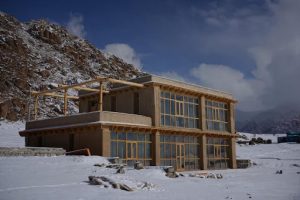
There is very little checked public information available on the exact address, the size, the valuation or the interior details of Sonam Wangchuk’s personal residence. So it would not be correct to make some property his private house without establishing that there was a real one.
What is certain is his strong connection to Ladakh and the sustainability institutions he has nurtured there. When Wangchuk talks about architecture and lifestyle, the SECMOL campus in the Phey area near Leh is one of the most important places.
The story of Sonam Wangchuk’s house, therefore, unlike the usual celebrity-house plots, is best read in the buildings and campuses and other sustainable spaces that dot his work.
Also Read: Rocking Star Yash House: Address, Price, Interior & Trending News
SECMOL Campus and Sustainable Architecture
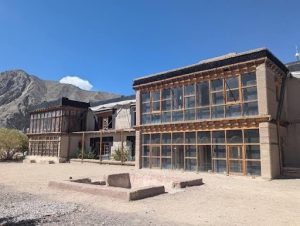
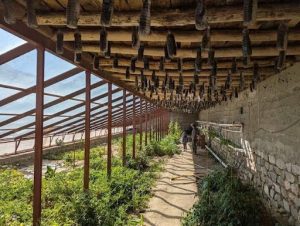
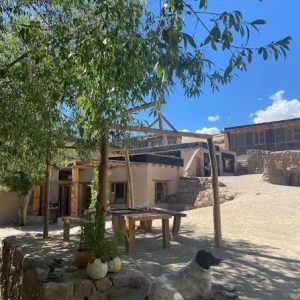
Its founder, the Students’ Educational and Cultural Movement of Ladakh or SECMOL, was started in 1988. The initiative was born out of Wangchuk’s belief that education must be real, meaningful and based on the realities that students face.
The campus has since become famous for its environmentally responsive building system, which is designed to respond to the cold desert climate of Ladakh.
Passive solar architecture forms an important aspect of this strategy. Buildings can be built to be able to absorb sunlight during the day making them heat-retaining during the day and in extreme cold during the winter.
The basic idea is simple. Instead of imposing a common building design on a difficult climate, architecture should adapt itself to its environment.
Also Read: Mukesh Ambani House: Address | Price | Interior | Trending news
What is different about Sonam Wangchuk’s methods of construction?
| Traditional Approach | Wangchuk’s Sustainable Philosophy |
| Heavy reliance on external energy | Greater use of renewable energy |
| Standardised construction | Climate-responsive architecture |
| Imported construction solutions | Preference for locally suitable solutions |
| Mechanical heating | Passive solar heating wherever possible |
| High environmental footprint | Focus on reducing environmental impact |
| Buildings separated from learning | Buildings used as practical learning environments |
The concept is particularly applicable to the Himalayan region, where fuel and construction materials can be costly and pose challenges to the environment.
For Wangchuk, sustainability does not involve just putting solar panels in. It includes knowledge of climate, the orientation of buildings, the thermal characteristics of materials, water resources and the environmental effects from construction over the long term.
Is Sonam Wangchuk’s House constructed of mud?
The internet makes casual statements here and there that Sonam Wangchuk just “lives in a mud house.” Such descriptions can be misleading because it doesn’t have verified information on his private residence.
In any case Wangchuk’s architectural work has been strongly favouring earth-based and locally appropriate construction techniques. But in regions with extreme temperature differences, sustainable earthen architecture — when designed correctly — brings remarkable thermal advantages.
His is the kind of work whose success suggests that traditional materials and contemporary engineering need not compete. When fused judiciously, they make designs that feel good, are efficient and environmentally friendly.
What is Solar Energy and Passive Heating
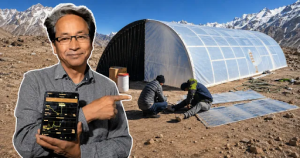
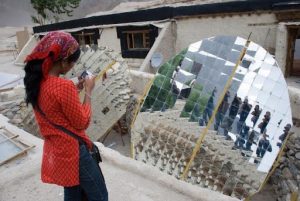
Wangchuk’s sustainable architecture is mainly based on solar energy, one of the most fascinating aspects of this project.
Ladakh has extremely cold winters but a lot of sunshine. Passive solar buildings attempt to take advantage of this natural advantage by positioning and constructing structures such that the sun reflects on them, and the solar helps to keep this warmth.
Insulation and thermal mass can serve to hold this heat for extended amounts of time.
This concept is an important lesson, particularly for modern real estate. A home that is sustainable does not always need sophisticated technology to operate; in some situations careful orientation, building insulation, ventilation and choice of materials can greatly improve the efficiency of energy use.
What Sonam Wangchuk Did Greatly
And the power of Sonam Wangchuk goes far beyond architecture.
SECMOL is one of the foundations of his first major initiatives. He wanted a classroom environment without the pressure of a classroom where students could learn best through experiential learning.
He was also included in Operation New Hope, a program to improve the government school education system in Ladakh through cooperation between communities, civil society and the administration.
He is best known internationally for the Ice Stupa. The idea is for a company to build artificial cone-shaped ice boxes to store water during the wintertime. This ice will melt slowly during the increasing heat; and if it provides water when farmers need it, for that matter.
In 2016, he received the Rolex Award for Enterprise while in 2018, Ramon Magsaysay Award. Along with its environmental design and research work, which he has been given special marks of recognition for new urban planning, he also won awards for sustainable architecture and environmental preservation.
Also Read: Allu Arjun House: Address | Price | Interior | Trending news
The Ice Stupa: The Innovation of Innovation from Small-Community Problems
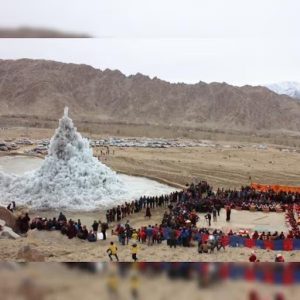
And it’s the Ice Stupa, probably the innovation most frequently linked to Sonam Wangchuk.
Ladakh is a frozen desert characterized by high dry altitudes, making access to water supply difficult, especially during critical agricultural seasons. The Ice Stupa idea suggests to put water in ice in winter and release it slowly as temperature rises.
This vertical aspect aids in holding large amounts of frozen water while reducing the area of the surface to receive direct sun exposure when compared to flatter formations.
The project exemplifies a larger principle that permeates Wangchuk’s work: identify a local problem, understand the surrounding nature and create a practical solution based on available resources.
What are Sonam Wangchuk’s Ideals and Philosophy
Sonam Wangchuk’s work embodies a number of intertwined ideas.
A good education should develop young people to address the issues of the world. Local community and ecosystem appreciation must be developed. Technology should simplify life instead of complicating it unnecessarily.
One of his other philosophies is environmental stewardship.
In places like Ladakh this is particularly crucial, since rapid construction in these parts is accompanied by tourism and infrastructure development needing to be undertaken amidst limited natural resources and a fragile Himalayan ecosystem.
The sustainable buildings of his work, then, represent physical iterations of this ideology.
Why Sonam Wangchuk is in the News
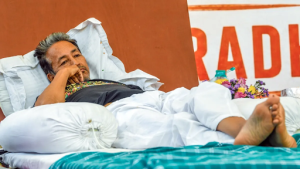
For years now, Sonam Wangchuk had emerged as the centrepiece of state discussions on Ladakh, the environment and development.
He’s back in national headlines in July 2026, as a hunger strike and broader public campaigns swept the country, and with it, his life and career.
The renewed attention, without getting too muddied by the politics of these developments, has emboldened many to return to what he’s done for decades with his school and innovation work, as well as his environmental work.
His core message has been emphasizing the need to conserve vulnerable areas and that development should take into account the long-term environmental implications.
Sonam Wangchuk’s Sustainable Architecture: What Should Modern Homebuyers Learn?
Projects linked to Wangchuk are living proof of the ideas that have relevance well beyond Ladakh.
Homebuyers pay more attention to natural lighting, ventilation, insulation, renewable energy and energy-efficient construction when evaluating properties than ever.
A climate-adapted building may have lower energy needs long-term while also enhancing indoor comfort.
The broader lesson is that sustainability starts in design. Developers and homeowners that anticipate building orientation, materials, water regulation and energy efficiency early can build homes better prepared for the future.
Why Choose Housiey?
Homebuyers can explore residential properties and get help and assistance at Homebuying Housiey.
At Housiey, buyers can explore residential developments and have assistance on every step of the journey to buy a home. With no brokerage, RERA certified, builder-direct projects with no broker for purchase, architect-direct pricing & easy visits from site visitors, and Housiey’s sole focus is to simplify the property search process through the customer experience with ease.
All from the beginning, knowing the project and location, developer, and long-term potential of the property are still important for you to identify before putting the option, whether you are interested in a modern apartment, an investment property, or homes that incorporate sustainable features.
Conclusion
The Sonam Wangchuk house story is less about getting a hold of the price tag on an expensive mansion or entering a celebrity’s extravagant living corner. It is about redefining the interrelationship between people, spaces and environment.
Details of Wangchuk’s private residence, even verified ones, aren’t widely found, but the sustainable campuses and architectural developments that came with his work say a great deal about his philosophy.
He has championed solar energy, passive heating, local materials and climate-responsive construction, as integral parts of the approach.
He is one of the most recognizable innovators of India today in the areas of education reform, Ice Stupa scheme and sustainable architecture. Even as major events continue to bring him to the news, his larger work is raising vital questions about the future of real estate: Could we ever build homes that are comfortable and consume less resources while respecting the environment around them?
For a world ever more worried about climate change and sustainable development, that could well be the best lesson that Sonam Wangchuk’s perspective on living and building offers us.
Key Takeaways
- Sonam Wangchuk is an engineer, innovator, education reformer and environmentalist closely associated with Ladakh.
- Verified public information about his exact private house, address, interiors and property value is limited.
- The SECMOL campus is one of the strongest examples of the sustainable architecture associated with his philosophy.
- His approach promotes passive solar design, renewable energy, locally appropriate materials and climate-responsive construction.
- Wangchuk founded SECMOL and contributed to education reform initiatives in Ladakh.
- The Ice Stupa is among his most internationally recognised innovations and aims to address seasonal water challenges.
- He received the Rolex Award for Enterprise in 2016 and the Ramon Magsaysay Award in 2018.
- His ideals broadly revolve around practical education, responsible development, environmental conservation and locally relevant innovation.
- His ongoing public advocacy has kept him in the news in 2026, while also renewing interest in his environmental and educational work.
- The architectural ideas associated with Wangchuk demonstrate how sustainable construction can provide valuable lessons for modern housing and real estate development.
Sources
- Ramon Magsaysay Award Foundation – Information on Sonam Wangchuk’s achievements and recognition.
- Rolex Awards for Enterprise – Information regarding the Ice Stupa project and innovation.
- Students’ Educational and Cultural Movement of Ladakh – Information regarding SECMOL and its educational philosophy.
- Himalayan Institute of Alternatives, Ladakh – Information on sustainable education, innovation and development initiatives.
- UNESCO and sustainable architecture resources – Reference material concerning earthen and climate-responsive architecture.
- Indian Express – Recent reporting and background information concerning Sonam Wangchuk and developments in 2026.
- Reuters – Recent news reporting concerning Sonam Wangchuk in July 2026.
FAQs
Sonam Wangchuk is closely associated with Ladakh, but the exact details of his private residence are not widely verified in reliable public sources. Much of the discussion around his lifestyle instead focuses on the sustainable campuses and buildings connected with his work.
Sonam Wangchuk has spent much of his life and career working in Ladakh. His educational, environmental and sustainable development initiatives are strongly connected with the region.
There is insufficient reliable public information to describe his private home definitively as a mud house. However, his sustainable architectural work has promoted earthen and locally appropriate construction techniques.
SECMOL is the Students’ Educational and Cultural Movement of Ladakh, founded in 1988. Its campus is known for practical education and sustainable design principles suited to Ladakh’s climate.
The SECMOL campus should not automatically be described as Sonam Wangchuk’s private house. It is primarily an educational campus associated with the organisation he helped establish.
The architecture associated with his work focuses on climate-responsive and environmentally responsible design. Passive solar heating, renewable energy and locally appropriate materials are important elements of this philosophy.
Solar energy is an important component of the sustainable buildings and campuses associated with Wangchuk’s work. This approach takes advantage of Ladakh’s sunlight to reduce dependence on conventional energy sources.
Sonam Wangchuk is an Indian engineer, innovator, education reformer and environmentalist from Ladakh. He is widely known for SECMOL, education reforms, sustainable architecture and the Ice Stupa concept.
Sonam Wangchuk is best known internationally for developing the Ice Stupa concept. These artificial cone-shaped ice structures are designed to store winter water for gradual use during warmer months.
An Ice Stupa is an artificial ice reservoir created by freezing water into a vertical cone-like structure during winter. The stored ice gradually melts as temperatures rise and can provide water when required.
He is famous for his contributions to education reform, environmental innovation and sustainable development in Ladakh. His practical approach to solving regional challenges has earned national and international recognition.
Sonam Wangchuk received the Ramon Magsaysay Award in 2018. He was recognised for his community-driven educational and social initiatives.
Yes, Sonam Wangchuk received a Rolex Award for Enterprise in 2016. The recognition was associated with his innovative Ice Stupa project.
His work broadly promotes practical education, environmental responsibility and sustainable development. He also emphasises creating locally appropriate solutions rather than depending entirely on imported approaches.
Ladakh has an extreme climate and a sensitive mountain ecosystem, making efficient resource use particularly important. Sustainable buildings can help reduce energy consumption while adapting more effectively to local climatic conditions.
Homeowners can learn the importance of designing buildings according to local climate conditions. Natural sunlight, insulation, ventilation and renewable energy can contribute to more efficient homes.
He has remained in national attention due to ongoing public advocacy and campaigns, including developments in July 2026. These events have also renewed public interest in his environmental, educational and social contributions.
Yes, education reform has been one of the central areas of his work for decades. He co-founded SECMOL to promote a more practical and locally relevant approach to learning.
Passive solar architecture uses building orientation, sunlight, insulation and thermal design to naturally improve indoor temperatures. It can reduce dependence on mechanical heating and cooling systems.
His work demonstrates that buildings can be designed around climate, available resources and long-term environmental considerations. These principles are increasingly relevant as homebuyers and developers focus more on energy efficiency and sustainable construction.

Ayush Oswal is an SEO Executive at Housiey, specializing in optimizing real estate content for better visibility and engagement. With a strong understanding of SEO strategies and the property market, he ensures that every blog helps homebuyers make informed decisions while performing well on search engines.
Related Stories