
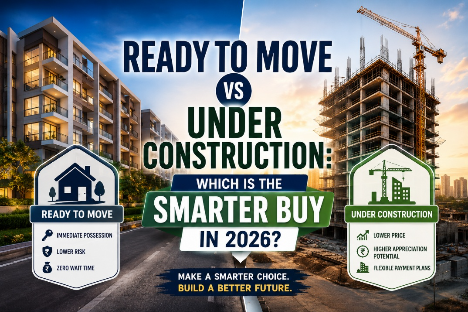
Ready to Move vs Under Construction: Which is the Smarter Buy in 2026?
-
 By L. Sadriwala
- June 17, 2026
Introduction
Buying a home is one of the biggest financial decisions most people will make in their lifetime. Yet one question continues to confuse homebuyers across India:
Should you buy a ready-to-move home or invest in an under-construction property?
The real estate market in 2026 presents a unique scenario. Property prices have risen significantly across major cities such as Mumbai, Pune, Bengaluru, Hyderabad, Chennai, and NCR. Infrastructure projects are expanding rapidly, interest rates remain an important consideration, and buyers have become more cautious after witnessing delays in previous real estate cycles.
As a result, homebuyers are carefully evaluating every aspect of their purchase before making a decision.
While ready-to-move homes provide certainty and immediate usability, under-construction projects often attract buyers through lower prices and future growth potential.
The challenge is that both options have advantages and disadvantages.
A ready property may cost more today but save you from future uncertainty. An under-construction project may seem affordable now but could involve waiting periods and project-related risks.
In this detailed guide, we will compare both options across multiple factors including cost, returns, taxation, risk, appreciation potential, financing, lifestyle convenience, and future market trends to help you determine which is the smarter buy in 2026.
Mumbai UC Projects Selling Fast – Book Before Price Hike!
Limited Units Left! Top RERA Verified UC Projects in Mumbai. Zero Brokerage – Direct from Builder!!
Book Before Price Hike →Quick Answer
The choice between a ready-to-move property and an under-construction property in 2026 depends on your financial goals, risk appetite, and timeline. If you want immediate possession, zero construction risk, and complete clarity on what you’re buying, a ready-to-move property is the smarter option. However, if you’re looking for potentially higher appreciation, flexible payment plans, and lower entry prices, an under-construction property may offer better long-term returns.
The smartest decision is not about which option is universally better—it is about which option aligns best with your current needs and future objectives.
Also Check Latest Blog: Which Property Investment is Best, Under-Construction or Ready Possession
Market Snapshot Table
|
Factor | Ready-to-Move Property |
Under-Construction Property |
|
Possession | Immediate | Future Date |
|
Construction Risk | None |
Present |
|
Price | Usually Higher | Usually Lower |
|
GST Impact | No GST |
GST Applicable |
| Rental Income | Immediate |
Delayed |
|
Appreciation Potential | Moderate | Higher Potential |
| Home Loan Burden | Immediate EMI |
Stage-wise Payments |
|
Property Inspection | Fully Possible | Limited |
| Customization | Minimal |
Higher |
| Investment Risk | Low |
Medium to High |
Understanding Ready-to-Move Properties
A ready-to-move property is a completed residential unit that has received occupancy-related approvals and is available for immediate possession.
The buyer can inspect the actual apartment, evaluate the amenities, and move in almost immediately after completing documentation and payment formalities.
These properties are popular among end-users who want certainty and immediate housing.
Bangalore UC Projects = Best Investment Decision of 2026!
High ROI RERA Approved UC Projects in Bangalore. No Brokerage – Direct from Builder!!
Invest in UC Now →Understanding Under-Construction Properties
An under-construction property is a project that is still being developed by the builder.
The buyer books the unit before completion and pays according to a construction-linked or milestone-based payment schedule.
These properties are often preferred by investors and buyers willing to wait several years for possession in exchange for potentially lower prices.
Why Are Ready-to-Move Properties Popular in 2026?
Immediate Possession Eliminates Waiting Time
One of the biggest advantages is instant usability.
There is no waiting period of two to five years for construction completion. Families can move in immediately without paying rent elsewhere.
This becomes particularly beneficial for homebuyers who are currently living in rented accommodation.
What You See Is What You Get
In a ready property, there are no assumptions.
You can physically inspect:
- Apartment layout
- Carpet area
- Construction quality
- Ventilation
- Natural lighting
- Amenities
- Common areas
This significantly reduces uncertainty.
No Construction Delay Risk
Project delays have historically been one of the biggest concerns in Indian real estate.
With a ready property, this risk disappears entirely because construction is already complete.
Immediate Rental Income Potential
Investors can start earning rental income immediately after purchase.
There is no waiting period before generating cash flow.
Easier Lifestyle Planning
Buyers can immediately plan:
- School admissions
- Daily commute
- Family relocation
- Interior design work
There are no unpredictable possession timelines.
Pune Smart Buyers Choose UC Over RTM – Here’s Why!
Top High ROI RERA Verified UC Projects in Pune. Zero Brokerage – Direct from Builder!!
See Why UC Wins →Why Are Under-Construction Properties Attractive in 2026?
Lower Entry Price
Developers typically offer attractive launch prices during early project stages.
The difference between an under-construction property and a ready property in the same micro-market can often be substantial.
This lower acquisition cost remains one of the biggest reasons buyers choose under-construction projects.
Higher Appreciation Potential
When infrastructure developments occur around a project during construction, property values may rise considerably by the time possession is delivered.
This creates wealth-generation opportunities for investors.
Flexible Payment Structures
Many developers offer:
- Construction-linked plans
- Down-payment schemes
- Subvention plans
- Staggered payment options
These structures can reduce the immediate financial burden on buyers.
Better Unit Selection
Early buyers generally have access to:
- Premium floors
- Better views
- Preferred layouts
- Corner units
- Garden-facing apartments
This advantage reduces as inventory gets sold.
Modern Amenities and Design
New launches in 2026 are increasingly incorporating:
- Smart home features
- EV charging stations
- Energy-efficient systems
- Larger recreational zones
- Wellness amenities
This can make newer projects more attractive than older ready properties.
Cost Comparison: Which Option Is More Affordable?
Initial Purchase Price
- Under-construction properties generally offer lower launch prices.
- Developers use attractive pricing to generate early sales and project funding.
- Ready properties usually command a premium because buyers gain immediate possession.
Winner: Under-Construction
Overall Cost of Ownership
The picture changes when considering:
- Rent paid during construction
- EMI payments
- Inflation
- Delayed possession costs
In some cases, buyers may end up spending more than anticipated due to extended waiting periods.
Winner: Depends on Possession Timeline
Tax Implications in 2026
Ready-to-Move Properties
- Ready homes generally do not attract GST.
- This can create significant savings for buyers.
Under-Construction Properties
- GST may apply to eligible under-construction purchases depending on project classification and prevailing regulations.
- This increases acquisition costs.
Winner: Ready-to-Move
First Home in Hyderabad? RTM vs UC – We Help You Decide!
Top RERA Verified RTM & UC Projects in Hyderabad. Zero Brokerage – Direct from Builder!!
Help Me Decide →Which Option Offers Better Appreciation?
Ready-to-Move Appreciation
Ready properties appreciate based on:
- Existing demand
- Established infrastructure
- Occupancy levels
- Rental demand
Growth tends to be stable and predictable.
Under-Construction Appreciation
Under-construction projects can benefit from:
- Infrastructure announcements
- Metro connectivity
- Commercial development
- Neighborhood growth
Returns may be significantly higher if the project is located in an emerging corridor.
Winner: Under-Construction
Risk Comparison
Risks in Ready-to-Move Properties
Potential concerns include:
- Higher acquisition cost
- Older design specifications
- Limited customization opportunities
However, overall risk remains relatively low.
Risks in Under-Construction Properties
Potential concerns include:
- Project delays
- Regulatory issues
- Market fluctuations
- Builder-related challenges
- Cost escalation
Although regulations have improved transparency, certain risks still exist.
Winner: Ready-to-Move
Financing Considerations
Ready Property Financing
- Loan disbursement happens quickly.
- EMI payments begin immediately.
- However, the buyer gains possession right away.
Under-Construction Financing
- Loan disbursement occurs in phases.
- EMI obligations may initially remain lower depending on the payment structure.
- However, buyers often continue paying rent simultaneously.
Winner: Depends on Financial Situation
Which Option Is Better for End-Users?
For families planning immediate occupancy, ready-to-move properties generally make more sense.
They offer:
- Certainty
- Immediate possession
- Existing community
- Operational amenities
- Lower risk
Winner: Ready-to-Move
Which Option Is Better for Investors?
Investors focused on capital appreciation may find under-construction projects more rewarding.
Particularly in rapidly developing growth corridors, under-construction investments can deliver stronger returns.
Winner: Under-Construction
Buyer Insights
First-Time Homebuyers
- Ready-to-move properties often provide peace of mind and eliminate uncertainty.
Families with Immediate Housing Needs
- Ready homes remain the preferred option due to instant possession.
Long-Term Investors
- Under-construction projects can generate substantial appreciation if selected carefully.
Buyers Seeking Lower Initial Investment
- Under-construction projects generally offer more affordable entry points.
Risk-Averse Buyers
- Ready-to-move homes provide greater certainty and lower execution risk.
What Is the Smartest Choice in 2026?
The answer depends entirely on your objective.
Choose a ready-to-move property if:
- You need immediate possession.
- You want zero construction risk.
- You wish to earn rental income immediately.
- You value certainty over potential gains.
Choose an under-construction property if:
- You can wait for possession.
- You seek long-term appreciation.
- You want a lower entry price.
- You are investing in a high-growth location.
For most end-users purchasing their primary residence in 2026, ready-to-move properties offer greater peace of mind and financial predictability.
For investors with patience and a long-term horizon, carefully selected under-construction projects may provide superior wealth creation opportunities.
Why Buyers Choose Housiey
Homebuyers today need more than just property listings—they need accurate guidance and direct access to verified projects.
Housiey simplifies the home-buying journey by connecting buyers directly with developers, helping them explore suitable projects, compare options, understand market trends, and make informed decisions without the hassle of dealing with multiple intermediaries.
Whether you are evaluating a ready-to-move property or an under-construction project, expert assistance can significantly improve your decision-making process.
Conclusion
The debate between ready-to-move and under-construction properties has existed for decades, and in 2026, both options continue to serve different buyer needs.
A ready-to-move property delivers certainty, immediate usability, and lower risk. An under-construction property offers affordability, future appreciation potential, and flexibility.
Rather than asking which option is universally better, buyers should ask which option aligns better with their financial position, investment goals, family requirements, and risk tolerance.
The smartest property purchase is not necessarily the cheapest one or the one promising the highest returns. It is the one that supports your long-term lifestyle and financial objectives while minimizing unnecessary risks.
Careful research, location analysis, project evaluation, and professional guidance can help ensure that your real estate investment becomes a rewarding asset for years to come.
Key Takeaways
- Ready-to-move properties provide immediate possession and minimal risk.
- Under-construction properties generally offer lower purchase prices.
- Ready homes usually do not attract GST, making them financially attractive.
- Under-construction projects often have greater appreciation potential.
- Investors may benefit more from under-construction projects in growth corridors.
- End-users typically prefer ready properties for certainty and convenience.
- Construction delays remain a major consideration for under-construction purchases.
- Ready properties allow immediate rental income generation.
- Under-construction projects provide better unit selection and customization opportunities.
- The best choice depends on your financial goals, timeline, and risk appetite.
Sources
- Ministry of Housing and Urban Affairs (MoHUA)
- Real Estate (Regulation and Development) Act (RERA) Framework and State RERA Portals
- Reserve Bank of India (RBI)
- National Housing Bank (NHB)
- Housing and Urban Development Corporation (HUDCO)
- Ministry of Finance, Government of India
- GST Council Notifications and Guidelines
- Industry reports from leading real estate research and consultancy firms
- Annual reports and investor presentations of major listed real estate developers
- Real estate market studies published by industry associations
- Property registration and housing market trend reports from various state governments
FAQs
- A ready-to-move property is a completed residential unit available for immediate possession. Buyers can inspect the actual apartment before making the purchase.
- An under-construction property is a project that is still being developed by the builder. Possession is offered after construction reaches completion.
- Under-construction properties are usually priced lower than ready homes. This lower pricing helps attract buyers during the development phase.
- Under-construction properties generally have higher appreciation potential. Growth depends on location, infrastructure development, and market demand.
- No, possession is only provided after construction is completed and approvals are received. Buyers must wait until the project is ready.
- Generally, ready-to-move homes do not attract GST if completion requirements are fulfilled. This can reduce the overall purchase cost.
- They can involve risks such as construction delays and project-related uncertainties. Buyers should evaluate the developer’s track record carefully.
- Ready-to-move properties are often preferred by first-time buyers. They provide certainty and immediate usability.
- No, rental income can only begin after possession is received. Ready properties allow immediate rental opportunities.
- Investors often prefer under-construction projects for appreciation potential. However, ready properties can generate immediate rental returns.
- Yes, banks provide home loans for both ready and under-construction properties. Eligibility depends on the lender and project status.
- Ready-to-move properties offer greater transparency because buyers can inspect the finished product. This reduces uncertainty.
- Many developers allow limited customization during construction stages. The extent of customization varies by project.
- Ready-to-move properties generally carry lower risk. Buyers know exactly what they are purchasing.
- In many cases, yes. The premium reflects immediate possession and reduced uncertainty.
- Under-construction projects may benefit more from market appreciation during the construction period. Returns depend on project execution and location growth.
- They should review approvals, project timelines, developer reputation, and legal documentation. Proper due diligence is essential.
- In most completed projects, amenities are already operational or close to becoming operational. Buyers can assess them before purchase.
- Yes, project timelines may change due to various factors. Buyers should account for possible delays while planning finances.
- For immediate occupancy and lower risk, ready-to-move properties are generally smarter. For long-term appreciation and lower entry costs, under-construction projects may be more rewarding.
L. Sadriwala is the Editor-in-Chief at Housiey, with a professional writing career spanning since 2015. Coming from a family of real estate developers, her deep-rooted industry understanding naturally shaped her focus on real estate content, where she combines domain knowledge with clear, reader-first writing.
She specializes in simplifying complex property concepts — from housing policies and market trends to builder reviews and project insights — into accurate, easy-to-understand guidance for homebuyers and investors.
At Housiey, every article by L. Sadriwala is built on thorough research and verified facts. Her goal is straightforward: to empower homebuyers and investors with reliable, trustworthy information that helps them make confident property decisions.
Related Stories