

India Faces LPG Supply Strain Amid Global Tensions: Decoding Narendra Modi’s “COVID-Like Preparedness” Remark
-
 By L. Sadriwala
- March 24, 2026
Introduction
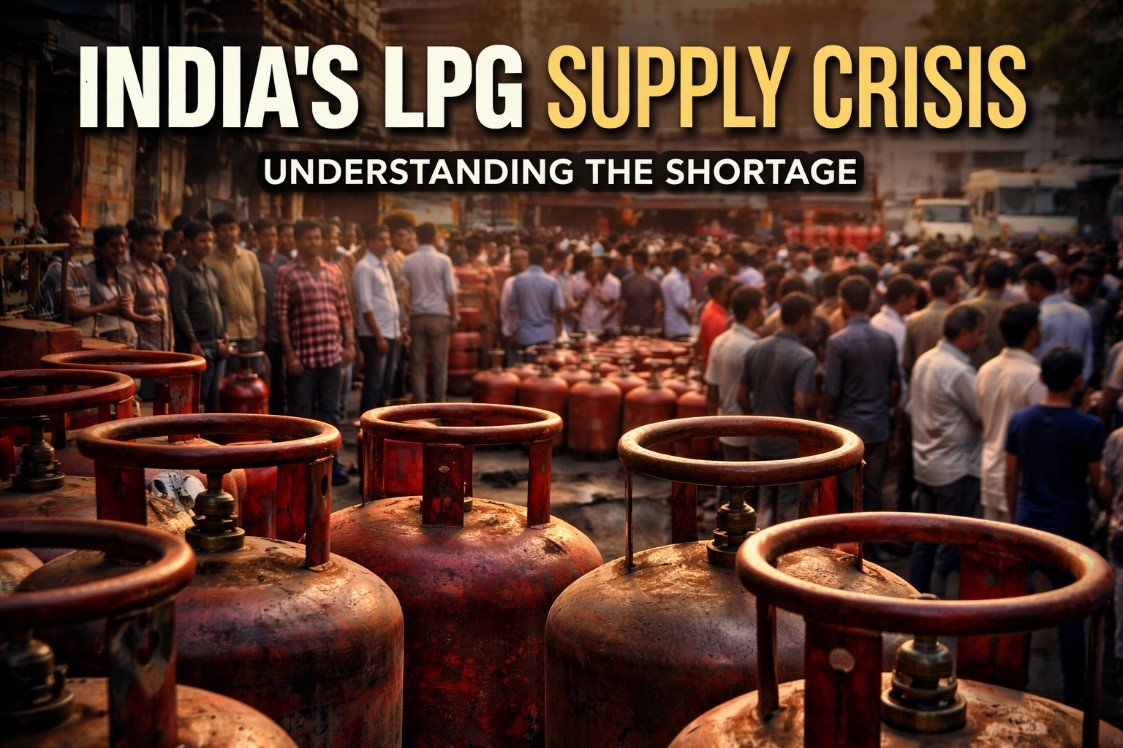
India is currently witnessing a noticeable strain in LPG (cooking gas) availability, a situation that has moved beyond speculation into everyday reality for households and businesses across multiple cities.
Longer delivery timelines, rising prices in certain segments, and increasing pressure on supply chains have created a sense of unease. At the same time, a recent statement by Narendra Modi, urging citizens to remain “prepared like during COVID-19,” has intensified public attention.
Taken together, these developments point toward a larger, interconnected issue, one that is rooted not within India, but in the evolving global energy landscape.
A Global Trigger with Local Impact
The current LPG strain in India is closely linked to escalating geopolitical tensions involving Iran, the United States, and Israel.
This region plays a critical role in global energy supply, particularly through key maritime routes that facilitate the movement of oil and gas. Disruptions in these corridors, whether due to military activity, restricted movement, or heightened security risks, have led to:
- Delays in LPG shipments
- Reduced tanker movement
- Increased uncertainty in delivery schedules
For a country like India, which relies heavily on imports to meet its LPG demand, such disruptions translate quickly into domestic supply pressure.
The Ground Reality: LPG Availability Under Stress
Across urban and semi-urban India, the effects are becoming increasingly visible.
- Delayed cylinder deliveries are being reported in several regions
- Waiting periods have extended, especially in high-demand pockets
- Commercial LPG prices have surged sharply, impacting small businesses
In cities like Mumbai, consumers are beginning to experience longer refill cycles, while restaurants and food vendors are adjusting operations due to inconsistent supply.
This is not a complete breakdown of the system, but it is a clear indication of strain.
Businesses Feel the Pressure
The commercial impact of LPG shortages is particularly significant.
- Restaurants and small eateries are reporting reduced operational capacity
- Rising fuel costs are squeezing already tight margins
- Some businesses are exploring alternative cooking methods to cope with supply gaps
For many small-scale operators, LPG is not just a utility—it is the backbone of daily operations. Any disruption, even temporary, directly affects revenue and sustainability.
Supply vs Demand: A Delicate Balance
An important factor intensifying the situation is behavioral response.
As concerns around shortages grow:
- Households are booking cylinders earlier than required
- In some cases, multiple bookings are being attempted
- This creates artificial demand spikes, putting further pressure on distribution systems
In such scenarios, even a manageable supply disruption can escalate into a perceived shortage, amplifying the problem.
Interpreting “Prepared Like COVID”
The Prime Minister’s comparison to COVID-19 needs to be understood in this context.
It was not a signal of restrictions or lockdowns, but rather a reference to:
- Responsible consumption
- Public cooperation during disruption
- Staying calm under uncertain conditions
During COVID, India demonstrated the ability to adapt collectively to an evolving situation. The same principle is being emphasized now, particularly as the country navigates an external, supply-driven challenge.
The Strategic Concern: Energy Security
At the heart of this issue lies a broader concern, energy security.
India imports a significant portion of its LPG requirements, making it sensitive to:
- Global price fluctuations
- Shipping route stability
- Geopolitical developments
Any prolonged disruption can lead to:
- Increased fuel costs
- Pressure on household budgets
- Wider inflationary effects across sectors
Economic Ripple Effects
While the immediate impact is being felt in kitchens and commercial establishments, the ripple effects extend further.
- Logistics and transportation costs may rise
- Construction and infrastructure expenses could increase
- Consumer sentiment may turn cautious in the short term
However, these effects remain gradual and indirect, rather than abrupt or disruptive to the overall economic structure.
Why Buyers Choose Housiey
In times of uncertainty, clarity and trust become essential.
Housiey enables:
- Direct interaction with builders without intermediary layers
- Access to verified, transparent project information
- A seamless and informed home-buying journey
Allowing buyers to make confident decisions, even when external conditions are evolving.
Conclusion
India is currently navigating a real but manageable LPG supply strain, driven by global geopolitical developments rather than internal systemic failure.
The situation is evolving:
- Supply chains are disrupted, not halted
- Availability is uneven, not absent
- Systems are under pressure, not collapsing
The statement by Narendra Modi reflects a call for awareness and responsible behavior, not alarm.
As with any externally driven challenge, the path forward lies in:
- Measured consumption
- Reliable information
- Collective calm
Preparedness, in this context, is not about fear, it is about stability in the face of uncertainty.
L. Sadriwala is the Editor-in-Chief at Housiey, with a professional writing career spanning since 2015. Coming from a family of real estate developers, her deep-rooted industry understanding naturally shaped her focus on real estate content, where she combines domain knowledge with clear, reader-first writing.
She specializes in simplifying complex property concepts — from housing policies and market trends to builder reviews and project insights — into accurate, easy-to-understand guidance for homebuyers and investors.
At Housiey, every article by L. Sadriwala is built on thorough research and verified facts. Her goal is straightforward: to empower homebuyers and investors with reliable, trustworthy information that helps them make confident property decisions.
Related Stories