
Delhi Metro Pink Line Route: Station List | Opening Date | Route | News
-
By Ayush Oswal
- June 26, 2026
Introduction
The Delhi Metro has transformed the way people travel across the National Capital Region (NCR), making daily commuting faster, safer, and more convenient. Among its many corridors, the Pink Line (Line 7) stands out as one of the most strategically planned routes. Unlike several metro lines that primarily pass through the city’s central areas, the Pink Line acts as a ring corridor, connecting residential neighbourhoods, commercial hubs, educational institutions, and major transport terminals.
Whether you are a daily commuter, tourist, student, or property buyer looking to invest in well-connected locations, understanding the Delhi Metro Pink Line route can help you make informed travel and real estate decisions. With multiple interchange stations connecting almost every major metro corridor, the Pink Line has become an essential part of Delhi’s urban transportation network.
In this blog, we explore the Delhi Metro Pink Line’s opening timeline, complete station list, route map, major interchange stations, latest developments, and why this metro corridor continues to play a vital role in Delhi’s infrastructure growth.
Quick Answer
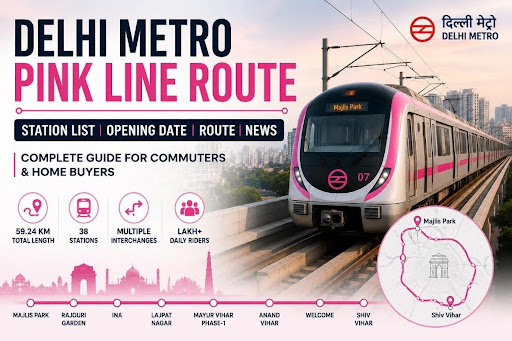
The Delhi Metro Pink Line is one of the longest and most important metro corridors in Delhi. Covering approximately 59.24 km with 38 stations, it connects Majlis Park in North Delhi to Shiv Vihar in North-East Delhi, offering seamless connectivity through multiple interchange stations and significantly reducing travel time across the city.
Also Read: Delhi Metro Blue Line 2026: Station | Route | Maps | Timings
Market Snapshot Table
| Particular | Details |
|---|---|
| Metro Line | Pink Line (Line 7) |
| Route | Majlis Park – Shiv Vihar |
| Total Length | Approximately 59.24 km |
| Total Stations | 38 |
| Operator | Delhi Metro Rail Corporation (DMRC) |
| Type | Mostly Elevated with Underground Sections |
| First Section Opened | March 2018 |
| Fully Operational Since | December 2021 |
Buyer Insights
Metro connectivity has become one of the biggest factors influencing property demand in Delhi. Areas located along the Pink Line enjoy improved accessibility, shorter travel times, better public transport options, and stronger long-term appreciation potential.
Residential localities situated near Pink Line stations have witnessed increased interest from homebuyers due to easier access to employment hubs, shopping centres, educational institutions, hospitals, and railway stations.
Delhi Metro Pink Line Opening Date
Construction of the Pink Line was carried out in multiple phases under the Delhi Metro Phase III expansion project.
The first operational section between Majlis Park and Durgabai Deshmukh South Campus opened to the public in March 2018.
Subsequent sections were gradually inaugurated over the next few years. The final missing stretch between Trilokpuri-Sanjay Lake and Mayur Vihar Pocket-1 became operational in December 2021, making the entire Pink Line fully functional.
Today, it serves lakhs of passengers every day and remains one of the busiest metro corridors in the Delhi Metro network.
Delhi Metro Pink Line Route
The Pink Line begins at Majlis Park in North Delhi and ends at Shiv Vihar in North-East Delhi.
Unlike straight metro corridors, the Pink Line forms a semi-circular route around Delhi, connecting numerous residential and commercial districts while offering convenient interchange options with almost every major metro line.
The route connects important destinations such as Azadpur, Netaji Subhash Place, Rajouri Garden, INA, South Extension, Lajpat Nagar, Sarai Kale Khan, Mayur Vihar, Anand Vihar, Welcome, and Shiv Vihar.
This circular alignment enables commuters to travel between different parts of Delhi without entering the highly congested city centre.
Also Read: Delhi Cantt: Metro Station List | Nearest Metro | Base Hospital
Delhi Metro Pink Line Station List
The Delhi Metro Pink Line consists of the following stations:
- Majlis Park
- Azadpur
- Shalimar Bagh
- Netaji Subhash Place
- Shakurpur
- Punjabi Bagh West
- ESI-Basaidarapur
- Rajouri Garden
- Maya Puri
- Naraina Vihar
- Delhi Cantt
- Durgabai Deshmukh South Campus
- Sir Vishweshwaraiah Moti Bagh
- Bhikaji Cama Place
- Sarojini Nagar
- INA
- South Extension
- Lajpat Nagar
- Vinobapuri
- Ashram
- Sarai Kale Khan–Nizamuddin
- Mayur Vihar Phase-1
- Mayur Vihar Pocket-1
- Trilokpuri-Sanjay Lake
- East Vinod Nagar-Mayur Vihar-II
- Mandawali-West Vinod Nagar
- IP Extension
- Anand Vihar
- Karkarduma
- Karkarduma Court
- Krishna Nagar
- East Azad Nagar
- Welcome
- Jaffrabad
- Maujpur-Babarpur
- Gokulpuri
- Johri Enclave
- Shiv Vihar
Major Interchange Stations
One of the biggest strengths of the Pink Line is its extensive connectivity.
Some important interchange stations include:
- Azadpur (Yellow Line)
- Netaji Subhash Place (Red Line)
- Rajouri Garden (Blue Line)
- INA (Yellow Line)
- Lajpat Nagar (Violet Line)
- Mayur Vihar Phase-1 (Blue Line)
- Anand Vihar (Blue Line and Railway Station)
- Welcome (Red Line)
These interchanges make travelling across Delhi significantly easier without relying heavily on road transport.
Benefits of the Delhi Metro Pink Line
Excellent Connectivity
The Pink Line links several residential, commercial, and institutional areas, reducing dependence on private vehicles.
Reduced Travel Time
Passengers can bypass congested roads and reach destinations much faster using multiple interchange stations.
Better Airport and Railway Access
The corridor provides convenient access to railway stations and offers easy connectivity towards Airport Express through interchange stations.
Boost to Real Estate
Improved metro connectivity has increased the attractiveness of many residential and commercial areas located along the corridor.
Comfortable Daily Commute
Modern trains, air-conditioned coaches, digital information systems, and regular services make commuting more comfortable.
Latest News About Delhi Metro Pink Line
The Delhi Metro Rail Corporation continues to improve passenger facilities on the Pink Line through technology upgrades, enhanced security measures, better station accessibility, and integrated digital ticketing solutions.
The Pink Line also remains one of the most significant corridors supporting Delhi’s growing public transportation network. Authorities continue to focus on improving first-mile and last-mile connectivity through feeder buses, e-rickshaws, pedestrian-friendly infrastructure, and seamless integration with other metro corridors.
Why the Pink Line Matters for Property Buyers
Metro connectivity has become a major factor influencing residential property demand in Delhi.
Localities situated along the Pink Line benefit from easier commuting, better social infrastructure, improved public transport, and greater accessibility to employment centres. These advantages often contribute to stronger buyer interest and long-term appreciation potential.
For homebuyers seeking convenience and connectivity, properties located near Pink Line stations remain attractive options.
Why Buyers Choose Housiey
Buying a home involves much more than choosing a location. Buyers also need expert guidance, verified information, transparent communication, and access to reputed developers.
Housiey simplifies this journey by connecting homebuyers directly with developers, ensuring a smooth and transparent home-buying experience without sharing your contact details with multiple brokers. Whether you’re looking for investment opportunities or your dream home near metro-connected locations, Housiey helps you make informed decisions with confidence.
Conclusion
The Delhi Metro Pink Line has become one of the most important transportation corridors in the capital. Stretching across nearly 60 kilometres and connecting 38 stations, it plays a crucial role in improving mobility for millions of residents every year.
Its extensive interchange network, modern infrastructure, and strategic route make it an indispensable part of Delhi’s public transport system. For commuters, it offers faster and more convenient travel, while for property buyers, it enhances the value and accessibility of neighbourhoods located along its route. As Delhi continues to expand, the Pink Line will remain a key driver of sustainable urban mobility and real estate growth.
Key Takeaways
The Delhi Metro Pink Line connects Majlis Park to Shiv Vihar across approximately 59.24 km.
The corridor consists of 38 metro stations.
The first section opened in March 2018, while the complete line became operational in December 2021.
The Pink Line offers multiple interchanges with major Delhi Metro corridors.
It significantly reduces travel time and improves city-wide connectivity.
Areas near Pink Line stations continue to attract homebuyers due to better accessibility and infrastructure.
Sources
Delhi Metro Rail Corporation (DMRC)
Ministry of Housing and Urban Affairs
Delhi Metro Rail Corporation Annual Reports
Press Information Bureau (PIB)
Government of Delhi Transport Department
Official Delhi Metro route maps and operational updates
FAQs
- The Pink Line is Line 7 of the Delhi Metro network. It connects Majlis Park with Shiv Vihar through 38 stations.
- The Pink Line is approximately 59.24 kilometres long. It is among the longest metro corridors in Delhi.
- There are 38 stations on the Delhi Metro Pink Line. These stations cover major residential and commercial areas.
- The first section opened in March 2018. The entire corridor became operational in December 2021.
- Majlis Park is the starting station. It serves as the northern terminal of the corridor.
- Shiv Vihar is the terminal station. It is located in North-East Delhi.
- Yes, the complete corridor is operational. All stations are open for passenger services.
- It connects with the Yellow, Red, Blue, and Violet Lines among others. This makes city-wide travel easier.
- Yes, it significantly reduces travel time. It also offers multiple interchange options.
- Yes, it connects to important railway stations through interchange points. This improves regional connectivity.
- Yes, all trains are fully air-conditioned. They also feature modern passenger information systems.
- The Delhi Metro Rail Corporation operates the Pink Line. DMRC also manages the rest of the Delhi Metro network.
- Metro connectivity often improves an area’s attractiveness. This may positively influence long-term property demand.
- INA, Rajouri Garden, and Lajpat Nagar are among the busiest interchange stations. They connect important metro corridors.
- Yes, it provides access to several popular destinations. Tourists can easily switch to other metro lines.
- Yes, the corridor includes both elevated and underground sections. This helped accommodate varying urban landscapes.
- Yes, regular Delhi Metro smart cards are accepted. Digital ticketing options are also available.
- Parking is available at several stations. Availability varies depending on the station.
- It improves connectivity across multiple parts of Delhi. It also reduces dependence on road transport.
- Yes, it is a major component of Delhi’s transport infrastructure. It will continue supporting urban mobility and development.

Ayush Oswal is an SEO Executive at Housiey, specializing in optimizing real estate content for better visibility and engagement. With a strong understanding of SEO strategies and the property market, he ensures that every blog helps homebuyers make informed decisions while performing well on search engines.
Related Stories