
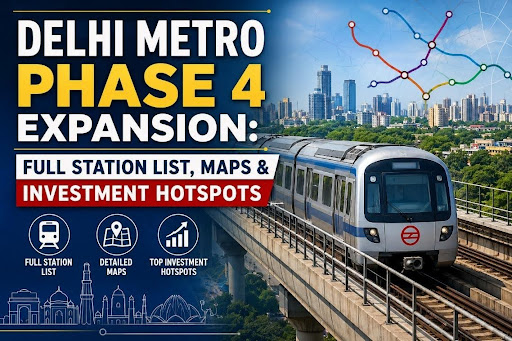
Delhi Metro Phase 4 Expansion: Full Station List, Maps & Investment Hotspots
-
By Ayush Oswal
- July 7, 2026
Introduction
Delhi has one of the most advanced metro systems in India, serving millions of commuters every day. As the city continues to grow, improving public transportation has become essential for reducing congestion, supporting economic development, and connecting newly developed residential and commercial zones.
Delhi Metro Phase 4 is designed to address these growing transportation needs. It introduces new metro corridors, additional stations, better interchange facilities, and improved connectivity between outer Delhi, central business districts, and neighbouring regions.
Beyond transportation, the expansion is expected to significantly influence the real estate market. Areas that previously had limited connectivity are witnessing increasing interest from developers, investors, and homebuyers due to upcoming metro access.
In this guide, we will explore Delhi Metro Phase 4 in detail, including its routes, station list, proposed maps, project status, and the investment opportunities emerging around the new metro corridors.
Quick Answer
Delhi Metro Phase 4 is one of the largest metro expansion projects currently underway in the National Capital Region (NCR). The phase aims to improve connectivity across Delhi by adding new corridors, expanding access to underserved localities, reducing travel time, and boosting real estate demand in emerging residential and commercial micro-markets.
Also Read: Delhi Metro Phase 5 Explained: Routes, Station List & Real Estate Opportunities
Market Snapshot Table
| Particular | Details |
|---|---|
| Project Name | Delhi Metro Phase 4 |
| Implementing Authority | Delhi Metro Rail Corporation (DMRC) |
| Total Planned Length | Approximately 112 km |
| Number of New Stations | More than 80 |
| Number of Corridors | 6 Major Corridors |
| Estimated Cost | Over ₹24,000 Crore |
| Current Status | Under Construction |
| Primary Objective | Improve connectivity across Delhi NCR |
| Expected Benefit | Faster commute and higher real estate growth |
What is Delhi Metro Phase 4?
Delhi Metro Phase 4 is the latest expansion programme undertaken by the Delhi Metro Rail Corporation (DMRC). The project focuses on connecting densely populated residential areas, employment hubs, educational institutions, industrial zones, and rapidly developing suburbs.
The expansion has been planned after analysing passenger demand, future population growth, and urban development patterns across Delhi.
Major objectives include:
- Improving last-mile connectivity
- Reducing traffic congestion
- Connecting outer Delhi with central regions
- Supporting sustainable urban development
- Encouraging transit-oriented development (TOD)
Also Read: Delhi Cantt: Metro Station List | Nearest Metro | Base Hospital
Delhi Metro Phase 4 Corridors
The project consists of six important metro corridors.
- Janakpuri West – RK Ashram Marg
One of the longest corridors in Phase 4, this route significantly improves East-West connectivity while linking multiple residential neighbourhoods with central Delhi.
Major stations include:
- Janakpuri West
- Krishna Park Extension
- Keshopur
- Paschim Vihar
- Peeragarhi
- Mangolpuri
- Rohini East
- Rohini West
- Pitampura
- Netaji Subhash Place
- Ashok Vihar
- Pulbangash
- RK Ashram Marg
- Aerocity – Tughlakabad
This corridor strengthens north-south connectivity and links the airport region with South Delhi.
Important stations include:
- Aerocity
- Mahipalpur
- Vasant Kunj
- Kishangarh
- Chhatarpur
- Saket G Block
- Pushpa Bhawan
- Khanpur
- Ambedkar Nagar
- Tughlakabad
- Majlis Park – Maujpur Extension
This extension enhances connectivity in North-East Delhi while improving interchange opportunities.
Key stations include:
- Majlis Park
- Burari
- Jagatpur Village
- Sonia Vihar
- Khajuri Khas
- Maujpur
- Lajpat Nagar – Saket G Block
Designed primarily for South Delhi commuters, this corridor connects several busy residential and commercial centres.
Major stations include:
- Lajpat Nagar
- Andrews Ganj
- GK-1
- Chirag Delhi
- Pushpa Bhawan
- Saket G Block
- Inderlok – Indraprastha
This corridor improves connectivity between Central and East Delhi.
Major stations include:
- Inderlok
- Dayabasti
- Sarai Rohilla
- Ajmal Khan Park
- Delhi Gate
- Indraprastha
- Rithala – Narela – Nathupur
This corridor extends metro services into rapidly developing northern Delhi.
Major stations include:
- Rithala
- Rohini Sector 25
- Bawana
- Narela
- Nathupur
Delhi Metro Phase 4 Station List
Overall, Phase 4 includes more than 80 new stations spread across all six corridors.
The stations have been planned to provide:
- Easy interchange with existing metro lines
- Bus integration
- Better pedestrian movement
- Parking facilities
- Improved accessibility
Many stations will also support transit-oriented development, encouraging mixed-use residential and commercial projects around metro hubs.
Delhi Metro Phase 4 Route Maps
The official route maps illustrate how the new corridors integrate with the existing Delhi Metro network.
The maps highlight:
- Interchange stations
- Elevated sections
- Underground sections
- Depot locations
- Future expansion possibilities
As construction progresses, DMRC continues updating route maps and station information.
Current Construction Status
Delhi Metro Phase 4 construction is progressing across multiple corridors simultaneously.
Key developments include:
- Tunnel excavation
- Pier construction
- Station foundation work
- Track installation
- Depot development
Different corridors are at different stages of execution, with phased completion expected over the coming years.
Investment Hotspots Along Delhi Metro Phase 4
Metro connectivity has historically increased property demand across Delhi. Phase 4 is expected to continue this trend.
Janakpuri
Already a mature residential market, improved connectivity may further strengthen property appreciation.
Rohini
New metro connectivity is likely to increase demand for both affordable and premium housing.
Ashok Vihar
Its strategic location and improved accessibility make it attractive for residential redevelopment.
Narela
Narela is expected to emerge as one of the biggest beneficiaries due to improved connectivity with central Delhi.
Chhatarpur
The locality offers a mix of plotted developments, apartments, and commercial opportunities, making it attractive for long-term investment.
Saket Region
Enhanced connectivity is expected to increase demand for premium residential and commercial properties.
Aerocity
With business parks, hotels, and commercial developments, Aerocity continues attracting institutional and commercial investments.
Buyer Insights
Homebuyers should evaluate metro projects beyond current property prices. Factors such as station proximity, infrastructure development, social amenities, future commercial growth, and government planning often determine long-term appreciation.
Investors looking at Delhi Metro Phase 4 should focus on locations where construction is progressing steadily, civic infrastructure is improving, and residential demand remains healthy.
Benefits of Delhi Metro Phase 4
Improved Connectivity
The project reduces travel time across several important parts of Delhi.
Reduced Traffic Congestion
More commuters shifting to metro services can help reduce road congestion.
Higher Property Appreciation
Properties near metro stations often witness stronger long-term demand.
Better Commercial Growth
Improved accessibility encourages businesses to establish offices and retail spaces.
Sustainable Urban Development
Metro expansion supports environmentally friendly transportation while reducing pollution.
Challenges
Although the project offers numerous benefits, certain challenges remain.
These include land acquisition, traffic diversions during construction, coordination with existing infrastructure, and maintaining project timelines. However, phased construction is helping minimise disruption while ensuring long-term urban development.
Why Buyers Choose Housiey
Housiey simplifies the home-buying journey by connecting buyers directly with reputed builders, ensuring greater transparency throughout the process. From property discovery to site visits and expert guidance, Housiey helps buyers make informed real estate decisions with confidence.
Conclusion
Delhi Metro Phase 4 represents another milestone in Delhi’s rapidly evolving public transportation network. The expansion is expected to improve connectivity across underserved regions, reduce travel time, support sustainable urban growth, and create fresh opportunities for both homebuyers and investors.
As new stations become operational, surrounding localities are likely to experience increased infrastructure development, improved accessibility, and stronger real estate demand. Buyers planning long-term investments should closely monitor upcoming metro corridors, construction progress, and infrastructure upgrades to identify promising investment destinations.
Key Takeaways
- Delhi Metro Phase 4 adds over 112 km of new metro connectivity.
- More than 80 new stations are planned across six corridors.
- The project aims to reduce congestion and improve city-wide mobility.
- Narela, Rohini, Janakpuri, Chhatarpur, Aerocity, and Ashok Vihar are emerging investment hotspots.
- Metro connectivity generally supports long-term property appreciation.
- Construction is progressing in phases across multiple corridors.
- Better public transport is expected to encourage sustainable urban growth.
Sources
Delhi Metro Rail Corporation (DMRC)
Ministry of Housing and Urban Affairs (Government of India)
Delhi Development Authority (DDA)
Press Information Bureau (PIB)
Government of NCT of Delhi
Delhi Metro official project reports and planning documents
FAQs
Delhi Metro Phase 4 is the latest expansion of the Delhi Metro network aimed at improving connectivity across the city. It introduces new corridors, stations, and interchanges to serve growing residential and commercial areas.
Phase 4 consists of six major metro corridors. These corridors will connect several new and existing parts of Delhi.
More than 80 new stations are proposed under Phase 4. The exact count may change as the project progresses.
The Delhi Metro Rail Corporation (DMRC) is implementing the project. It is responsible for planning, construction, and operations.
The planned network is approximately 112 km long. It is among the largest metro expansion projects in Delhi.
Yes, construction is currently underway across multiple corridors. Different sections are progressing at varying stages.
Metro connectivity often improves property demand over time. However, appreciation depends on several local market factors.
Narela is gaining attention due to improved future connectivity and planned urban development. It also offers relatively affordable investment opportunities.
The expanded metro network is expected to encourage more people to use public transport. This could help reduce congestion on major roads.
Yes, several new interchange stations are planned. These will improve connectivity across existing metro lines.
Yes, metro systems promote sustainable transportation by reducing dependence on private vehicles. This contributes to lower emissions over time.
Commercial areas near metro stations often experience higher footfall. This can improve business activity and leasing demand.
Yes, some corridors include underground stretches where required. Others are being constructed as elevated lines.
Yes, the Aerocity corridor enhances access to the airport region. It also improves connectivity with South Delhi.
Metro connectivity improves accessibility, making locations more attractive to buyers and businesses. This often supports long-term development.
Yes, buyers may find good opportunities in emerging metro-connected localities. Early investment can be advantageous if supported by proper research.
DMRC periodically updates official route maps as construction progresses. These reflect new alignments, stations, and operational timelines.
Upcoming metro corridors can influence long-term property demand. Investors should also evaluate infrastructure, amenities, and legal approvals before purchasing.
Professional guidance helps buyers understand market trends and project quality. Housiey assists buyers by connecting them directly with reputed builders.

Ayush Oswal is an SEO Executive at Housiey, specializing in optimizing real estate content for better visibility and engagement. With a strong understanding of SEO strategies and the property market, he ensures that every blog helps homebuyers make informed decisions while performing well on search engines.
Related Stories