

RERA & Construction Quality: Can Homebuyers Fight Back Against Faulty Homes?
-
 By L. Sadriwala
- April 26, 2026
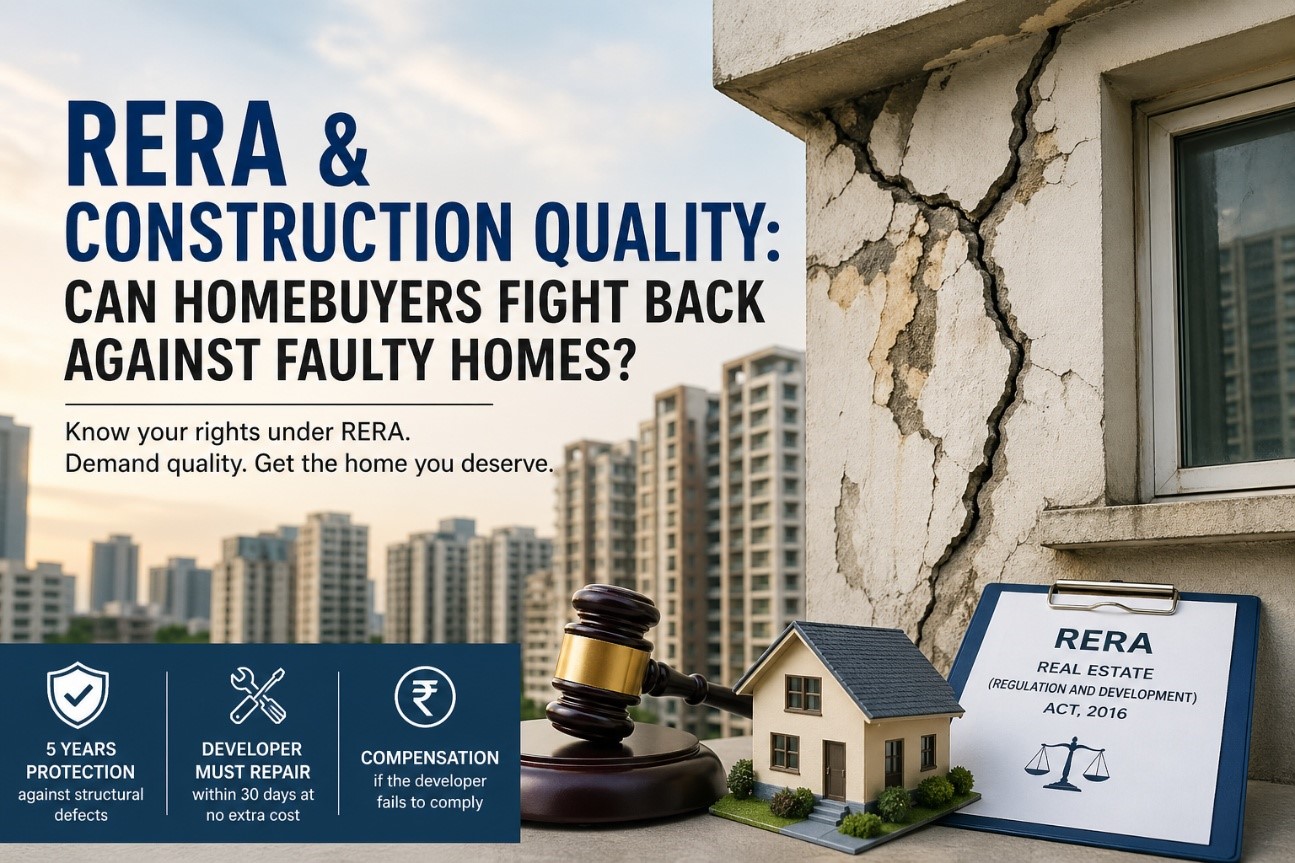
Buying a home is often one of the biggest financial commitments a person makes. But what happens when your dream home begins to show cracks, literally, just weeks after possession? Across India, a growing number of homebuyers are raising serious concerns about poor construction quality, even in high-end residential projects. Thankfully, the law does provide a safety net, and it comes in the form of the Real Estate (Regulation and Development) Act, 2016, commonly known as RERA.
When the Dream Home Turns Problematic
Take the case of a 29-year-old homebuyer in Pune who invested ₹60 lakh in a top-floor apartment in 2023. Within just two months of moving in, she began noticing water seepage in one of the bedrooms. When she reported the issue, the developer assured her that repairs would be carried out after the monsoon season, delaying immediate relief.
In another widely discussed case from Noida, a homeowner who spent nearly ₹1 crore on a high-rise apartment shared a viral video exposing visible construction flaws. The visuals showed peeling plaster, fading exterior walls, and a general lack of finishing quality; far from what one would expect at that price point.
What made matters worse were hygiene concerns. The homeowner pointed out insect infestations allegedly linked to pigeon waste accumulating in a nearby vacant flat. The video quickly gained traction, sparking a larger conversation about the disconnect between soaring property prices and the actual quality delivered.
What Does the Law Say About Structural Defects?
Under Section 14(3) of the Real Estate (Regulation and Development) Act, 2016, homebuyers are protected against structural defects for a period of five years from the date of possession.
Here’s what the law mandates:
- If a structural defect or issue related to workmanship, quality, or services arises within five years, the buyer can notify the developer.
- The developer is legally obligated to fix the issue within 30 days, without charging anything extra.
- If the developer fails to do so, the homebuyer is entitled to compensation under the Act.
This provision is one of the strongest protections available to buyers, especially in a market where post-possession issues are not uncommon.
What Qualifies as a Structural Defect?
According to the Maharashtra Real Estate Regulatory Authority, structural defects go beyond visible cracks. They include:
- Issues in the foundation, beams, columns, or slabs
- Faults in overall workmanship or construction quality
- Deficiencies in essential services promised in the agreement
This broad definition ensures that buyers are not left helpless even in cases where the defects are not immediately obvious but affect long-term durability and safety.
Also Read:- Will RERA 2.0 in 2026 Increase Demand for 1 BHK and 2 BHK Homes in India?
Recent Legal Developments Strengthening Buyer Rights
In a significant ruling on November 29, 2025, the Karnataka Real Estate Regulatory Authority tribunal reinforced accountability among developers. It ruled that builders must either provide mandatory insurance documents under Section 16 or bear the cost of repairs themselves.
This judgment highlights a growing trend, regulatory bodies are becoming stricter and more proactive in protecting buyer interests.
Why This Matters More in Cities Like Mumbai
In a city like Mumbai, where redevelopment and high-rise projects dominate the skyline, structural integrity isn’t just a technical detail; it’s a long-term safety concern.
With increasing vertical expansion, even minor lapses in construction quality can have serious implications over time. This makes awareness of legal rights under RERA even more crucial for buyers.
Checklist Before Taking Possession of Your Home
Experts and the Maharashtra Real Estate Regulatory Authority recommend that buyers follow a strict checklist before accepting possession:
- Ensure all original property documents are handed over
- Verify the Occupancy Certificate (OC), confirming legal completion
- Check if the architect’s Form 4 is uploaded on the RERA portal
- Inspect the property thoroughly for visible defects
Being proactive at this stage can help avoid prolonged disputes later.
The Bigger Picture: Awareness is Power
While RERA has significantly improved transparency and accountability in the real estate sector, its effectiveness depends largely on how aware buyers are of their rights. Many homeowners still hesitate to escalate complaints, often settling for temporary fixes or delayed responses.
But the law is clear; developers are accountable, and buyers are well within their rights to demand quality construction.
Final Thoughts
The gap between premium pricing and actual delivery quality has become a pressing issue in India’s real estate market. However, with strong legal backing from RERA and increasing consumer awareness, homebuyers today are better equipped than ever to challenge poor construction practices.
If your home shows signs of structural issues, don’t ignore them; document, report, and take action. Because when it comes to your home, compromise shouldn’t be an option.
L. Sadriwala is the Editor-in-Chief at Housiey, with a professional writing career spanning since 2015. Coming from a family of real estate developers, her deep-rooted industry understanding naturally shaped her focus on real estate content, where she combines domain knowledge with clear, reader-first writing.
She specializes in simplifying complex property concepts — from housing policies and market trends to builder reviews and project insights — into accurate, easy-to-understand guidance for homebuyers and investors.
At Housiey, every article by L. Sadriwala is built on thorough research and verified facts. Her goal is straightforward: to empower homebuyers and investors with reliable, trustworthy information that helps them make confident property decisions.
Related Stories