
India’s Biggest AI & HPC Hub Planned Near Noida Airport: Yamuna City to Get 1 GW Digital Mega Facility by 2030
-
 By L. Sadriwala
- February 14, 2026
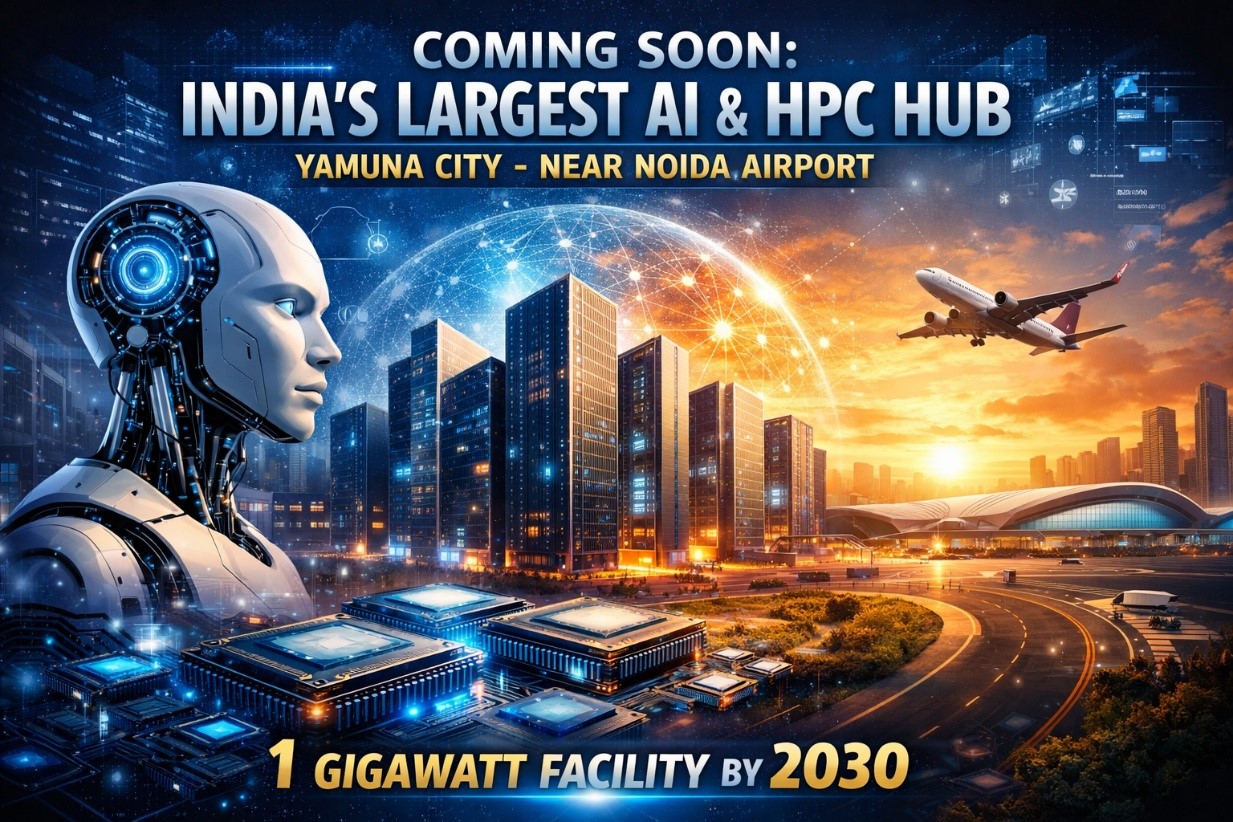
In a major development that could redefine Uttar Pradesh’s position in India’s fast-growing tech and data ecosystem, Yamuna Expressway Industrial Development Authority (Yeida) has announced plans for a massive AI and high-performance computing (HPC) hub in Yamuna City.
The project is being pitched as one of the largest digital infrastructure initiatives in the country, with a target to reach full operational capacity by 2030.
AM Green Group Signs MoU for Mega AI Investment
Hyderabad-based AM Green Group has signed a memorandum of understanding (MoU) with Invest UP to establish a 1 gigawatt AI and HPC hub in the Yamuna City region, located under Yeida’s jurisdiction along the Yamuna Expressway.
Officials revealed that the company is planning an investment of nearly ₹2.2 lakh crore (₹2.2 trillion), making it one of the biggest commitments in India’s AI and data centre space.
289 Acres Allocated Across Two Sectors
According to Yeida authorities, the project will come up on a total land parcel of 289 acres, spread across:
- 114 acres in Sector 28
- 175 acres in Sector 8D
These allocations were formalised through Letters of Intent (LOIs) issued by Yeida.
Operations by 2028, Full Capacity by 2030
Yeida CEO RK Singh stated that the project will be developed in phases, with:
- Initial operations expected by 2028
- Full-scale capacity targeted by 2030
The facility is expected to be powered entirely through round-the-clock carbon-free energy, ensuring it remains aligned with sustainability goals.
500,000 Advanced Chipsets to Power AI Workloads
One of the standout features of the upcoming hub is its planned deployment of approximately 500,000 advanced chipsets, which will significantly boost India’s computing capability.
This level of infrastructure could become a game-changer for AI research, model training, and advanced computing workloads that currently rely heavily on overseas cloud infrastructure.
Strategic Location Near Noida International Airport
The project’s location is being seen as a major advantage due to its proximity to the upcoming Noida International Airport, which is expected to become operational soon.
Officials noted that the Yamuna City region is quickly emerging as a key industrial and logistics hotspot, making it a prime destination for large-scale digital infrastructure development.
Built for Global Hyperscalers and Sovereign AI Needs
Yeida’s additional CEO Shailendra Bhatia explained that the hub is being designed as a scalable and globally competitive compute facility capable of supporting:
- Global hyperscalers
- Research institutions
- Enterprises and startups
- Government-backed sovereign AI programs
With a planned capacity of 1 gigawatt, the data centre ecosystem will be able to handle demanding AI and HPC applications across industries such as healthcare, finance, defence, manufacturing, and smart infrastructure.
Sustainability at the Core: 24×7 Carbon-Free Energy
A major highlight of the project is its sustainability-first design.
Officials confirmed the hub will run entirely on 24×7 carbon-free energy, sourced through a mix of:
- Solar power
- Wind energy
- Pumped storage solutions
This approach aligns with AM Green Group’s broader focus on green infrastructure, energy transition, and decarbonisation initiatives.
Boost for Jobs, FDI, and Tech Ecosystem Growth
The AI hub is expected to create a ripple effect across multiple industries, generating:
- Thousands of high-skilled jobs
- Major inflow of foreign direct investment (FDI)
- Growth opportunities for allied sectors
Authorities also anticipate the development of a strong ecosystem around:
- Hardware and semiconductor support systems
- Software development firms
- Cooling technology innovations
- Cloud and networking infrastructure
- AI model development and deployment services
Big Push for Indian AI Developers and Enterprises
The facility will also enable Indian businesses and developers to gain access to world-class AI infrastructure and next-generation chipsets domestically, potentially reducing dependency on foreign computing resources.
Who is AM Green Group?
AM Green Group is backed by the founders of Greenko Group and is known for its work in:
- Renewable energy projects
- Energy storage solutions
- Decarbonisation platforms
- Green industrial infrastructure
This AI hub marks the group’s major entry into the digital and computing infrastructure space, signalling that India’s clean energy players are now expanding into future tech domains like AI and HPC.
A Landmark Moment for Uttar Pradesh’s Digital Future
With an investment of ₹2.2 lakh crore and an infrastructure scale rarely seen in India’s data centre sector, this proposed AI hub could transform Yamuna City into a key global computing destination.
If executed as planned, Uttar Pradesh may soon emerge as one of India’s leading AI and data infrastructure states, especially with the Noida airport and industrial corridors strengthening the region’s global connectivity.
L. Sadriwala is the Editor-in-Chief at Housiey, with a professional writing career spanning since 2015. Coming from a family of real estate developers, her deep-rooted industry understanding naturally shaped her focus on real estate content, where she combines domain knowledge with clear, reader-first writing.
She specializes in simplifying complex property concepts — from housing policies and market trends to builder reviews and project insights — into accurate, easy-to-understand guidance for homebuyers and investors.
At Housiey, every article by L. Sadriwala is built on thorough research and verified facts. Her goal is straightforward: to empower homebuyers and investors with reliable, trustworthy information that helps them make confident property decisions.
Related Stories