

Hidden Costs of Buying a Home Nobody Tells You
-
 By L. Sadriwala
- January 28, 2026
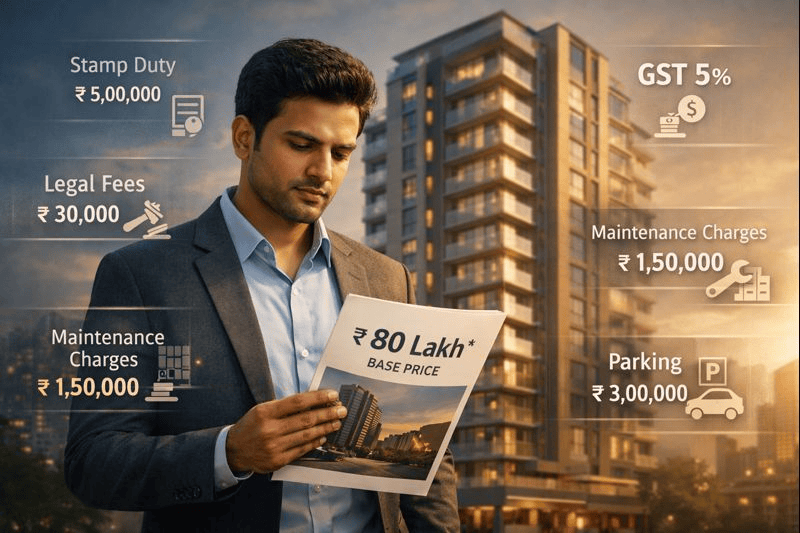
Buying a home is often described as one of the happiest milestones of life, and rightly so. A home represents stability, emotional security, and long-term wealth creation. However, while most homebuyers focus heavily on the property’s price and loan eligibility, very few are truly prepared for the hidden costs that quietly creep in before, during, and even long after the purchase is complete.
These costs are rarely highlighted by advertisements or sales conversations. They don’t show up clearly on brochures, and many first-time buyers only discover them once they are already financially committed. From government levies and legal expenses to maintenance charges and post-possession costs, these “invisible expenses” can collectively add several lakhs to your total outflow.
This is exactly why informed decision-making is crucial. At Housiey, we believe transparency is not optional—it’s essential. By connecting homebuyers directly with verified builders and providing complete cost clarity, Housiey ensures you don’t walk into surprises that strain your finances later.
In this detailed guide, we uncover the hidden costs of buying a home nobody tells you about, explain why they matter, and show how you can plan better and smarter, before signing on the dotted line.
Also Check:- How to Verify Builder Credibility in 10 Minutes
Stamp Duty & Registration Charges – The First Big Shock
Most buyers mentally prepare for the down payment but underestimate how high stamp duty and registration charges can be. These are mandatory government charges and must be paid upfront at the time of property registration.
Stamp duty rates vary from state to state and typically range between 5% to 7% of the property’s agreement value, while registration charges add another 1% approximately. Importantly, banks do not finance these costs under home loans, meaning they come straight out of your pocket.
Many buyers realize too late that this alone can add ₹5–10 lakhs to their initial payment burden, especially in metro cities.
GST on Under-Construction Properties – Often Overlooked
If you’re buying an under-construction property, Goods and Services Tax (GST) is applicable. While ready-to-move homes are exempt, under-construction homes attract GST at 1% for affordable housing and 5% for non-affordable housing, without input tax credit.
This cost is frequently downplayed during discussions and is sometimes not clearly mentioned in marketing material. Since GST is calculated on the base value of the property, it can significantly increase the total cost.
Platforms like Housiey clearly disclose GST applicability upfront, ensuring buyers understand whether their selected project includes this tax or not.
Also Check:- What Is GST on Under‑Construction Property?
Legal Fees & Documentation Charges – Small but Necessary
Buying a home involves extensive legal paperwork—sale agreements, title verification, loan agreements, and registration documentation. Hiring a competent property lawyer is not optional if you want peace of mind.
Legal fees typically range from ₹20,000 to ₹1,00,000, depending on the city and complexity of the transaction. While this may seem small compared to the property price, skipping legal due diligence can lead to far costlier problems later.
Home Loan Processing Fees & Bank Charges
When opting for a home loan, buyers often focus only on interest rates. However, banks charge a processing fee, generally between 0.25% to 1% of the loan amount, along with administrative and technical valuation charges.
In addition, there may be legal verification fees, MOD charges, and document handling costs that add to the total expense. These are usually deducted upfront or paid before loan disbursement.
Housiey helps buyers connect with trusted financial partners who clearly explain all loan-related charges in advance.
Also Check:- Home Loan Foreclosure Charges & Rules, Benefits
Maintenance Deposits & Society Charges
Builders typically collect maintenance deposits or corpus funds at the time of possession. These are meant to cover future society expenses such as security, lifts, common lighting, and clubhouse upkeep.
This one-time cost can range anywhere from ₹50,000 to ₹3 lakhs, depending on the project’s scale and amenities. Many buyers mistake this as a refundable amount, which is not always the case.
Parking Charges – Not Always Included
Contrary to popular belief, parking is not always bundled with the apartment cost. Builders may charge separately for covered or podium parking spaces.
In metro cities, parking costs can go up to ₹3–6 lakhs, especially in premium developments. If you require multiple parking slots, this cost multiplies quickly.
Interior Work & Customization Costs
A bare-shell or semi-finished apartment might look affordable initially, but the real expenses begin once possession is handed over. Modular kitchens, wardrobes, lighting, curtains, false ceilings, and air conditioning installations add up fast.
Interior costs can easily range between ₹5–15 lakhs, depending on size and quality preferences. These expenses are rarely factored into the initial budget planning.
Utility Connection Charges & Meter Deposits
Electricity meter installation, water connection charges, gas pipeline deposits, and sewage connection fees are often billed separately.
While each charge might seem minor, together they can total ₹25,000–₹75,000, especially in newly developed projects.
Property Tax & Municipal Levies
Once you become a homeowner, the annual property tax becomes your responsibility. This tax varies by location, property size, and municipal rules.
Additionally, there may be local levies such as water tax, garbage tax, and infrastructure cess that buyers are unaware of at the time of purchase.
Home Insurance – Smart but Optional Cost
While not mandatory, home insurance is strongly recommended and sometimes required by lenders. It protects your home structure and contents against natural disasters, fire, and other risks.
Premiums vary based on coverage but add to recurring annual costs that buyers often forget to account for.
Clubhouse Membership & Amenity Charges
Many premium projects charge a one-time clubhouse or amenity access fee. This covers gyms, swimming pools, sports courts, and recreational areas.
These charges can range from ₹50,000 to ₹2 lakhs, depending on the project and lifestyle offering.
Moving & Setup Expenses
Shifting costs, temporary rentals, storage charges, and basic setup expenses (internet, furniture movement, cleaning) can quietly stretch your budget.
Though not technically part of the property cost, these are unavoidable expenses tied directly to buying a home.
Hidden Cost Summary Table
| Hidden Cost Component | Approximate Cost Range |
| Stamp Duty & Registration | 6%–8% of property value |
| GST (Under-Construction) | 1%–5% |
| Legal Fees | ₹20,000 – ₹1,00,000 |
| Loan Processing Charges | 0.25%–1% of loan |
| Maintenance Deposit | ₹50,000 – ₹3,00,000 |
| Parking Charges | ₹1,50,000 – ₹6,00,000 |
| Interior & Setup | ₹5,00,000 – ₹15,00,000 |
| Utility & Meter Charges | ₹25,000 – ₹75,000 |
How Housiey Protects You from These Hidden Costs
At Housiey, transparency is not a feature, it’s the foundation. Unlike traditional property platforms that circulate your contact details to multiple brokers, Housiey connects you directly with verified builders, ensuring clear communication and zero confusion.
Housiey provides:
- Complete cost breakdowns upfront
- Builder-verified pricing with no hidden surprises
- Direct access without broker interference
- Expert guidance at every stage of the buying journey
When you buy through Housiey, you don’t just buy a home—you buy clarity, confidence, and control.
Also Read:- Common Real Estate Fraud and How to Avoid Them
Conclusion: A Home Should Bring Joy, Not Financial Stress
Buying a home is an emotional and financial commitment that should be handled with foresight, not assumptions. Hidden costs can silently derail your budget, delay your plans, and create unnecessary stress if you’re unprepared.
The smartest homebuyers are not those who find the cheapest property, but those who understand the true cost of ownership. By planning ahead and choosing transparent platforms like Housiey, you ensure your dream home remains a source of happiness, not regret.
If you’re serious about buying smart, buying safe, and buying transparent, Housiey is where your journey should begin.
FAQs
- Hidden costs are additional expenses beyond the property’s base price, including taxes, legal fees, maintenance deposits, and setup costs. These costs are often not highlighted upfront but significantly impact the total budget.
- No, most banks do not finance stamp duty and registration charges. Buyers must arrange these funds separately at the time of registration.
- GST applies only to under-construction properties, not ready-to-move homes. The applicable rate depends on whether the property qualifies as affordable housing.
- Maintenance deposits are collected to fund future society expenses and common area upkeep. These charges help ensure smooth operations once residents move in.
- Yes, in many projects parking is sold separately and is not included in the base apartment price. Buyers should always confirm this before booking.
- Interior costs vary widely but typically range from 10%–20% of the property value. Planning this early prevents financial strain post-possession.
- Yes, banks levy processing fees, legal verification charges, and technical evaluation costs. These are usually payable before loan disbursement.
- While not legally mandatory, hiring a property lawyer is highly recommended. Legal verification ensures clear titles and protects buyers from disputes.
- A corpus fund is a one-time contribution collected to manage long-term society expenses. It helps fund major repairs and infrastructure upgrades.
- Clubhouse and amenity charges are generally non-refundable. They are collected for access and long-term maintenance of shared facilities.
- In many projects, utility connections are charged separately. Buyers should ask for a detailed breakup before possession.
- Yes, property tax becomes applicable once ownership is transferred. The amount depends on municipal rules and property size.
- Home insurance is not legally mandatory but is often required by lenders. It is strongly recommended for financial protection.
- Some costs like parking or maintenance deposits may be negotiable, especially during festive offers. Government charges, however, are fixed.
- Yes, ready-to-move homes usually have fewer taxes like GST. However, maintenance deposits and setup costs still apply.
- Housiey provides transparent pricing and builder-verified details upfront. Buyers get complete clarity before making any commitment.
- Broker-driven platforms may focus on closing deals rather than cost transparency. This can lead to unpleasant surprises later.
- Some banks offer separate interior or renovation loans. However, these come with higher interest rates than standard home loans.
- Stamp duty and interior costs are most commonly underestimated. Together, they can significantly inflate the total investment.
- Add an extra 10%–15% buffer over the property price. Using transparent platforms like Housiey ensures you plan accurately and confidently.
L. Sadriwala is the Editor-in-Chief at Housiey, with a professional writing career spanning since 2015. Coming from a family of real estate developers, her deep-rooted industry understanding naturally shaped her focus on real estate content, where she combines domain knowledge with clear, reader-first writing.
She specializes in simplifying complex property concepts — from housing policies and market trends to builder reviews and project insights — into accurate, easy-to-understand guidance for homebuyers and investors.
At Housiey, every article by L. Sadriwala is built on thorough research and verified facts. Her goal is straightforward: to empower homebuyers and investors with reliable, trustworthy information that helps them make confident property decisions.
Related Stories