
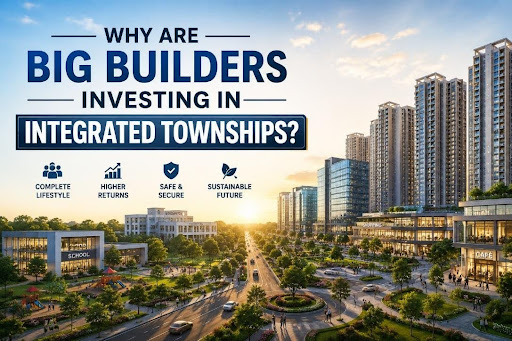
Why Are Big Builders Investing in Integrated Townships?
-
By Ayush Oswal
- July 5, 2026
Introduction
India’s real estate market has evolved significantly over the past decade. Homebuyers are no longer searching for just an apartment, they are looking for a complete ecosystem that offers convenience, safety, work opportunities, recreation, education, and healthcare within one planned community. This shift has encouraged leading developers to focus on integrated townships rather than standalone residential projects.
Integrated townships combine residential developments with commercial spaces, schools, hospitals, parks, shopping centres, and entertainment facilities. These projects create self-sustained communities that improve the quality of life while generating long-term returns for developers.
Let’s understand why major builders are increasingly investing in integrated township developments.
Quick Answer
Integrated townships are becoming the preferred choice for large real estate developers because they offer long-term value, multiple revenue streams, better land utilization, and a complete lifestyle for residents. With increasing urbanization, infrastructure development, and demand for self-sufficient communities, integrated townships have emerged as one of the most attractive real estate investment models in India.
Also Read: Top 15 Largest States in India by Area, Population, Real Estate Insights and GDP Data in 2025
What Is an Integrated Township?
An integrated township is a large, master-planned development spread across a substantial land parcel. Instead of constructing only residential buildings, the developer creates an entire neighbourhood that includes:
- Residential apartments and villas
- Commercial offices
- Retail spaces
- Schools and educational institutions
- Hospitals and healthcare centres
- Parks and gardens
- Clubhouses and sports facilities
- Religious places
- Public transport connectivity
- Wide internal roads and utility infrastructure
The objective is to provide residents with everything they need within a single community.
Why Are Large Builders Choosing Integrated Townships?
- Better Utilization of Large Land Banks
Major developers often own large land parcels acquired years ago. Instead of launching multiple disconnected projects, integrated townships allow them to utilize the land more efficiently through phased development.
This approach maximizes both land value and long-term profitability.
- Rising Demand for Lifestyle-Oriented Living
Modern homebuyers prioritize convenience over proximity. Families increasingly prefer communities where schools, supermarkets, parks, gyms, and healthcare facilities are within walking distance.
Integrated townships meet these expectations by offering a complete lifestyle instead of just a home.
- Multiple Revenue Opportunities
Unlike standalone residential projects, integrated townships generate revenue from various segments, including:
- Residential sales
- Commercial leasing
- Retail spaces
- Office developments
- Hospitality projects
- Maintenance and facility management
This diversified model reduces business risk.
Also Read: Builder Cheating You? How RERA Can Get Your Money Back in 2026
- Long-Term Brand Building
Developing a township strengthens a builder’s reputation. Successfully delivering an entire city within a city enhances customer trust and establishes the developer as a long-term community creator rather than simply a home builder.
Brand value often leads to faster sales in future projects.
- Government Support for Planned Urban Development
Urban planning authorities increasingly encourage large-scale planned developments because they reduce pressure on existing city infrastructure.
Many state governments also support integrated township policies by providing clear planning frameworks and infrastructure connectivity.
- Better Infrastructure Planning
Since the entire township is developed under one master plan, infrastructure can be designed more efficiently.
Developers can provide:
- Internal roads
- Water supply systems
- Sewage treatment plants
- Rainwater harvesting
- Smart security systems
- Green open spaces
- Utility management
This creates a more organized living environment.
- Stronger Property Value Appreciation
Properties within well-planned integrated townships often experience steady appreciation because residents benefit from continuously improving infrastructure and amenities.
As commercial and social infrastructure develops, demand usually increases, contributing to long-term value growth.
- Higher Customer Retention
Townships cater to different buyer segments by offering various property configurations, such as:
- Affordable apartments
- Premium residences
- Luxury villas
- Senior living communities
As families grow or their needs change, they can often upgrade within the same township instead of relocating elsewhere.
- Sustainability and Green Development
Integrated townships increasingly incorporate sustainable planning through:
- Solar lighting
- Waste management systems
- Rainwater harvesting
- Green landscapes
- Electric vehicle charging stations
- Energy-efficient infrastructure
These features align with growing environmental awareness among buyers.
- Future-Ready Urban Communities
India’s rapid urbanization is creating demand for organized, self-sufficient communities.
Integrated townships are designed to accommodate future population growth while maintaining quality infrastructure, making them attractive for both end-users and investors.
Benefits for Homebuyers
Homebuyers enjoy several advantages when purchasing within integrated townships:
- Better security
- Reduced travel time
- Access to quality amenities
- Improved social infrastructure
- Higher community engagement
- Better resale potential
- Enhanced lifestyle
- Long-term appreciation prospects
Challenges Faced by Developers
Despite their advantages, integrated township projects require:
- Significant capital investment
- Long development timelines
- Complex regulatory approvals
- Efficient infrastructure planning
- Strong project management
- Continuous maintenance planning
Only well-capitalized and experienced developers are typically able to execute such large-scale projects successfully.
Future of Integrated Townships in India
As metro expansion, expressways, airports, and industrial corridors continue to reshape Indian cities, integrated townships are expected to become even more prominent. Buyers increasingly value convenience, sustainability, and community living, making township developments well-positioned to meet future housing demands.
For developers, these projects represent an opportunity to create long-lasting communities while building stronger brands and diversified revenue streams.
Conclusion
Integrated townships represent the next phase of urban development in India. Rather than building isolated residential complexes, large developers are creating complete ecosystems where people can live, work, study, shop, and relax without travelling long distances.
As infrastructure improves and buyer expectations evolve, integrated townships are likely to remain a major focus of India’s real estate sector. If you’re planning to invest in a home, evaluating township projects can offer both lifestyle advantages and long-term value. At Housiey, we help buyers explore verified residential projects and connect directly with trusted builders for a seamless home-buying experience.
Key Takeaways
- Integrated townships combine residential, commercial, educational, healthcare, and recreational facilities within one planned development.
- Large builders benefit from better land utilization and diversified revenue streams.
- Homebuyers enjoy convenience, security, and access to premium infrastructure.
- Planned developments generally support stronger long-term property appreciation.
- Sustainability and smart infrastructure are becoming key features of modern townships.
- Government-backed infrastructure projects are accelerating township development across India.
- Integrated townships are expected to play a significant role in India’s future urban growth.
Sources
- Ministry of Housing and Urban Affairs (MoHUA)
- Real Estate (Regulation and Development) Act (RERA)
- National Building Code of India (NBC)
- NITI Aayog
- Central Public Works Department (CPWD)
- State Urban Development Authorities
- Reserve Bank of India (RBI)
- Industry reports by leading real estate consultancy firms
- Government urban planning and infrastructure policy documents
FAQs
- An integrated township is a large planned development containing homes, commercial spaces, schools, hospitals, parks, and recreational facilities. It functions as a self-sufficient community.
- They offer better land utilization and multiple revenue opportunities. They also help developers build long-term brand value.
- Yes, they provide education, healthcare, recreation, and daily conveniences within the community. This improves overall quality of life.
- Most township projects include extensive lifestyle amenities. These often exceed those available in standalone residential projects.
- Many township properties have strong appreciation potential due to planned infrastructure. However, investment performance depends on location and market conditions.
- Yes, many feature offices, retail outlets, and shopping centres. This creates a live-work environment.
- They enjoy convenience, security, and reduced travel for everyday needs. The community environment is another major attraction.
- Many include sustainable features such as rainwater harvesting and solar lighting. Green spaces are also an important part of their design.
- They are generally developed by large and financially strong real estate companies. These projects require substantial planning and investment.
- Townships are usually developed in multiple phases over several years. Individual phases may be delivered before the entire township is completed.
- Well-planned infrastructure can positively influence property appreciation. Market conditions also play an important role.
- Many integrated townships include educational institutions or reserve land for schools. Availability varies by project.
- Several townships include clinics or hospitals within the development. This improves accessibility for residents.
- Professional facility management is commonly provided. This helps maintain common areas and infrastructure efficiently.
- Yes, they often provide walkable layouts, green spaces, healthcare access, and enhanced security. These features support comfortable living.
- Properties in established townships may attract tenants seeking better amenities. Rental demand depends on location and employment hubs.
- Townships are developed under a unified master plan. This ensures coordinated infrastructure and organized growth.
- Many include workplaces, retail, and essential services within the development. This can significantly reduce daily travel.
- Most modern townships incorporate smart infrastructure and sustainable planning. They are designed to accommodate long-term urban growth.
- They should verify legal approvals, developer credibility, location, infrastructure, and future growth potential. Comparing amenities and connectivity is equally important.

Ayush Oswal is an SEO Executive at Housiey, specializing in optimizing real estate content for better visibility and engagement. With a strong understanding of SEO strategies and the property market, he ensures that every blog helps homebuyers make informed decisions while performing well on search engines.
Related Stories