
Adani Group Bets Big on Mumbai: ₹1 Lakh Crore Motilal Nagar Redevelopment Set to Transform Goregaon
-
 By L. Sadriwala
- April 18, 2026
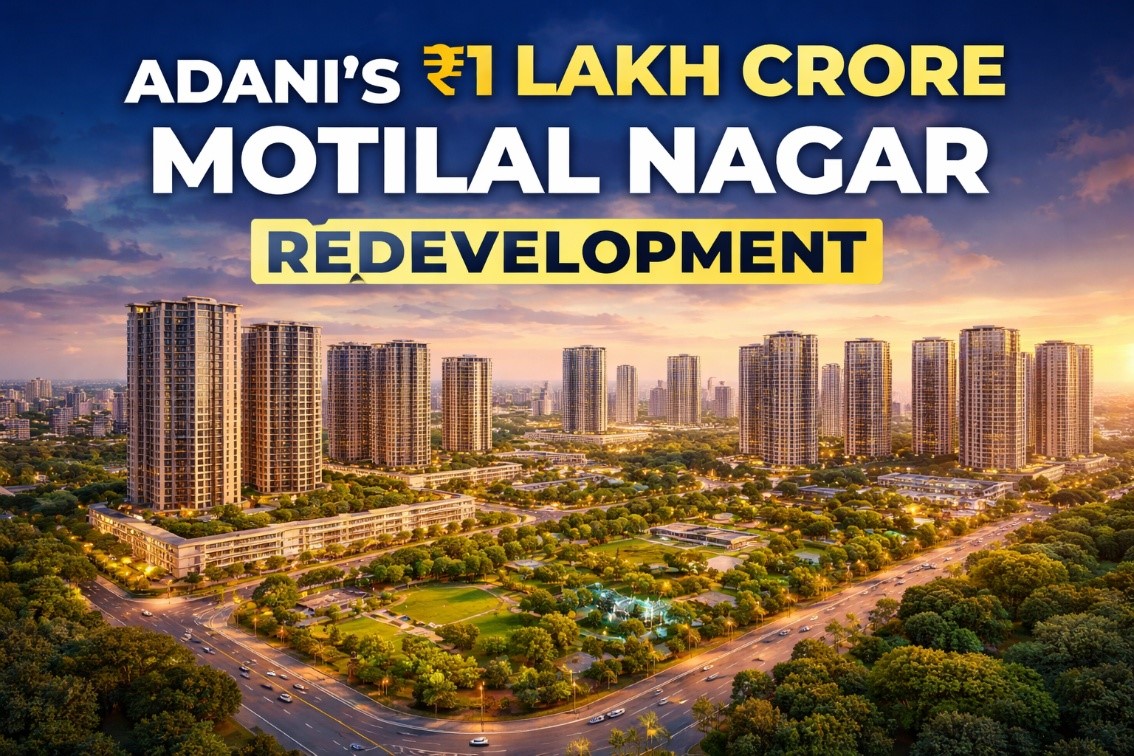
Mumbai’s skyline is on the brink of another massive transformation, and this time, the spotlight is firmly on Goregaon West. In what could become one of India’s most ambitious urban renewal projects, the Adani Group is preparing to invest close to ₹1 lakh crore into the redevelopment of Motilal Nagar, a sprawling 143-acre cluster governed by MHADA.
This large-scale project is not just about redevelopment; it’s about reshaping how Mumbai accommodates its growing population while balancing rehabilitation, infrastructure, and premium real estate supply.
Also Read:- Mumbai’s Luxury Coastline Boom: Sri Lotus Developers Unveils ₹9,000 Crore Sea-Facing Project Pipeline
A Mega Redevelopment Project in the Making
Located in Goregaon West, Motilal Nagar is set to undergo a complete transformation under MHADA’s cluster redevelopment model. The project will combine rehabilitation housing for existing residents with a sizeable free-sale component, making it both socially impactful and commercially significant.
According to MHADA CEO Sanjeev Jaiswal, the redevelopment is expected to generate approximately 28 lakh square metres of Floor Space Index (FSI), a key metric that determines the total buildable area.
Out of this:
- Around 17 lakh sq m will be allocated to Adani Group as the development agency
- Nearly 6.44 lakh sq m will go towards rehabilitation housing
- Approximately 3.74 lakh sq m will be retained by MHADA
This balanced distribution reflects the project’s dual objective, rehousing thousands of residents while unlocking premium real estate inventory.
Rehabilitation at the Core
A major highlight of the project is its focus on inclusive development. The plan aims to rehabilitate nearly 5,000 existing tenements, covering residential units, commercial spaces, and slum dwellings.
The initial target is to complete rehabilitation within seven years, although minor timeline extensions may occur depending on execution challenges.
What makes this project particularly noteworthy is its scale. Unlike smaller redevelopment efforts, this cluster model allows for holistic planning, including better roads, open spaces, and modern infrastructure, something Mumbai’s older layouts often lack.
Also Read:- MHADA Lottery 2026: 2,640 Homes in Mumbai from ₹29 Lakh to ₹6.82 Crore
Investment Breakdown: From ₹36,000 Crore to ₹1 Lakh Crore
The financial scope of the project is as ambitious as its scale.
- Around ₹36,000 crore is expected to be spent on rehabilitation, MHADA’s share, and infrastructure development
- When the commercial sale component is included, the total investment over the project lifecycle could reach ₹1 lakh crore
Given that the development timeline may stretch over 10 to 15 years (or longer), actual FSI utilization and revenue generation will depend heavily on market conditions over time.
Also Read:- What Are the New Upcoming New Launch Projects in Mumbai & Thane 2026 List?
What Will Be Sold? A Mixed-Use Urban Hub
The free-sale component is expected to emerge as a mixed-use development, offering:
- Premium residential apartments
- Commercial office spaces
- Retail hubs
- Hospitality projects
- Educational institutions
Current market estimates suggest pricing in the region of ₹30,000 per sq ft, with residential units likely to drive the strongest demand.
This positions the project as not just a housing initiative but a self-sustained urban ecosystem in one of Mumbai’s key growth corridors.
Also Read:- Which Is the Most Luxurious Apartment in Mumbai?
Part of a Larger Transformation Story
The Motilal Nagar redevelopment follows closely behind another landmark project—the Dharavi Redevelopment, also being executed by the Adani Group.
Together, these projects signal a broader shift toward large-scale, planned urban regeneration in Mumbai.
MHADA has also outlined an aggressive pipeline for the future:
- 923 acres of land across Mumbai are expected to be opened up for cluster redevelopment
- Around 75,445 tenements are projected to be rehabilitated across multiple projects in the next 5–8 years
This scale of redevelopment is being described as unprecedented, not just for Mumbai but potentially across India.
Also Read:- What Are the New Developing Areas in Mumbai?
What This Means for Mumbai’s Real Estate Market
This project could significantly influence Mumbai’s real estate landscape in multiple ways:
- Increased housing supply in western suburbs
- Upgraded infrastructure in older localities
- Boost to property values in and around Goregaon
- More organized urban planning through cluster redevelopment
However, the pace at which new inventory enters the market will depend on economic cycles, demand trends, and execution timelines.
Also Read:- Who Is the No. 1 Builder in Mumbai? A Complete 2026 Analysis of Mumbai’s Top Real Estate Developers
Final Thoughts
The Motilal Nagar redevelopment is more than just a real estate project—it’s a glimpse into Mumbai’s future. With a blend of rehabilitation, premium development, and infrastructure upgrades, it has the potential to set new benchmarks for urban transformation in India.
If executed efficiently, this ₹1 lakh crore investment could redefine not just Goregaon, but the way cities approach redevelopment at scale.
L. Sadriwala is the Editor-in-Chief at Housiey, with a professional writing career spanning since 2015. Coming from a family of real estate developers, her deep-rooted industry understanding naturally shaped her focus on real estate content, where she combines domain knowledge with clear, reader-first writing.
She specializes in simplifying complex property concepts — from housing policies and market trends to builder reviews and project insights — into accurate, easy-to-understand guidance for homebuyers and investors.
At Housiey, every article by L. Sadriwala is built on thorough research and verified facts. Her goal is straightforward: to empower homebuyers and investors with reliable, trustworthy information that helps them make confident property decisions.
Related Stories