

Why Homebuyers Are Leaving Metro Cities for Tier-2 Towns in 2026
-
 By L. Sadriwala
- May 5, 2026
Introduction
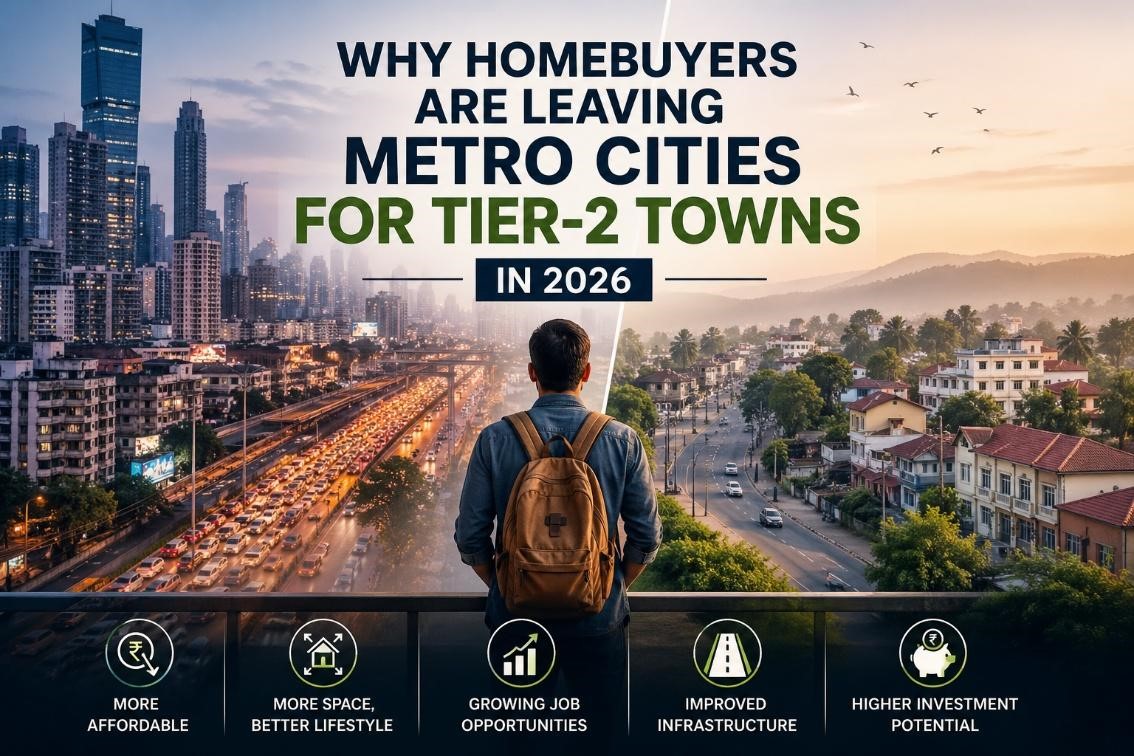
India’s real estate story in 2026 is undergoing a quiet but powerful shift. For decades, metro cities like Mumbai, Delhi, and Bengaluru dominated housing demand. But today, the narrative is changing. Homebuyers are increasingly turning their attention toward Tier-2 cities such as Indore, Lucknow, Coimbatore, Jaipur, and Nagpur; not as a compromise, but as a conscious lifestyle upgrade.
This shift is not driven by a single factor. Instead, it is a combination of affordability pressures, lifestyle aspirations, infrastructure development, and changing work patterns. The result? India’s housing demand is no longer metro-centric; it is becoming multi-polar and distributed across emerging cities.
In this blog, we’ll break down exactly why homebuyers are leaving metro cities for Tier-2 towns in 2026, what it means for buyers, and whether this trend is here to stay.
Also Read:- How Do Navi Mumbai and Mumbai Compare for Real Estate Investment?
Quick Answer
Homebuyers are moving to Tier-2 cities in 2026 due to better affordability, improved infrastructure, rising job opportunities, lower cost of living, and a desire for a better lifestyle and space.
Market Snapshot Table
|
Factor |
Metro Cities |
Tier-2 Cities |
| Property Prices | Very High & Rising | Affordable & Stable |
| Cost of Living | Expensive | Moderate |
| Space Availability | Limited | Spacious Homes |
| Job Opportunities | High but Saturated | Growing Rapidly |
| Infrastructure | Mature but Congested | Rapidly Developing |
| Investment Potential | Slower Appreciation | Higher Growth Potential |
Are Rising Property Prices Pushing Buyers Out of Metros?
One of the biggest triggers behind this migration is affordability. Property prices in metro cities have surged significantly, especially in the premium segment. In fact, luxury housing now dominates the market, leaving fewer options for budget and mid-income buyers.
Additionally, affordable housing sales have declined sharply in major cities due to rising land and construction costs.
This has created a situation where:
- First-time buyers are priced out
- Middle-class families are forced to compromise
- Rental costs are rising faster than income
In contrast, Tier-2 cities offer larger homes at significantly lower prices, making homeownership more achievable.
Also Read:- Smartworks Expands in Mumbai with 1,150 Seats Deal, Targets ₹51 Cr Revenue Boost
Is Affordability the Biggest Advantage of Tier-2 Cities?
Absolutely. Affordability is the backbone of this shift.
In Tier-2 cities, buyers can:
- Purchase larger homes at lower costs
- Enjoy lower EMIs compared to metro properties
- Access better value per square foot
Lower land acquisition and construction costs make projects more feasible and accessible for developers and buyers alike.
This affordability advantage is especially appealing to:
- First-time homebuyers
- Millennials entering the property market
- Families upgrading from rented homes
Are Infrastructure Developments Changing the Game?
Yes—and this is a major turning point.
Tier-2 cities are no longer “underdeveloped alternatives.” Massive investments in infrastructure are transforming them into well-connected urban hubs.
Key developments include:
- New highways and expressways
- Expanding airport connectivity
- Smart City initiatives
- Metro rail expansions in select cities
These upgrades are improving accessibility and livability, making Tier-2 cities more attractive for both living and investment.
Also Read:- Which Is the Most Luxurious Apartment in Mumbai?
Are Job Opportunities Expanding Beyond Metro Cities?
This is one of the strongest structural shifts in 2026.
Businesses are increasingly moving operations to Tier-2 cities due to:
- Lower operational costs
- Availability of skilled workforce
- Reduced attrition rates
Global Capability Centers (GCCs) and IT firms are expanding into cities like Jaipur, Indore, and Coimbatore, creating new employment hubs.
This decentralization of jobs means people no longer need to live in metros to build successful careers.
Is Remote Work Accelerating This Migration?
Post-pandemic work culture has permanently changed housing preferences.
Remote and hybrid work models allow professionals to:
- Live in smaller cities
- Avoid daily commutes
- Improve work-life balance
As a result, many professionals are choosing Tier-2 cities where they can afford better homes and enjoy a calmer lifestyle without sacrificing income.
Are Homebuyers Seeking Better Lifestyle and Space?
Metro living often comes with compromises, smaller homes, congestion, pollution, and long commutes.
In contrast, Tier-2 cities offer:
- Larger homes (including villas and duplexes)
- Cleaner environments
- Less traffic and noise
- Stronger community living
Interestingly, even premium housing formats like duplex apartments are gaining popularity in Tier-2 cities, reflecting rising lifestyle expectations.
Also Read:- How Is the Metro Impacting Real Estate Prices Across Mumbai Corridors?
Are Developers Also Shifting Focus to Tier-2 Cities?
Yes, and this validates the trend.
Developers are actively expanding into Tier-2 markets because:
- Land is cheaper
- Demand is growing steadily
- Inventory risks are lower
Government initiatives like Smart Cities Mission and AMRUT have further accelerated this development.
This has improved the quality of projects, amenities, and overall buyer confidence in these markets.
Is Investment Potential Higher in Tier-2 Cities?
From an investment perspective, Tier-2 cities are becoming extremely attractive.
Reasons include:
- Lower entry prices
- Higher appreciation potential
- Growing rental demand
Many investors see these cities as early-stage markets with strong long-term growth potential, especially as infrastructure and employment continue to improve.
Are Tier-2 Cities More Stable Than Metro Markets?
Interestingly, yes.
Metro markets are often:
- Highly volatile
- Saturated
- Sensitive to economic cycles
Tier-2 cities, on the other hand, offer:
- More stable demand
- Lower price volatility
- Sustainable growth patterns
This makes them attractive not just for end-users but also for long-term investors.
Also Read:- Top 10 Benefits of Buying a Home in Navi Mumbai 2025
Are There Any Challenges in Moving to Tier-2 Cities?
While the benefits are strong, buyers should also consider certain challenges:
- Limited healthcare infrastructure in some cities
- Fewer premium educational institutions
- Slower urban planning in certain regions
However, these issues are gradually improving with increasing investments and regulatory reforms.
Buyer Insights
- The shift is not temporary, it is structural and long-term
- Millennials and first-time buyers are leading this migration
- End-use buying is stronger than speculative investment
- Lifestyle-driven decisions are becoming as important as financial ones
Why Buyers Choose Housiey
In a market where choices are expanding beyond metros, platforms like Housiey simplify the home-buying journey by connecting buyers directly with builders. This ensures a transparent, hassle-free experience without unnecessary broker interference, especially important when exploring emerging Tier-2 markets.
Conclusion
The movement of homebuyers from metro cities to Tier-2 towns in 2026 is not just a trend; it is a transformation.
Rising costs in metros, combined with improved infrastructure, job decentralization, and evolving lifestyle preferences, are reshaping India’s housing landscape. Tier-2 cities are no longer secondary options; they are becoming primary destinations for homebuyers seeking value, comfort, and growth.
As this shift continues, India’s real estate future will likely be defined not by a few megacities, but by a network of thriving urban centers across the country.
Key Takeaways
- Metro cities are becoming increasingly unaffordable for average homebuyers
- Tier-2 cities offer better value, space, and lifestyle
- Infrastructure growth is making smaller cities more accessible
- Job opportunities are expanding beyond metros
- Developers and investors are actively focusing on Tier-2 markets
- The shift is long-term and driven by structural changes
FAQs
- Rising property prices and cost of living are pushing buyers to look for affordable alternatives. Tier-2 cities offer better value and improved lifestyle options.
- Yes, they offer higher appreciation potential due to lower entry prices. Infrastructure growth further strengthens long-term returns.
- Cities like Indore, Jaipur, Coimbatore, Lucknow, and Nagpur are gaining traction. These cities are witnessing strong infrastructure and employment growth.
- Yes, property prices are significantly lower compared to metro cities. Buyers also get larger homes for the same budget.
- Yes, many companies are expanding into smaller cities. IT, manufacturing, and service sectors are creating new opportunities.
- Infrastructure is rapidly improving with government initiatives. Connectivity and urban facilities are getting better each year.
- Yes, many Tier-2 cities offer safer and calmer environments. They are often preferred for family living.
- Yes, remote and hybrid work models make this possible. Many professionals are already making this shift.
- Rental demand is increasing as job opportunities grow. Returns are improving steadily.
- Yes, developers are actively launching projects in these markets. Lower land costs and growing demand make them attractive.
- Yes, premium and duplex homes are becoming common. Lifestyle upgrades are driving this segment.
- Yes, affordability makes them ideal for first-time buyers. Financing options are also more accessible.
- In some cities, healthcare infrastructure is still developing. However, major cities are improving rapidly.
- Many cities have quality institutions, though options may be fewer than metros. Education infrastructure is expanding.a
- Yes, traffic congestion is significantly lower. This improves daily quality of life.
- Pollution levels are generally lower than metro cities. Cleaner environments attract homebuyers.
- It depends on the city and legal processes. Buyers should ensure proper documentation and due diligence.
- Yes, ongoing infrastructure and economic growth make them future-ready. They are key to India’s urban expansion.
- Yes, the shift is structural and expected to continue. Economic decentralization will drive sustained demand.
- If affordability, space, and lifestyle matter to you, it’s a great option. However, evaluate job opportunities and infrastructure before deciding.
L. Sadriwala is the Editor-in-Chief at Housiey, with a professional writing career spanning since 2015. Coming from a family of real estate developers, her deep-rooted industry understanding naturally shaped her focus on real estate content, where she combines domain knowledge with clear, reader-first writing.
She specializes in simplifying complex property concepts — from housing policies and market trends to builder reviews and project insights — into accurate, easy-to-understand guidance for homebuyers and investors.
At Housiey, every article by L. Sadriwala is built on thorough research and verified facts. Her goal is straightforward: to empower homebuyers and investors with reliable, trustworthy information that helps them make confident property decisions.
Related Stories