

Stamp Duty & Registration Charges in Nagaland 2026: Complete Buyer’s Handbook with Rates, Rules & Smart Calculations
-
 By L. Sadriwala
- February 27, 2026
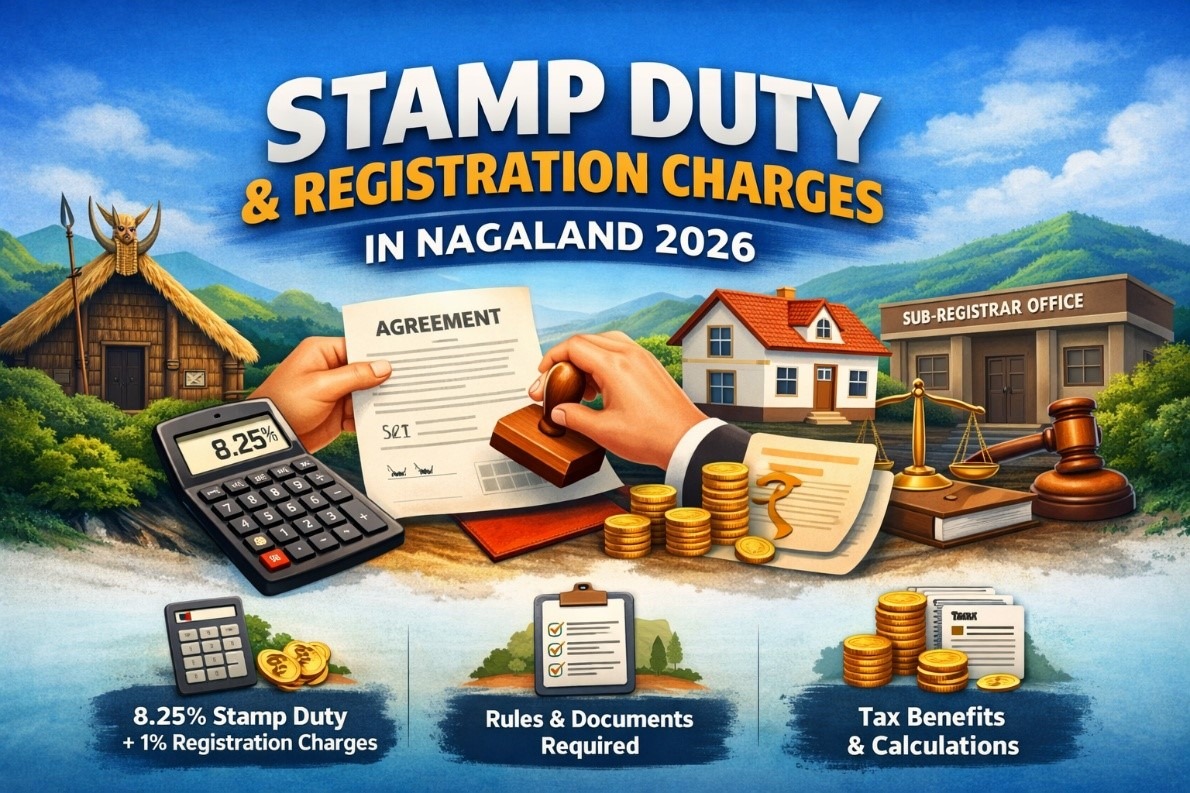
Buying property in Nagaland in 2026? Then stamp duty and registration charges are not just formalities, they are legally mandatory payments that validate your ownership in government records. Whether you’re purchasing residential land, a house, commercial space, or executing a gift or lease deed, understanding these charges in advance can save you from last-minute surprises.
In this detailed and systematic guide, we’ll walk you through:
- Latest stamp duty rates in Nagaland (2026)
- Registration charges applicable on different documents
- How stamp duty is calculated
- Important tribal land regulationsHow is Stamp Duty Calculated in Nagaland?
- Documents required for registration
- Tax benefits under the Income Tax Act
- Practical insights every buyer should know
Let’s decode everything step by step.
What is Stamp Duty in Nagaland?
Stamp duty is a government levy imposed on property transactions. It is paid to legally record the transfer of ownership from seller to buyer. Without paying stamp duty and completing registration, the transaction has no legal validity in official land records.
Stamp duty in Nagaland is governed primarily under the provisions of the Indian Stamp Act, 1899 and relevant state amendments. The amount payable is calculated on the higher of:
- The transaction value mentioned in the agreement
- The government-determined valuation (circle rate/guideline value)
This ensures undervaluation of property for tax avoidance does not occur.
Also Read:- Best Ways to Save Stamp Duty on Property Purchase
Latest Stamp Duty & Registration Charges in Nagaland (2026)
Unlike several Indian states that offer concessions for women buyers, Nagaland maintains a uniform stamp duty structure across ownership categories.
Stamp Duty & Registration Charges by Ownership Type (2026)
|
Ownership Category |
Stamp Duty |
Registration Charges |
| Male Buyer | 8.25% | 1% of property value |
| Female Buyer | 8.25% | 1% of property value |
| Joint (Male + Female) | 8.25% | 1% of property value |
| Joint (Female + Female) | 8.25% | 1% of property value |
| Joint (Male + Male) | 8.25% | 1% of property value |
Stamp Duty: 8.25%
Registration Charges: 1% (subject to prevailing administrative norms)
Important Insight: The rate applies to the higher of agreement value or circle rate — whichever is greater.
Also Read:- Stamp Duty and Registration Charges in West Bengal | 2026
Stamp Duty Based on Type of Document
Stamp duty isn’t just for sale deeds. It applies to various legal instruments as well.
| Document Type | Purpose | Stamp Duty | Registration Charges |
| Sale Deed / Conveyance | Ownership transfer | 8.25% | 1% of value |
| Gift Deed | Property gifted without sale consideration | 8.25% | 1% |
| Lease Deed | Property given on lease | 8.25% (as applicable) | ₹1,000 (fixed, may vary) |
| Power of Attorney | Authority to act on behalf | As per declared value | ₹1,000 approx |
| Partition Deed | Division of property share | 8.25% | 1% |
| Will / Miscellaneous Instruments | Declaration of rights | As applicable | ₹500–₹1,000 |
Rates may slightly vary based on the nature and tenure of the document.
How is Stamp Duty Calculated in Nagaland?

Let’s understand with a simple example.
Example:
- Property Sale Value: ₹50,00,000
- Government Circle Rate Value: ₹52,00,000
Since stamp duty is calculated on the higher value:
Stamp Duty = 8.25% of ₹52,00,000
= ₹4,29,000
Registration Charges = 1% of ₹52,00,000
= ₹52,000
Total payable = ₹4,81,000
This calculation makes budgeting extremely important before closing a deal.
Unique Land Ownership Structure in Nagaland
Nagaland has a distinctive land governance system due to tribal ownership patterns.
Under Article 371A of the Indian Constitution, Nagaland enjoys special provisions protecting tribal land rights. Much of the land is owned and regulated by tribal communities and village councils.
Important Conditions:
- Approval from respective tribal authorities may be required
- Land transactions may require clearance from district administration
- Local customary laws may apply
- The Sub-Registrar’s office handles final registration
Because of these special regulations, buyers must ensure due diligence before finalizing transactions.
Step-by-Step Process to Pay Stamp Duty in Nagaland
- Draft the sale agreement
- Verify circle rate and property valuation
- Obtain tribal or local authority clearance (if required)
- Visit the Sub-Registrar’s Office
- Submit required documents
- Pay stamp duty and registration charges
- Biometric verification of buyer, seller & witnesses
- Document registration and record entry
Only after completion of this process does the ownership become legally valid.
Documents Required for Property Registration

Here is a comprehensive checklist:
- Original Sale Deed
- Encumbrance Certificate
- Property Card
- Survey Details & Land Records
- Tehsildar’s Valuation Certificate
- Property Map
- Aadhaar Card
- PAN Card
- Passport-size photographs
- Identity proof of buyer, seller & witnesses
- Power of Attorney (if applicable)
Missing documentation can delay registration significantly.
Tax Benefits on Stamp Duty & Registration Charges

Under Section 80C of the Income Tax Act, stamp duty and registration charges qualify for deduction.
Maximum Deduction:
Up to ₹1.5 lakh in a financial year.
Conditions to Claim Deduction:
- Applicable only to Individuals and HUFs
- Must be paid from personal funds
- Can be claimed only in the year of payment
- Applicable for residential property purchase
- Joint owners can claim proportionately
- Generally applicable for new residential property
It’s important to note that land-only purchases may not qualify under deduction rules.
What Happens if Stamp Duty is Not Paid?
Failure to pay stamp duty can result in:
- Document not legally enforceable
- Ownership disputes
- Financial penalties
- Legal complications in resale
Stamp duty is not optional; it is mandatory for legal ownership recognition.
Conclusion:
Stamp duty in Nagaland may appear straightforward with a flat 8.25% rate, but the tribal land regulations and valuation rules make due diligence extremely important.
Before signing any agreement:
- Verify circle rates
- Check tribal clearance requirements
- Budget for stamp duty and registration
- Consult local authorities if necessary
If you are researching property opportunities beyond Nagaland, don’t miss our detailed guide on Gomti Enclave under Avadh Vihar Yojana, Lucknow, which covers pricing, location advantages, and eligibility norms in depth.
And if you want a smooth, transparent home-buying journey without broker harassment, explore Housiey, a platform that connects buyers directly with developers.
FAQ
- The stamp duty rate in Nagaland is 8.25% of the property value. It is calculated on the higher of the sale agreement value or government circle rate.
- No, Nagaland follows a uniform stamp duty structure for all ownership types. There are no gender-based concessions currently.
- Registration charges are typically 1% of the property value. These charges apply during document registration at the Sub-Registrar’s office.
- Yes, gift deeds attract stamp duty. The applicable rate is generally similar to sale deeds.
- Availability of online payment depends on local administrative facilities. Many areas still require physical registration at the Sub-Registrar office.
- Circle rate is the minimum government-declared property value for an area. Stamp duty is calculated on the higher of circle rate or agreement value.
- No, stamp duty is fixed by the state government. It cannot be negotiated between buyer and seller.
- Refund policies are subject to state rules. Certain cancellations may allow partial refund under specific conditions.
- Yes, joint owners can claim deductions individually under Section 80C. Each must contribute to the payment to claim benefits.
- Yes, lease deeds attract stamp duty based on tenure and declared value. Registration charges may be fixed or variable.
- Authorities can reassess and demand additional duty. Penalties may also apply.
- In many cases, yes. Local tribal regulations may require clearance before transfer.
- Yes, Aadhaar is generally required for identity verification. PAN is also necessary for financial compliance.
- Most banks do not finance stamp duty. Buyers usually pay it from personal funds.
- Yes, resale property transactions also attract stamp duty. The rate remains the same.
- No, it must be paid in full at the time of registration. Installment payment is not permitted.
- It is a legal document showing property’s ownership history. It confirms whether the property has any pending liabilities.
- Yes, without registration, the transfer of ownership is legally incomplete. It is mandatory under property law.
- NRIs must comply with local land laws and RBI regulations. Tribal land restrictions may apply.
- Stamp duty validates your ownership legally. Without it, your property transaction is not enforceable in court.
L. Sadriwala, the Editor-in-Chief at Housiey, is a seasoned writer whose professional journey in content creation began in 2015. With a background rooted in a family of real estate developers, her transition into real estate writing was a natural evolution, bringing together her storytelling expertise and deep industry understanding.
Over the years, she has authored impactful blogs across diverse niches such as food, travel, and lifestyle, before establishing her reputation as a trusted voice in Indian real estate. Today, her work stands out for its clarity, accuracy, and ability to simplify complex property concepts for readers.
At Housiey, every article crafted by L. Sadriwala reflects thorough research, verified facts, and a reader-first approach. From decoding housing policies and trends to offering in-depth builder reviews and project insights, her mission is clear: to empower homebuyers and investors with the knowledge they need to make confident property decisions.
Her writing not only informs but also builds trust, making her one of the most credible editorial voices in the real estate space.
Related Stories