
No Parking, No Claim: MahaRERA Draws a Clear Line for Homebuyers
-
 By L. Sadriwala
- May 13, 2026
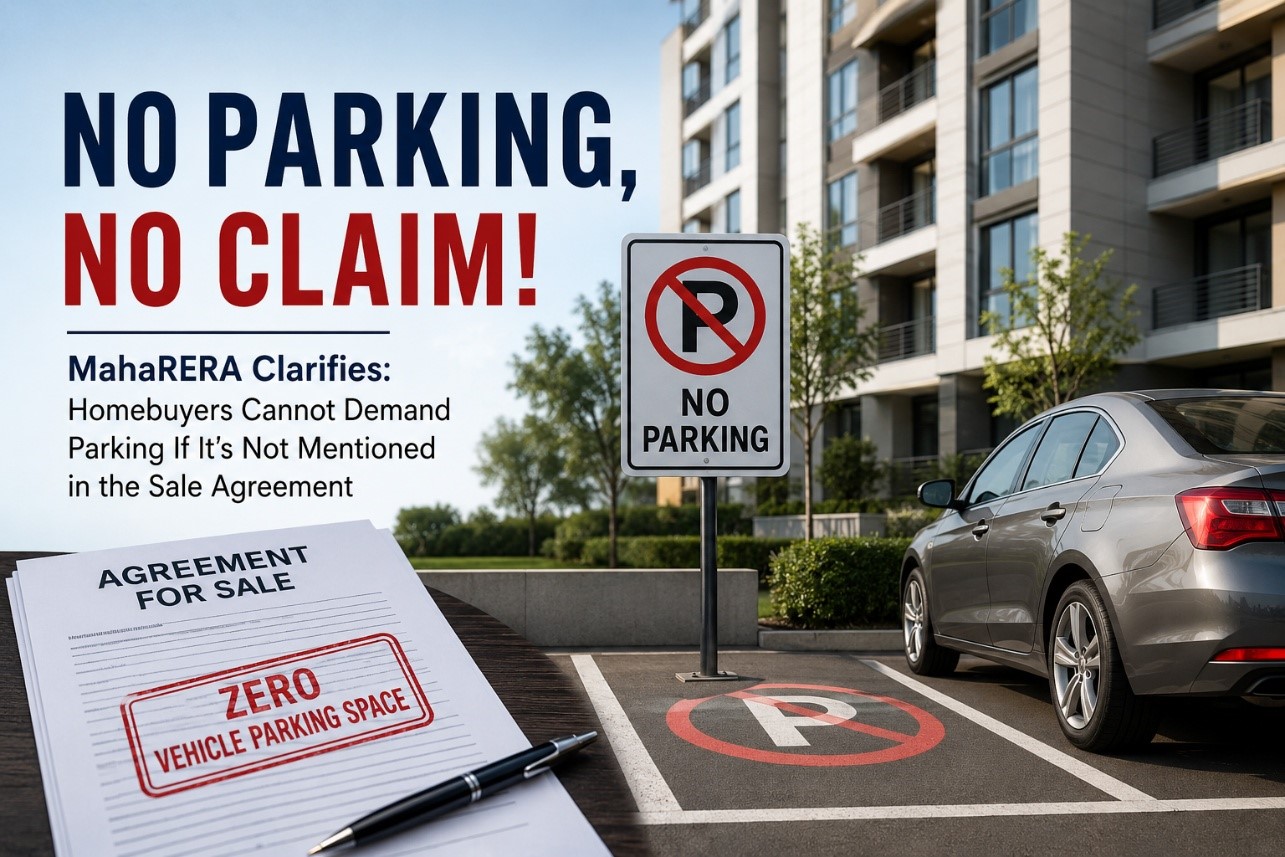
In a significant ruling that could shape expectations for thousands of property buyers across Maharashtra, the Maharashtra Real Estate Regulatory Authority has clarified that car parking cannot be claimed as a right if it is not explicitly included in the sale agreement. The decision reinforces a simple but often overlooked principle in real estate: what is not written into the contract cannot be demanded later.
The Dispute: What Homebuyers Alleged
The case revolved around two homebuyers who purchased an apartment in Mumbai’s suburbs under a registered agreement signed in July 2018. Over time, they raised multiple concerns against the developer, alleging that several promised features were either incomplete or entirely missing.
Their complaints included:
- Absence of a designated parking space
- Lack of a solar energy system for the housing society
- No proper compound wall along the property boundary
- Persistent leakage and seepage issues inside the apartment
To support their claims, the buyers submitted photographic evidence showing water damage, poor terrace conditions, and the incomplete infrastructure around the building. They also argued that the developer had ignored repeated follow-ups to address these issues, causing ongoing inconvenience.
Developer’s Defense: What the Agreement Actually Said
In response, the developer relied heavily on the wording of the registered agreement. According to them, the contract clearly stated that the apartment came with “zero vehicle parking space.” They emphasized that no additional payment had been made by the buyers for parking, making any later demand unjustified.
The developer also denied making any formal commitments regarding a solar system or compound wall. They further explained that certain structural elements—such as a permanent boundary wall—were not permitted under approved municipal plans, as the area needed to remain open to comply with regulatory requirements.
On the issue of leakage, the developer maintained that the apartment had been delivered in a livable condition. They suggested that any seepage could be due to natural wear and tear or post-possession modifications, rather than construction defects.
MahaRERA’s Verdict: Contract Is King
In its order dated May 4, 2026, MahaRERA sided with the developer on the parking issue. The authority highlighted that both the agreement for sale and official registration documents (Index-II) explicitly mentioned the absence of parking.
MahaRERA reiterated its consistent stance:
- If parking is not part of the agreement
- And no separate payment has been made
- Then, no legal right to claim parking exists later
This ruling underscores the importance of carefully reviewing property documents before purchase. Buyers cannot rely on verbal assurances or assumptions when it comes to key amenities like parking.
What About Other Amenities?
On the question of shared facilities such as solar systems and compound walls, MahaRERA clarified that these fall under common amenities. Typically, disputes related to such features should be raised collectively by a housing society or association of allottees, rather than by individual buyers—unless a specific contractual promise exists.
Relief for Homebuyers: Action on Leakage Complaints
While the authority rejected the parking claim, it did provide partial relief on the issue of water seepage. MahaRERA directed the developer to conduct a joint inspection of the apartment within 30 days.
If the inspection reveals:
- Structural defects
- Poor workmanship
- Or deficiencies in service
Then the developer must fix these issues at their own cost within another 30 days, as mandated under Section 14(3) of the Real Estate (Regulation and Development) Act, 2016.
Why This Ruling Matters
This decision sends a strong message to both buyers and developers:
- For buyers: Always ensure every promised feature, especially high-value ones like parking, is clearly documented in the agreement.
- For developers: Transparency in agreements can prevent prolonged legal disputes.
In a market where assumptions often lead to disputes, MahaRERA’s ruling reinforces the idea that real estate transactions must be guided strictly by written commitments, not expectations.
L. Sadriwala is the Editor-in-Chief at Housiey, with a professional writing career spanning since 2015. Coming from a family of real estate developers, her deep-rooted industry understanding naturally shaped her focus on real estate content, where she combines domain knowledge with clear, reader-first writing.
She specializes in simplifying complex property concepts — from housing policies and market trends to builder reviews and project insights — into accurate, easy-to-understand guidance for homebuyers and investors.
At Housiey, every article by L. Sadriwala is built on thorough research and verified facts. Her goal is straightforward: to empower homebuyers and investors with reliable, trustworthy information that helps them make confident property decisions.
Related Stories