
What is a Kutcha House? Meaning, Types and Key Facts
-
 By L. Sadriwala
- May 9, 2026
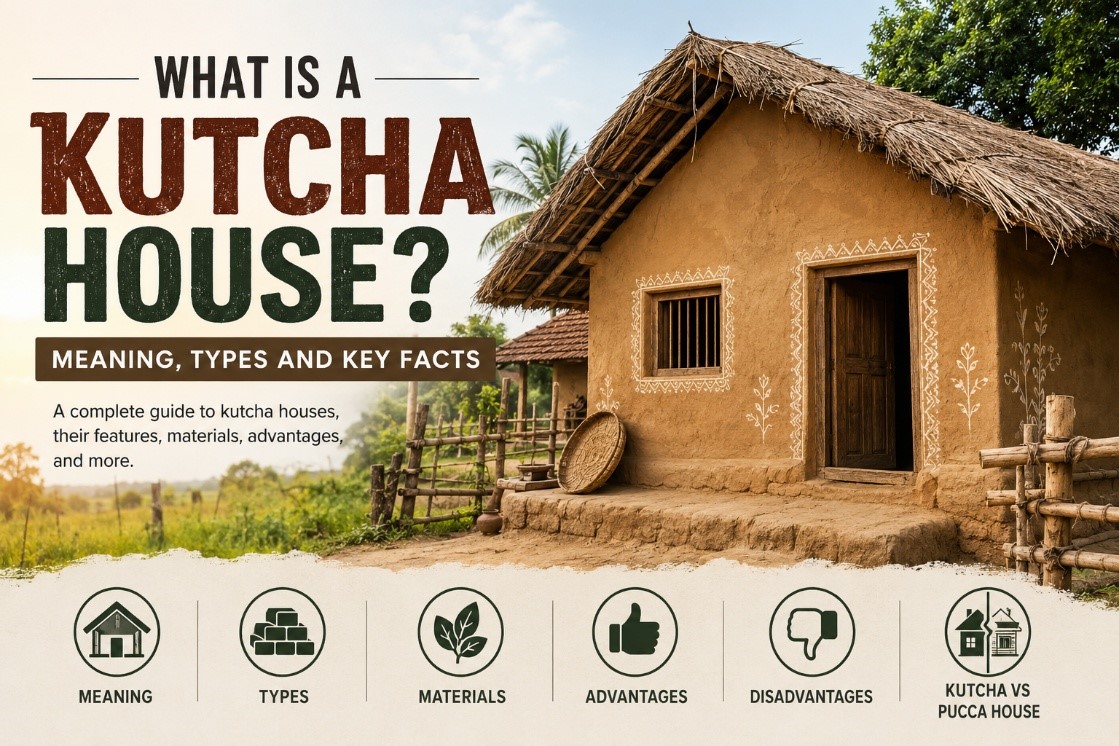
India’s housing landscape is incredibly diverse. From luxury high-rise apartments in metro cities to simple village homes built using mud and bamboo, every type of house reflects a unique lifestyle, climate, and economic condition. One such traditional housing structure that continues to exist across rural and semi-urban India is the kutcha house.
Even today, millions of families across villages and remote regions live in kutcha homes because they are affordable, locally sourced, and quick to construct. However, with growing urbanisation and government housing schemes, the conversation around kutcha houses has also evolved. People now want to understand their durability, practicality, safety, and how they differ from modern pucca homes.
If you have ever wondered about the kutcha house meaning, the different kutcha house types, or the difference between kutcha and pucca house structures, this detailed guide will help you understand everything in a systematic manner.
Also Read:- Bhunaksha Rajasthan: How to Access the Official Land Map Portal at bhunaksha.rajasthan.gov.in
What is a Kutcha House?
A kutcha house is a temporary or semi-permanent structure made using natural and locally available materials such as mud, bamboo, straw, clay, thatch, leaves, stones, or unburnt bricks. These houses are generally less durable compared to pucca houses and are commonly found in rural parts of India.
The term “kutcha” means unfinished or temporary. Therefore, a kutcha house refers to a dwelling that is not built using long-lasting construction materials like cement, concrete, steel, or baked bricks.
In simple words, if someone asks “what is kutcha house,” it is a house made from natural materials with limited structural strength and durability.
Also Read:- Webland AP Gov In Login: Step-by-Step Guide to Access Your Land Records in Andhra Pradesh
Kutcha House Meaning in India
The kutcha house meaning in India is deeply connected to traditional village architecture and low-cost living. These homes have existed for centuries and were originally designed according to local weather conditions and material availability.
For example:
- In Rajasthan, mud walls help keep interiors cool during extreme summers.
- In Assam, bamboo kutcha houses are elevated to avoid flood damage.
- In tribal regions, thatched roof homes are built using forest resources.
These homes are often constructed by local labourers or even by families themselves without requiring advanced engineering techniques.
Main Features of a Kutcha House
Understanding the basic characteristics of a kutcha house helps in identifying its practical use and limitations.
Built Using Natural Materials
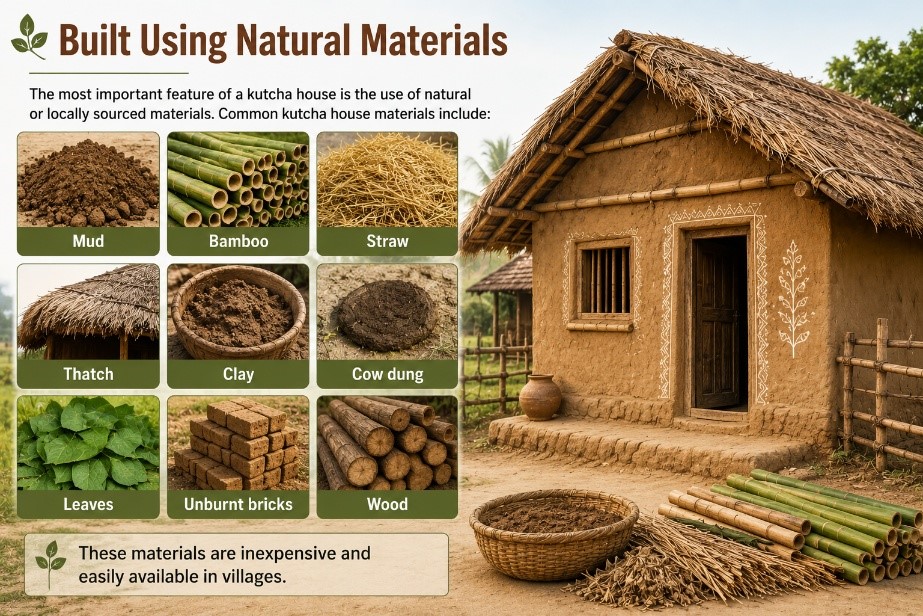
The most important feature of a kutcha house is the use of natural or locally sourced materials. Common kutcha house materials include:
- Mud
- Bamboo
- Straw
- Thatch
- Clay
- Cow dung
- Leaves
- Unburnt bricks
- Wood
These materials are inexpensive and easily available in villages.
Low Construction Cost
Kutcha houses are highly affordable compared to modern homes. Since the materials are cheap and labour costs are lower, they are preferred by economically weaker sections.
Quick Construction Process
Most kutcha houses can be built within a few days or weeks depending on the size and materials used.
Less Durable Structure
One of the biggest disadvantages of kutcha houses is their low durability. Heavy rainfall, floods, storms, and earthquakes can damage these homes easily.
Eco-Friendly Nature
Since kutcha houses use natural materials, they are considered environmentally sustainable and biodegradable.
Also Read:- How Do Marriage and Kids Change Home-Buying Decisions? A Deep-Dive Guide for Modern Indian Families (2026)
Types of Kutcha Houses
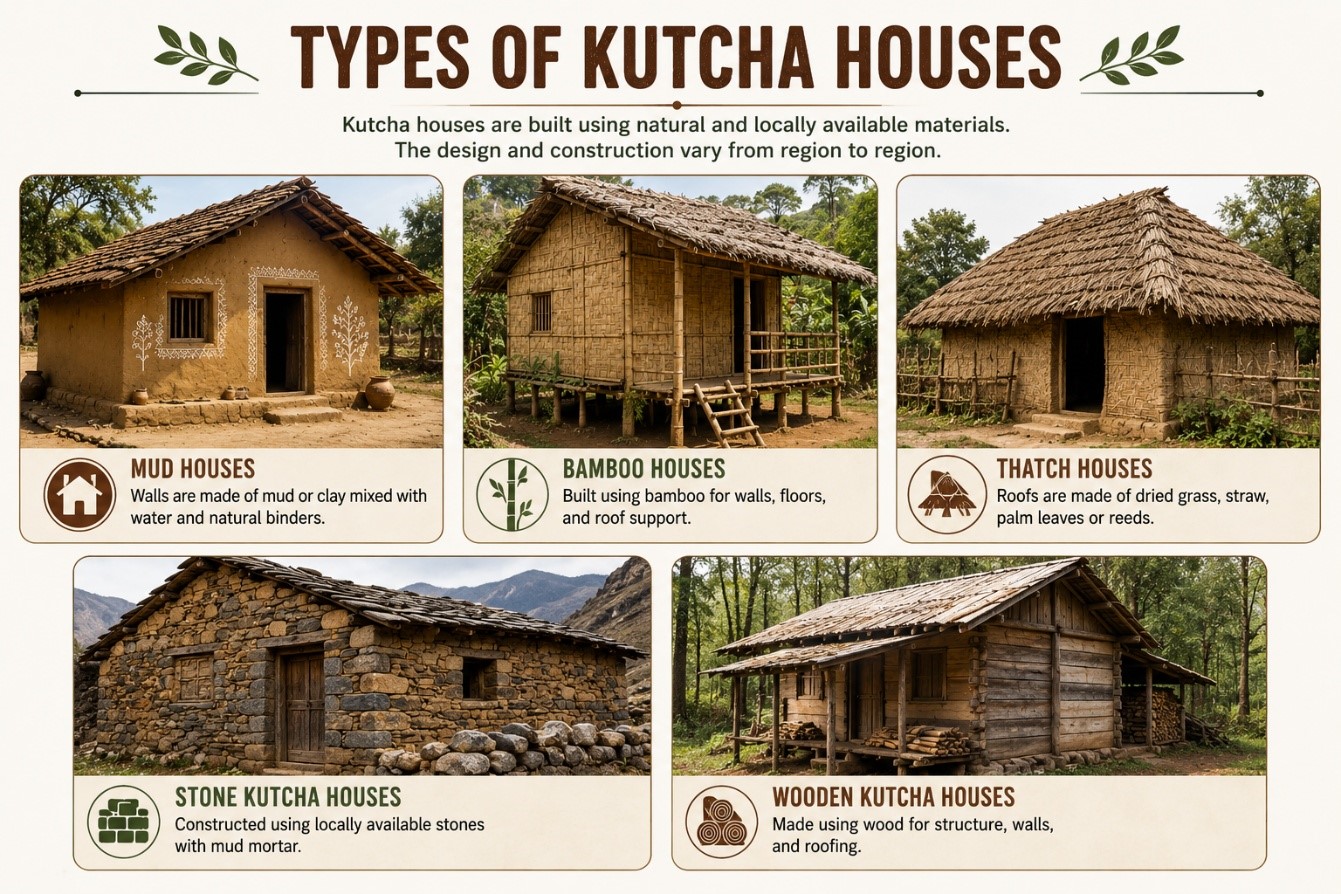
There are several kutcha house types found across different regions of India. Each type depends on climate, geography, and locally available resources.
Mud Houses
Mud houses are among the oldest forms of kutcha homes in India. The walls are made using clay soil mixed with water and sometimes cow dung for better strength.
Key Features
- Naturally cool interiors
- Affordable construction
- Eco-friendly design
- Suitable for hot climates
Common Locations
Mud houses are common in Rajasthan, Madhya Pradesh, Uttar Pradesh, and parts of Maharashtra.
Bamboo Houses
Bamboo houses are lightweight structures made primarily using bamboo frames and walls.
Key Features
- Flexible structure
- Earthquake-resistant to some extent
- Fast construction
- Renewable material usage
Common Locations
These homes are widely seen in Assam, Meghalaya, Tripura, and other northeastern states.
Thatch Houses
Thatch houses use dry vegetation such as straw, palm leaves, or reeds for roofing.
Key Features
- Excellent insulation
- Low construction cost
- Traditional rural appearance
Common Locations
These are common in coastal and agricultural regions.
Stone Kutcha Houses
Some rural areas use loosely stacked stones combined with mud mortar to create semi-permanent kutcha homes.
Key Features
- Better durability than mud houses
- Natural cooling effect
- Suitable for hilly areas
Common Locations
Seen in Himachal Pradesh, Uttarakhand, and parts of Jammu & Kashmir.
Wooden Kutcha Houses
Wooden houses are common in forest regions and cold-weather zones.
Key Features
- Warm interiors
- Easy to repair
- Rustic appearance
Common Locations
Found in Himalayan and tribal regions.
Kutcha House Materials
The durability and appearance of a kutcha house largely depend on the materials used during construction.
|
Material |
Purpose |
| Mud | Wall construction |
| Bamboo | Framework and support |
| Straw | Roofing and insulation |
| Clay | Wall plastering |
| Wood | Doors and roof support |
| Leaves | Roof covering |
| Stones | Foundation and walls |
| Cow dung | Floor and wall finishing |
These kutcha house materials are inexpensive and usually available within the local region itself.
Advantages of Kutcha Houses
Understanding the kutcha house advantages and disadvantages is important before evaluating their practicality.
Affordable Housing Option
Kutcha houses are extremely economical. Families with limited financial resources can build homes without taking large loans.
Environmentally Sustainable
These homes are made using biodegradable materials that do not heavily damage the environment.
Better Natural Ventilation
Traditional kutcha homes are designed to allow proper airflow and maintain cooler indoor temperatures.
Easy Repairs
Damaged walls or roofs can often be repaired quickly using locally available resources.
Cultural and Traditional Importance
Kutcha homes represent regional architectural heritage and traditional construction methods.
Disadvantages of Kutcha Houses
Despite their affordability, kutcha houses also have several drawbacks.
Low Durability
Heavy rain, floods, termites, and harsh weather can weaken the structure quickly.
Poor Disaster Resistance
Kutcha houses are vulnerable during earthquakes, storms, and cyclones.
Frequent Maintenance
These homes require regular repairs, especially after monsoon seasons.
Limited Modern Facilities
Many traditional kutcha homes may lack advanced plumbing, electrical systems, or proper sanitation.
Shorter Lifespan
Compared to pucca houses, kutcha homes have a significantly shorter life expectancy.
Difference Between Kutcha and Pucca House
One of the most searched topics is the difference between kutcha and pucca house structures.
|
Basis |
Kutcha House |
Pucca House |
| Construction Material | Mud, bamboo, straw | Cement, concrete, steel |
| Durability | Low | High |
| Cost | Affordable | Expensive |
| Lifespan | Short | Long |
| Maintenance | Frequent | Less frequent |
| Disaster Resistance | Weak | Strong |
| Construction Time | Quick | Longer |
| Structural Strength | Limited | Strong |
The pucca house vs kutcha house comparison clearly shows that pucca homes are more durable and modern, while kutcha homes are more affordable and eco-friendly.
Kutcha House in India
The presence of a kutcha house in India is still significant, especially in rural and economically weaker regions. According to various housing surveys and census reports, many Indian households continue to live in kutcha or semi-pucca structures.
Government initiatives such as:
- Pradhan Mantri Awas Yojana (PMAY)
- Indira Awas Yojana
- Rural housing schemes
have aimed to convert kutcha homes into safer pucca houses.
However, despite modernization, traditional kutcha houses continue to hold cultural and functional importance in many communities.
Kutcha House Amenities
Traditional kutcha homes may not always include advanced infrastructure, but modern rural housing improvements are changing this scenario.
Today, some upgraded kutcha house amenities include:
- Solar lighting
- Borewell water supply
- Toilets
- Electricity connections
- Basic kitchen setups
- Rainwater harvesting systems
Semi-kutcha homes are also becoming common, where part of the structure is built using cement while the remaining portion uses traditional materials.
Semi-Kutcha Houses
A semi-kutcha house is a combination of kutcha and pucca construction styles.
Example
- Brick walls with a thatched roof
- Cement flooring with mud walls
- Concrete foundation with bamboo roofing
These homes offer better durability while maintaining affordability.
Why Kutcha Houses Were Popular in Earlier Times
Before modern construction materials became widely accessible, people relied on local resources for shelter. Kutcha houses became popular because:
- They were inexpensive
- Materials were easily available
- Construction skills were simple
- They suited local climates
- Communities built homes collectively
These houses were practical solutions for rural living conditions.
Modern Relevance of Kutcha Houses
Even today, architects and environmentalists study kutcha homes for sustainable housing inspiration.
Many modern eco-homes now incorporate:
- Mud walls
- Natural cooling systems
- Bamboo structures
- Traditional ventilation techniques
As sustainability becomes important globally, traditional kutcha construction methods are receiving renewed appreciation.
Challenges Faced by Residents of Kutcha Houses
Families living in kutcha houses often face multiple challenges:
- Leakage during monsoon
- Pest infestation
- Structural cracks
- Poor sanitation
- Heat and humidity issues
- Lack of security
This is one of the main reasons why housing development remains an important focus area in India.
Government Support for Rural Housing
The Indian government has launched multiple schemes to improve rural housing conditions.
Pradhan Mantri Awas Yojana – Gramin (PMAY-G)
This scheme focuses on providing affordable pucca houses to rural families living in kutcha homes.
Financial Assistance
Eligible families receive monetary support for:
- House construction
- Sanitation facilities
- Electricity access
- Clean cooking fuel
These schemes aim to improve living standards while reducing unsafe housing conditions.
Are Kutcha Houses Still Relevant Today?
Yes, kutcha houses remain relevant in many parts of India due to:
- Affordability
- Sustainable construction
- Climate adaptability
- Cultural value
However, safety and durability concerns continue to encourage the transition toward stronger housing structures.
Conclusion
A kutcha house is more than just a temporary structure. It represents India’s traditional housing culture, rural lifestyle, and resourceful construction practices. Built using natural materials such as mud, bamboo, straw, and wood, these homes have served generations across villages and remote regions.
While kutcha houses are affordable and environmentally friendly, they also come with limitations related to durability, safety, and maintenance. The difference between kutcha and pucca house structures clearly highlights how modern construction offers better protection and longevity. Still, traditional kutcha architecture continues to inspire sustainable housing concepts even today.
As India rapidly urbanises, understanding traditional housing forms like kutcha homes helps us appreciate the country’s architectural diversity and evolving housing landscape. At Housiey, we believe informed homebuyers and readers should understand every aspect of Indian housing , from modern skyscrapers to traditional village homes.
Key Takeaways
- The kutcha house meaning refers to temporary or semi-permanent homes made using natural materials.
- Common kutcha house materials include mud, bamboo, straw, clay, and wood.
- Different kutcha house types include mud houses, bamboo houses, thatch houses, stone houses, and wooden homes.
- Kutcha houses are affordable and eco-friendly but less durable than pucca homes.
- The difference between kutcha and pucca house structures mainly lies in construction quality and lifespan.
- Kutcha house in India remains common in rural and economically weaker regions.
- Modern eco-friendly architecture is increasingly inspired by traditional kutcha housing techniques.
- Government housing schemes aim to replace unsafe kutcha homes with stronger pucca houses.
Sources
- Census of India Housing Reports
- Ministry of Rural Development
- Pradhan Mantri Awas Yojana (PMAY) Guidelines
- National Housing Bank Reports
- Rural Housing and Infrastructure Development Studies
- Government of India Rural Development Publications
- Indian Architecture and Vernacular Housing Studies
- State Rural Housing Department Publications
- Housing and Urban Affairs Research Papers
- Sustainable Rural Construction Studies
FAQs
- A kutcha house is a temporary or semi-permanent house made using natural materials like mud, bamboo, straw, and wood. These houses are generally less durable compared to cement-based pucca houses.
- The term kutcha house refers to a house built using locally available natural materials instead of concrete or cement. It usually indicates a structure with limited durability and strength.
- Common kutcha house materials include mud, bamboo, straw, clay, leaves, stones, and wood. These materials are inexpensive and easily available in rural areas.
- The main kutcha house types include mud houses, bamboo houses, thatched houses, stone houses, and wooden houses. Different regions use different styles based on climate and resource availability.
- Kutcha houses are built using temporary natural materials, while pucca houses use cement, steel, and concrete. Pucca homes are stronger, more durable, and more resistant to disasters.
- Kutcha houses may provide basic shelter but are less safe during floods, earthquakes, or storms. Their safety depends heavily on construction quality and maintenance.
- Kutcha houses are common in villages because they are affordable and easy to build using locally sourced materials. Rural communities have traditionally relied on these construction methods for generations.
- Kutcha houses are low-cost, eco-friendly, and naturally ventilated. They also use sustainable construction materials that are biodegradable.
- Kutcha houses have low durability and require frequent maintenance. They are also vulnerable to weather damage and natural disasters.
- A semi-kutcha house combines both kutcha and pucca construction materials. For example, it may have brick walls but a thatched roof.
- Yes, kutcha houses are considered environmentally friendly because they use natural and biodegradable materials. They also have a lower carbon footprint compared to concrete construction.
- Kutcha houses are commonly found in rural areas of Rajasthan, Assam, Bihar, Madhya Pradesh, and Uttar Pradesh. Tribal and hilly regions also have traditional kutcha structures.
- Yes, some modern kutcha homes include electricity, toilets, water supply, and solar power systems. Rural housing development has improved basic infrastructure in many areas.
- The lifespan of a kutcha house depends on the materials used and weather conditions. Regular maintenance is required to extend its durability.
- Mud walls naturally absorb and regulate heat, helping maintain cooler indoor temperatures. This makes mud houses suitable for hot climatic conditions.
- Pucca houses are permanent and durable structures built using modern construction materials. Kutcha houses are comparatively temporary and built using traditional natural resources.
- Yes, kutcha houses are significantly cheaper because their materials and labour costs are lower. They are often built without advanced machinery or engineering.
- Heavy rainfall can damage kutcha houses if they are not maintained properly. Water seepage and roof leakage are common problems during monsoons.
- Bamboo is easily available in Northeast India and is suitable for humid climates. Bamboo houses are also flexible and relatively earthquake-resistant.
- Yes, schemes like Pradhan Mantri Awas Yojana aim to provide safer pucca homes to families living in kutcha houses. These initiatives focus on improving rural housing standards.
L. Sadriwala is the Editor-in-Chief at Housiey, with a professional writing career spanning since 2015. Coming from a family of real estate developers, her deep-rooted industry understanding naturally shaped her focus on real estate content, where she combines domain knowledge with clear, reader-first writing.
She specializes in simplifying complex property concepts — from housing policies and market trends to builder reviews and project insights — into accurate, easy-to-understand guidance for homebuyers and investors.
At Housiey, every article by L. Sadriwala is built on thorough research and verified facts. Her goal is straightforward: to empower homebuyers and investors with reliable, trustworthy information that helps them make confident property decisions.
Related Stories