

Pedestrian Zones vs Vehicle Access: Can RWAs Really Control Internal Roads in Housing Societies?
-
By Ayush Oswal
- May 2, 2026
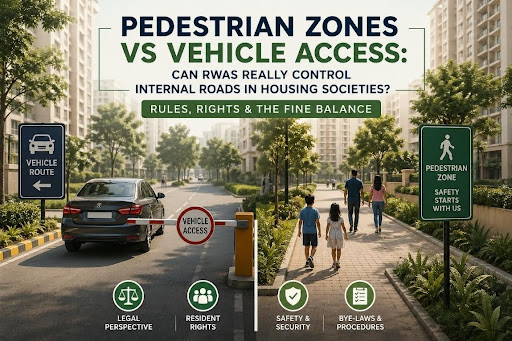
A growing debate in Bengaluru’s residential communities has brought an important question into the spotlight: how much authority does a Residents’ Welfare Association (RWA) actually have when it comes to controlling vehicular movement within a housing complex?
The issue came to light after a resident raised concerns about internal roads being shut off to vehicles and converted into pedestrian-only zones, sparking a wider discussion on rights, safety, and governance within gated communities.
What Triggered the Controversy?
In one prominent housing society in Bengaluru, residents noticed a significant shift in how internal roads were being used. According to one homeowner, the original layout designed by the builder allowed seamless vehicular movement between all towers. This ensured smooth entry, exit, and overall circulation within the complex.
However, once the RWA took over the management, several of these internal roads were reportedly closed off to vehicles and repurposed as pedestrian-only pathways. While the intent may have been to create safer, quieter spaces, the move didn’t sit well with everyone.
Residents from certain towers began experiencing longer travel routes within the premises, with some claiming delays of up to 5–10 minutes during peak hours. For daily commuters, this added inconvenience quickly became a point of frustration.
Also Read: Brigade Group & Bain Capital Join Forces for Landmark ₹2,200 Crore Mixed-Use Project in Whitefield
A Divided Community: Safety vs Convenience
Interestingly, not all residents opposed the decision. A section of the community welcomed the move, arguing that pedestrian-friendly zones significantly improve safety—especially for children and elderly residents.
Supporters believe that RWAs should have the flexibility to modify how internal roads are used, as long as basic accessibility is maintained. Their argument is simple: while the physical roads may be part of the approved layout, the type of traffic allowed on them is not always rigidly defined in property agreements.
From this perspective, if residents can still access their designated parking spaces without obstruction, restrictions on certain routes may be considered reasonable, especially if backed by a majority consensus.
But Is It Legally Valid?
This is where things get more nuanced.
Several residents and experts argue that RWAs cannot take such decisions arbitrarily. Any significant change—especially one that alters the original usability of shared infrastructure—must follow proper procedures outlined in the society’s bye-laws.
Residents opposing such moves have suggested a more formal approach:
- Requesting official documentation of the decision
- Reviewing meeting minutes where the rule was approved
- Checking voting records and member consensus
- Identifying specific clauses in the bye-laws that permit such restrictions
Without these, the decision could be challenged for lack of transparency and authority.
What Do Legal Experts Say?
Legal professionals largely agree on one key point: RWAs do have the power to regulate—but not unreasonably restrict, vehicular movement within a housing society.
Regulation can include:
- Time-based restrictions (for example, limiting vehicle movement during evening play hours)
- Designating certain areas as pedestrian-first zones
- Introducing traffic calming measures for safety
However, completely shutting down roads that were originally part of the approved circulation plan is a different matter altogether.
Experts emphasize that any such decision must:
- Follow due process
- Be supported by the society’s registered bye-laws
- Have adequate backing from residents (usually through voting)
If these conditions are not met, affected homeowners may have valid grounds to challenge the decision legally.
Also Read: Big Developers Take Charge: Land Deals Dip, But Dominance Grows in FY2026
Owners vs Tenants: Who Has the Final Say?
Another important distinction highlighted by legal experts is the difference between homeowners and tenants.
Property owners generally have stronger legal standing when it comes to questioning or challenging decisions made by the RWA. Tenants, while impacted by such changes, may need to route their concerns through the property owner or rely on lease agreements for support.
The Bigger Picture: Finding the Right Balance
This situation reflects a broader challenge faced by modern housing societies—balancing safety, accessibility, and community preferences.
On one hand, pedestrian-friendly spaces promote a healthier, more secure living environment. On the other, restricting vehicular access too aggressively can disrupt daily convenience and create friction among residents.
The ideal approach lies somewhere in between:
- Transparent decision-making
- Active resident participation
- Clear communication
- Strict adherence to legal frameworks
When RWAs operate with accountability and inclusivity, such conflicts can often be avoided altogether.
Conclusion
As urban housing communities continue to evolve, the role of RWAs is becoming increasingly significant. While they play a crucial part in maintaining order and enhancing quality of life, their powers are not absolute.
Decisions that impact everyday living, like restricting internal roads, must be taken carefully, legally, and collectively. After all, a housing society thrives not just on rules, but on mutual understanding and cooperation among its residents.

Ayush Oswal is an SEO Executive at Housiey, specializing in optimizing real estate content for better visibility and engagement. With a strong understanding of SEO strategies and the property market, he ensures that every blog helps homebuyers make informed decisions while performing well on search engines.
Related Stories