
Mumbai Real Estate Sees 8% Dip in Registrations in January 2026, But Stamp Duty Revenue Climbs 2%
-
 By L. Sadriwala
- February 10, 2026
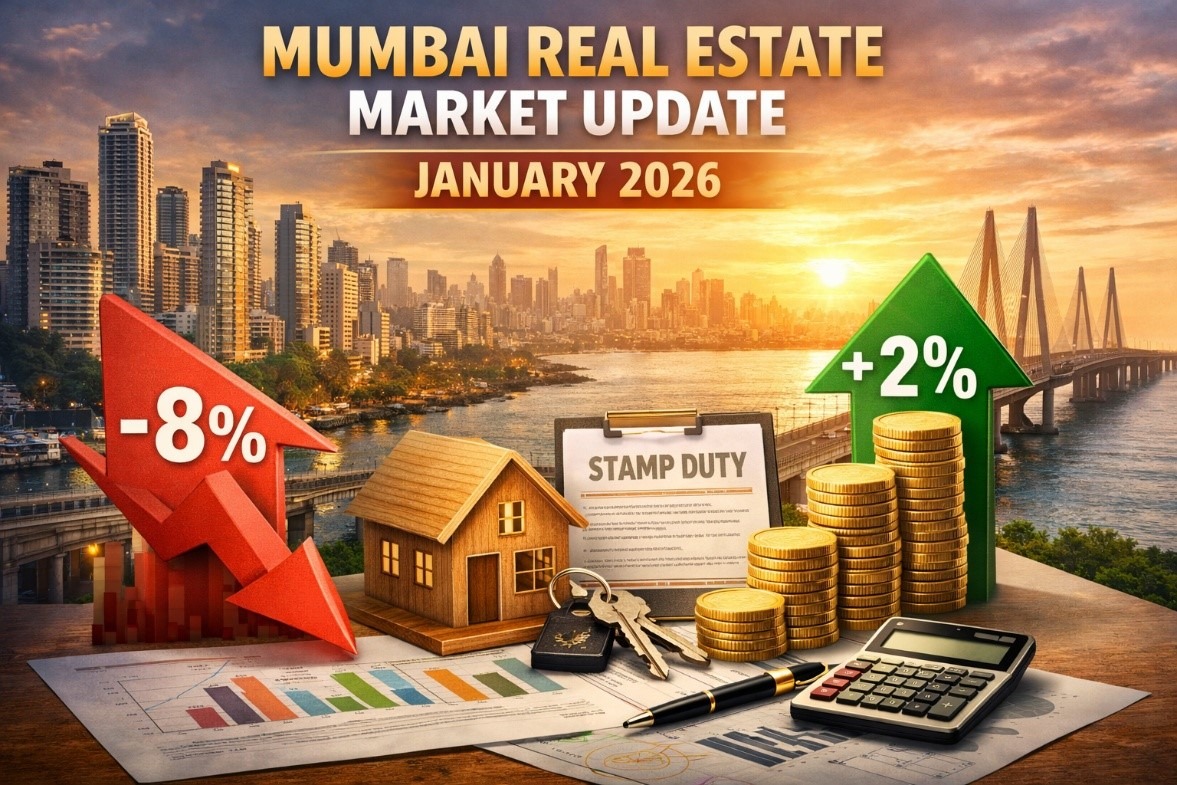
Mumbai’s property market has started 2026 on a slightly mixed note. While the number of registered property transactions dipped compared to last year, stamp duty collections still managed to rise, indicating that buyers are increasingly shifting towards higher-value homes.
As per data released by the Maharashtra Inspector General of Registration (IGR), Mumbai recorded 11,219 property registrations in January 2026, showing an 8% year-on-year decline from 12,249 registrations in January 2025.
However, despite fewer registrations, stamp duty collections increased by 2%, reaching ₹1,012 crore, compared to ₹994 crore during the same period last year.
This clearly suggests that the market is not slowing down drastically, rather, the nature of purchases is evolving.
Month-on-Month Drop Reflects Seasonal Trend
On a month-on-month basis, the fall was sharper.
- Property registrations dropped by 22%
- Stamp duty collections fell by 19%
This sequential decline, however, is being attributed to the typical seasonal slowdown that Mumbai experiences in January, especially after December usually records strong transaction activity.
According to real estate consultancy Knight Frank India, the dip is more of a routine moderation than a sign of weakening demand.
Residential Properties Continue to Dominate Market Activity
Despite fluctuations in numbers, Mumbai continues to show strong end-user sentiment.
The market remains largely driven by residential buyers, with housing transactions forming nearly 80% of total property registrations.
Experts believe this continued activity is being supported by:
- Positive homebuyer sentiment
- Stable economic environment
- Ongoing infrastructure upgrades across Mumbai
- Growing preference for ownership among end-users
This highlights that demand hasn’t vanished, it has simply become more selective and value-oriented.
“Highest January Stamp Duty Collection in 14 Years,” Says Knight Frank
Knight Frank India pointed out that January 2026 saw Mumbai recording its highest January stamp duty collections in 14 years, which is a major indicator of strong market confidence.
Shishir Baijal, Chairman and Managing Director, Knight Frank India, explained that even though volumes fell, revenue remained strong due to a shift towards premium transactions.
He noted that the market’s resilience reflects sustained end-user trust, backed by infrastructure development and stable economic conditions.
In simple terms: fewer homes were registered, but costlier homes were purchased.
What Are Mumbai Homebuyers Purchasing in 2026?
One of the most noticeable trends in January 2026 is the increasing demand for premium housing.
Luxury Segment Gains Momentum
Homes priced above ₹5 crore formed:
- 7% of total registrations in January 2026
- Compared to 6% in January 2025
This rise may look small, but it signals that luxury buyers are becoming more active, contributing heavily to stamp duty collections.
Affordable Housing Faces Pressure
On the other hand, the share of homes priced below ₹1 crore has declined, indicating that affordability remains a major challenge for a large section of buyers.
This is likely due to:
- Higher property prices
- Rising cost of living
- Home loan affordability pressure
- Limited supply in prime areas under ₹1 crore
Mumbai’s entry-level buyer segment appears to be feeling the squeeze.
₹1 Crore to ₹5 Crore Homes Dominate Demand
The mid-premium segment continues to be Mumbai’s strongest performing bracket.
Key trends:
- Homes priced ₹1 crore to ₹2 crore grew from 30% (Jan 2025) to 33% (Jan 2026)
- Homes priced ₹2 crore to ₹5 crore increased by 2% share
This confirms that Mumbai buyers are heavily leaning towards mid-to-premium homes, where both lifestyle and long-term investment potential align.
Homes Up to 1,000 Sq Ft Still Rule Mumbai’s Market
When it comes to size preferences, Mumbai continues to remain a compact-home market.
Units up to 1,000 sq ft contributed 83% of all registrations, exactly in line with last year.
Most Preferred Size Category:
The 500–1,000 sq ft segment remained the top choice, as it offers the best mix of:
- affordability
- usable space
- livability for small to mid-sized families
Larger Homes Still Remain a Niche
Larger apartments still attract buyers, but their market share remains limited.
- Homes between 1,000–2,000 sq ft saw a marginal dip of 1%
- Apartments above 2,000 sq ft stayed stable at 3%
This reflects Mumbai’s reality: even premium buyers often prefer practical sizes due to high ticket prices and maintenance costs.
Western and Central Suburbs Continue to Drive Mumbai’s Sales
Mumbai’s suburbs continue to dominate property registrations, proving once again that the city’s growth is strongly suburban-driven.
Suburban dominance in January 2026:
- Western Suburbs: 57% share
- Central Suburbs: 30% share
Together, these two regions contributed nearly 85% of Mumbai’s total registrations, highlighting their strong demand due to better connectivity, newer developments, and wider housing options.
South Mumbai and Central Mumbai Lag Behind
While suburbs remain the market leaders, premium legacy zones show smaller transaction volumes.
- South Mumbai held steady at 8%
- Central Mumbai slipped to 5%
This is likely due to:
- limited new supply
- extremely high property prices
- preference for newer gated communities in suburbs
What This Means for Mumbai’s Property Market in 2026
Even though registration numbers fell, Mumbai’s stamp duty collections rising clearly suggests that:
- buyer confidence remains intact
- premium purchases are increasing
- the market is shifting towards higher ticket-size homes
- suburbs continue to be Mumbai’s strongest growth engines
In short, Mumbai’s real estate market is not slowing, it is simply evolving.
L. Sadriwala is the Editor-in-Chief at Housiey, with a professional writing career spanning since 2015. Coming from a family of real estate developers, her deep-rooted industry understanding naturally shaped her focus on real estate content, where she combines domain knowledge with clear, reader-first writing.
She specializes in simplifying complex property concepts — from housing policies and market trends to builder reviews and project insights — into accurate, easy-to-understand guidance for homebuyers and investors.
At Housiey, every article by L. Sadriwala is built on thorough research and verified facts. Her goal is straightforward: to empower homebuyers and investors with reliable, trustworthy information that helps them make confident property decisions.
Related Stories