

Maharashtra’s Big Move: 25,000 Housing Societies in Mumbai May Soon Get Occupation Certificates
-
 By L. Sadriwala
- September 16, 2025
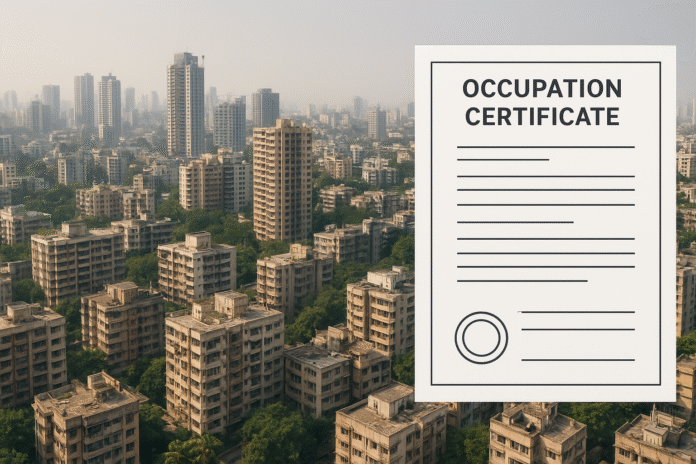
In a landmark step aimed at resolving decades-old disputes, the Maharashtra government is preparing to roll out a policy framework that could finally grant Occupation Certificates (OCs) to nearly 25,000 cooperative housing societies across Mumbai.
A detailed Government Resolution (GR) is expected in the first week of October, bringing clarity on rules, eligibility, and the amnesty process for societies stuck in legal and technical hurdles.
Also Read:-Maharashtra Govt & Lodha Developers Sign ₹30,000-Crore MoU for Green Data Centre Park Near Mumbai
What is an Occupation Certificate?
An Occupation Certificate (OC) is a crucial legal document issued by municipal authorities certifying that a building is constructed as per approved plans and is safe to live in. Without it:
- Residents technically cannot occupy the premises.
- Banks hesitate to grant loans or mortgages.
- Redevelopment projects face delays.
- Basic civic approvals like water and sewage connections remain uncertain.
Despite this, thousands of societies in Mumbai—many built decades ago—still lack OCs, leaving residents in a perpetual state of limbo.
Also read:-Maharashtra Housing Policy 2025: Separate RERA-like Law Proposed for Redevelopment Projects
What is the Government Planning?
According to officials, the state is planning an Amnesty Scheme, likely to be announced on October 2, which will:
- Simplify the OC application process.
- Waive or reduce penalties for societies applying within a fixed deadline.
- Regularise certain unauthorised constructions on payment of charges.
Penalties will vary depending on the extent of violations, building size, and type of irregularities.
Key Highlights Emerging So Far
While the detailed GR is still awaited, a few critical aspects are already known:
- Eligibility: Societies without conveyance deeds or Completion Certificates (CCs) can still apply.
- FSI Violations: Even societies with additional Floor Space Index (FSI) usage or structural alterations can apply, provided they pay a premium—at a discounted rate.
- Deadline-Driven: Applications will only be accepted within a specific time window.
Former BJP MP Gopal Shetty, who is also part of the committee framing the policy, stated:
“The state aims to ensure that all housing societies in Mumbai obtain an OC. Premiums will apply for extra FSI or alterations, but at concessional rates.”
Also Read:-Bhulekh Mahabhumi Land Record in Maharashtra & Housiey
Why This Matters for Mumbai Homeowners
If implemented smoothly, the scheme will:
- Unlock financial opportunities for residents through loans and mortgages.
- Enable faster redevelopment projects in aging societies.
- Provide legal and civic security to lakhs of families.
- Regularise decades of irregularities with a practical resolution.
For many homeowners, this long-awaited move may finally bring peace of mind and legal recognition to their homes.
L. Sadriwala is the Editor-in-Chief at Housiey, with a professional writing career spanning since 2015. Coming from a family of real estate developers, her deep-rooted industry understanding naturally shaped her focus on real estate content, where she combines domain knowledge with clear, reader-first writing.
She specializes in simplifying complex property concepts — from housing policies and market trends to builder reviews and project insights — into accurate, easy-to-understand guidance for homebuyers and investors.
At Housiey, every article by L. Sadriwala is built on thorough research and verified facts. Her goal is straightforward: to empower homebuyers and investors with reliable, trustworthy information that helps them make confident property decisions.
Related Stories