

What is Repo Rate: Defination and How its Work
-
By Zeeshan Qureshi
- March 21, 2025
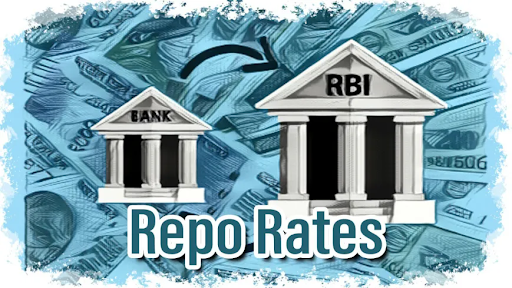
The repo rate plays a crucial role in a country’s financial ecosystem, affecting everything from interest rates on loans to economic growth and inflation control. But what exactly is the repo rate, and why does it matter? Whether you’re an investor, borrower, or simply someone trying to understand banking and economics, knowing how the repo rate works can help you make better financial decisions.
In this detailed guide, we will break down the repo rate definition, its significance in the Indian economy, and its impact on banking and inflation. We will also discuss the difference between repo rate and reverse repo rate, the history of repo rate changes in India, and the current repo rate scenario.
What is Repo Rate? Definition and Full Form
The full form of repo rate is Repurchase Agreement Rate. It refers to the interest rate at which the Reserve Bank of India (RBI) lends money to commercial banks when they need short-term liquidity.
Key Points About Repo Rate
- Repo rate in banking is used as a tool by the RBI to control money supply, inflation, and economic stability.
- When banks borrow money from the RBI, they pledge government securities as collateral.
- The higher the repo rate, the costlier it becomes for banks to borrow, reducing liquidity in the market.
- A lower repo rate makes borrowing cheaper, encouraging economic growth.
Also Read:- Section 80EEA: Deduction for interest on Home Loan – Housiey
How Does Repo Rate Work?
The repo rate mechanism involves a short-term loan transaction between the RBI and commercial banks. Let’s break it down step by step:
- Banks face a shortfall of funds and approach the RBI for a loan.
- RBI lends money to these banks at an agreed interest rate, called the repo rate.
- Banks provide collateral in the form of government bonds or treasury bills.
- Banks repay the loan with interest after the agreed period, and the collateral is returned to them.
This system helps the RBI regulate liquidity in the economy, either tightening or easing money supply based on economic conditions.
What is Repo Rate in India and Why It Matters?
Impact of Repo Rate in Banking and Economy
The repo rate in India directly impacts the banking sector, inflation levels, and overall economic growth. Here’s how:
| Factor | Higher Repo Rate Effect | Lower Repo Rate Effect |
|---|---|---|
| Loan Interest Rates | Increase (costlier loans) | Decrease (cheaper loans) |
| Inflation Control | Helps control inflation | Can increase inflation |
| Economic Growth | Slows down economic activity | Stimulates economic growth |
| Liquidity in Market | Decreases (less money supply) | Increases (more money supply) |
As seen in the table, the repo rate is a powerful tool that controls inflation and economic stability by regulating liquidity in the market.
What is Repo Rate and Reverse Repo Rate?
Repo rate and reverse repo rate are two sides of the same coin.
- Repo Rate: The interest rate at which RBI lends money to banks.
- Reverse Repo Rate: The interest rate at which RBI borrows money from banks.
Also Read:- Uniform Civil Code Uttarakhand 2025: News | Key points | Implementation
Repo Rate vs Reverse Repo Rate: Key Differences
| Aspect | Repo Rate | Reverse Repo Rate |
|---|---|---|
| Definition | Rate at which RBI lends to banks | Rate at which banks deposit funds with RBI |
| Effect on Liquidity | Reduces liquidity | Increases liquidity |
| Purpose | Controls inflation by restricting money supply | Absorbs excess liquidity from the banking system |
| Who Benefits? | Commercial banks borrowing from RBI | RBI controlling surplus money |
Currently, the reverse repo rate is usually lower than the repo rate, encouraging banks to lend more to the public instead of parking money with the RBI.
Repo Rate vs Bank Rate: Key Differences
The bank rate and repo rate are often confused, but they serve different purposes.
| Feature | Repo Rate | Bank Rate |
|---|---|---|
| Loan Type | Short-term borrowing (1-90 days) | Long-term borrowing (more than 90 days) |
| Collateral Requirement | Requires collateral (government securities) | No collateral required |
| Impact on Economy | Controls short-term liquidity | Influences long-term financial stability |
Repo Rate History in India
India’s repo rate has fluctuated over the years based on economic conditions. Here’s a quick look at its changes:
| Year | Repo Rate (%) | Key Economic Events |
|---|---|---|
| 2008 | 9.00% | Global financial crisis |
| 2012 | 8.00% | High inflation |
| 2016 | 6.50% | Demonetization |
| 2020 | 4.00% | COVID-19 pandemic |
| 2024 | (Current Repo Rate – Insert Value Here) | (Latest Economic Condition) |
What is Repo Rate Now? (Current Scenario)
As of (insert current month and year), the repo rate at present is (insert value here).
How Does This Impact You?
- If the repo rate is high, expect higher loan EMIs and costlier borrowing.
- If the repo rate is low, home loans and personal loans become cheaper.
Conclusion
Understanding the repo rate in economics is crucial for anyone involved in finance, whether as a borrower, investor, or policymaker. The repo rate is one of the most critical monetary policy tools used by the RBI to control inflation and economic stability. By adjusting the repo rate, the RBI ensures a balance between economic growth and inflation control.
At Housiey, we believe that staying informed about financial terms like repo rate helps homebuyers make better decisions. If you’re looking to understand how tax benefits work for home loans, check out our blog on Section 80EEA to maximize your savings.
FAQs
- The full form is Repurchase Agreement Rate.
- It is the interest rate at which the RBI lends money to banks for short-term needs.
- The current repo rate is (Insert Latest Value).
- A higher repo rate increases loan interest rates, making EMIs costlier.
- Repo rate is for short-term borrowing with collateral, while the bank rate is for long-term borrowing without collateral.
- Loans become more expensive, reducing borrowing and controlling inflation.
- Loans become cheaper, boosting spending and economic growth.
- A higher repo rate reduces inflation by controlling money supply, while a lower repo rate can increase inflation.
- The Monetary Policy Committee (MPC) of the Reserve Bank of India (RBI) decides the repo rate.
- The RBI reviews and updates the repo rate every two months during its monetary policy meetings.
- The repo rate is the rate at which RBI lends to banks, while the reverse repo rate is the rate at which banks deposit funds with RBI.
- A higher repo rate can increase FD interest rates, making savings more attractive.
- Yes, a higher repo rate can lead to a bearish stock market as borrowing becomes expensive for businesses.
- A lower repo rate can boost GDP growth by encouraging borrowing and investment.
- It directly affects loan EMIs, savings rates, and overall purchasing power.
- A lower repo rate makes home loans cheaper, boosting real estate demand.
- To make borrowing easier and stimulate spending and investment.
- A high repo rate can lead to increased credit card interest rates.
- The lowest repo rate in India was 4.00% during the COVID-19 pandemic (2020-2022).
- As of (insert latest date), the repo rate is (insert latest rate here).

I am Zeeshan Qureshi, a dedicated content writer for Housiey.com, passionate about simplifying the home-buying journey for everyone. With strong expertise in the real estate industry, I strive to offer transparent, reliable, and up-to-date information that empowers homebuyers to make smart property decisions.
My articles, guides, and project reviews reinforce Housiey’s core values—No Brokerage Policy and Bottom Rate Guarantee—ensuring every reader gets genuine market insight, legal clarity, and the most recent trends.
Through Housiey Blogs, I aim to provide readers with valuable knowledge on topics like Real Estate Law, RERA, Stamp Duty, Home Loans, Vastu Tips, and the latest property market updates.
Specialization: Project analysis, government policy explainers, financial guidance, home design tips.
Mission: To empower Indian families with trustworthy knowledge for their dream home purchase.
Writing Style: Making complex real estate topics easily understandable and engaging for every reader.
If you are seeking answers to your property questions or want to stay updated with the latest real estate trends, stay connected with Housiey Blogs—where you’ll always find insight, trust, and real-world guidance.
Related Stories