
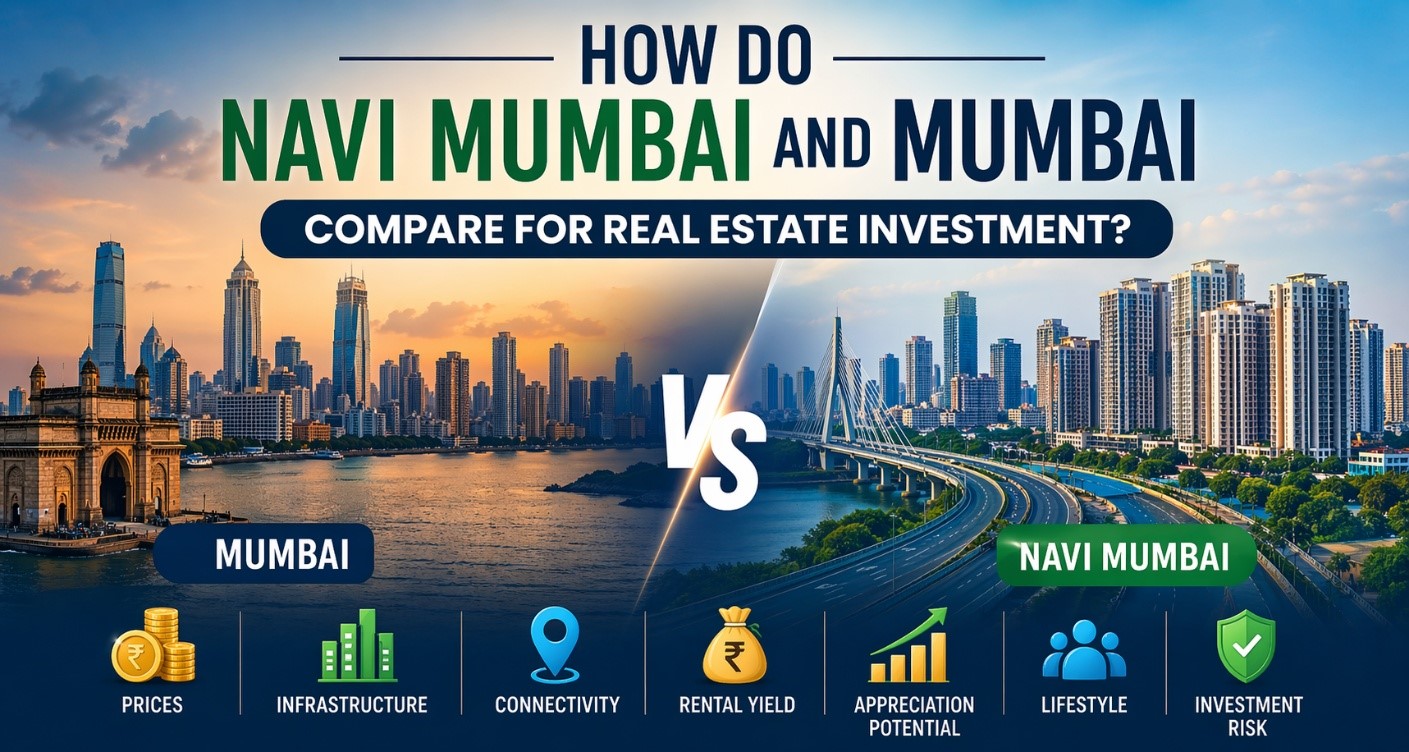
How Do Navi Mumbai and Mumbai Compare for Real Estate Investment?
-
 By L. Sadriwala
- April 23, 2026
Introduction
Mumbai has always been the heartbeat of India’s real estate market—fast-paced, aspirational, and consistently in demand. But over the past decade, Navi Mumbai has quietly evolved from a satellite city into a serious contender for property investment. With infrastructure upgrades, better planning, and relatively affordable pricing, it’s now attracting both end-users and investors.
So the big question is: where should you invest, Mumbai or Navi Mumbai?
This blog breaks down every critical aspect, pricing, infrastructure, rental yield, appreciation potential, lifestyle, and future growth, so you can make a confident, well-informed decision.
Quick Answer
If you’re looking for stability, high rental demand, and premium real estate, Mumbai remains a strong choice. If your goal is affordability, higher appreciation potential, and future growth, Navi Mumbai offers better long-term returns.
Market Snapshot Table
|
Parameter |
Mumbai |
Navi Mumbai |
| Average Property Price | ₹25,000 – ₹70,000 per sq ft | ₹8,000 – ₹20,000 per sq ft |
| Rental Yield | 2% – 3.5% | 3% – 5% |
| Infrastructure | Mature and saturated | Rapidly developing |
| Appreciation Potential | Moderate | High |
| Entry Cost | Very high | Relatively affordable |
| Supply Availability | Limited | Abundant |
| Connectivity | Excellent | Improving rapidly |
Pricing: Where Do You Get More Value?
Mumbai’s real estate is among the most expensive in India. Prime areas like South Mumbai, Bandra, and Lower Parel command extremely high prices, making entry difficult for many investors.
Navi Mumbai, on the other hand, offers significantly lower entry costs. Areas like Panvel, Kharghar, and Ulwe provide modern developments at a fraction of Mumbai’s cost, allowing investors to buy larger homes or multiple units.
Verdict: Navi Mumbai clearly wins on affordability and value for money.
Infrastructure: Developed vs Developing
Mumbai boasts well-established infrastructure—local trains, metro lines, commercial hubs, and social amenities are already in place.
Navi Mumbai is in a high-growth phase. Key developments like the Navi Mumbai International Airport, metro expansion, coastal road connectivity, and trans-harbour link are transforming the region.
Verdict: Mumbai is mature; Navi Mumbai is future-ready.
Connectivity: Accessibility and Commute
Mumbai’s connectivity is unmatched with its extensive suburban railway network and expanding metro lines.
Navi Mumbai has improved drastically with road networks, upcoming metro lines, and the Mumbai Trans Harbour Link (MTHL), which significantly reduces travel time to South Mumbai.
Verdict: Mumbai leads currently, but Navi Mumbai is catching up quickly.
Rental Yield: Where Do You Earn More?
Mumbai offers consistent rental demand, especially in business districts like BKC, Andheri, and Powai. However, due to high property prices, rental yields remain relatively low.
Navi Mumbai offers better rental yield percentages because of lower acquisition costs and growing demand from professionals working in nearby commercial hubs.
Verdict: Navi Mumbai offers better rental returns in percentage terms.
Appreciation Potential: Future Growth Outlook
Mumbai’s property prices are already at a premium level, so appreciation tends to be steady but slower.
Navi Mumbai is still developing, and with major infrastructure projects nearing completion, property values are expected to rise significantly over the next 5–10 years.
Verdict: Navi Mumbai has stronger appreciation potential.
Lifestyle and Livability
Mumbai offers unmatched lifestyle options, luxury housing, nightlife, premium schools, hospitals, and corporate hubs.
Navi Mumbai offers a more planned and less congested environment with wider roads, open spaces, and better air quality. It is ideal for families looking for a peaceful lifestyle.
Verdict: Mumbai wins on lifestyle luxury; Navi Mumbai wins on livability.
Supply and Demand Dynamics
Mumbai has limited land availability, leading to constrained supply and high competition for properties.
Navi Mumbai has ample land parcels and multiple ongoing projects, giving buyers more choices and better negotiation power.
Verdict: Navi Mumbai offers more flexibility and options.
Also Read:- New Under Construction Projects Near Navi Mumbai International Airport
Investment Risk
Mumbai is a low-risk market due to its established nature and consistent demand.
Navi Mumbai carries slightly higher risk as it depends on the timely completion of infrastructure projects, but it also offers higher rewards.
Verdict: Mumbai is safer; Navi Mumbai is higher risk, higher reward.
Buyer Insights
- Most investors in Mumbai are either high-net-worth individuals or those seeking stable rental income and capital preservation.
- Navi Mumbai attracts first-time buyers, mid-income investors, and those looking for future appreciation rather than immediate returns.
Why Buyers Choose Housiey
Housiey simplifies your home-buying journey by connecting you directly with verified builders, eliminating broker hassles and ensuring complete transparency. Whether you’re investing in Mumbai or Navi Mumbai, Housiey helps you explore the best projects, compare options, and make informed decisions with ease.
Conclusion
Both Mumbai and Navi Mumbai have their own strengths, and the right choice depends entirely on your investment goals.
If you want stability, premium location, and assured demand, Mumbai remains unbeatable. But if you’re looking for affordability, better rental yield, and strong future appreciation, Navi Mumbai is clearly the smarter long-term bet.
In many cases, a balanced approach, investing in both markets, can help you diversify risk while maximizing returns.
Key Takeaways
Mumbai offers stability, premium real estate, and consistent demand but comes with high entry costs. Navi Mumbai provides affordability, higher growth potential, and better rental yields, making it ideal for long-term investors. Infrastructure development is the biggest growth driver for Navi Mumbai, while Mumbai continues to dominate in terms of established lifestyle and connectivity. Your investment choice should align with your budget, risk appetite, and time horizon.
Also Read:- Top 10 Benefits of Buying a Home in Navi Mumbai 2025
Sources
- Maharashtra Real Estate Regulatory Authority (MahaRERA)
- Reserve Bank of India housing data reports
- Industry reports by JLL India
- Knight Frank India real estate outlook reports
- CBRE India residential market insights
- Government infrastructure announcements and urban development reports
- CIDCO planning and development reports
- Housing sales and pricing data from leading real estate analytics platforms
FAQs
- Navi Mumbai is better for affordability and future appreciation potential. Mumbai is better for stability and immediate rental demand.
- Navi Mumbai generally offers higher rental yields due to lower property prices. Mumbai yields are lower but more stable.
- Yes, due to upcoming infrastructure projects and planned development. It is expected to see strong appreciation over time.
- Limited land supply and high demand drive prices up. It is also India’s financial capital, attracting constant investment.
- Kharghar, Panvel, Ulwe, and Taloja are emerging hotspots. These areas benefit from upcoming infrastructure developments.
- Navi Mumbai is considered more planned and less congested. Both cities are generally safe with good civic infrastructure.
- Yes, especially after major infrastructure projects are completed. The growth potential remains strong.
- Yes, it is considered one of the safest real estate markets in India. Demand remains consistent across cycles.
- Affordability combined with future growth potential. It allows investors to enter the market at a lower cost.
- Dependence on infrastructure completion timelines. Delays can impact appreciation.
- Yes, many premium projects are coming up. However, they are still more affordable than Mumbai equivalents.
- Mumbai currently has better connectivity. Navi Mumbai is rapidly improving with new projects.
- It is suitable for both. End-users benefit from better living conditions, while investors gain from appreciation.
- Mumbai has higher and more consistent rental demand. Navi Mumbai demand is growing steadily.
- Yes, but only with reputed developers. Under-construction properties often offer better pricing.
- No, it is relatively less congested. It offers a more spacious and planned environment.
- Navi Mumbai is more suitable due to lower prices. It allows easier entry into the property market.
- Generally, they are comparable but slightly lower in some areas. Costs vary depending on location and property type.
- Location, connectivity, and commercial activity are key factors. Demand from professionals also plays a major role.
- Yes, diversifying across both markets can balance risk and returns. It is a smart strategy for long-term investors.
L. Sadriwala, the Editor-in-Chief at Housiey, is a seasoned writer whose professional journey in content creation began in 2015. With a background rooted in a family of real estate developers, her transition into real estate writing was a natural evolution, bringing together her storytelling expertise and deep industry understanding.
Over the years, she has authored impactful blogs across diverse niches such as food, travel, and lifestyle, before establishing her reputation as a trusted voice in Indian real estate. Today, her work stands out for its clarity, accuracy, and ability to simplify complex property concepts for readers.
At Housiey, every article crafted by L. Sadriwala reflects thorough research, verified facts, and a reader-first approach. From decoding housing policies and trends to offering in-depth builder reviews and project insights, her mission is clear: to empower homebuyers and investors with the knowledge they need to make confident property decisions.
Her writing not only informs but also builds trust, making her one of the most credible editorial voices in the real estate space.
Related Stories