
Ajit Pawar’s Tragic Death in Plane Crash Revives Memories of Sanjay Gandhi’s 1980 Loss
-
 By L. Sadriwala
- January 29, 2026
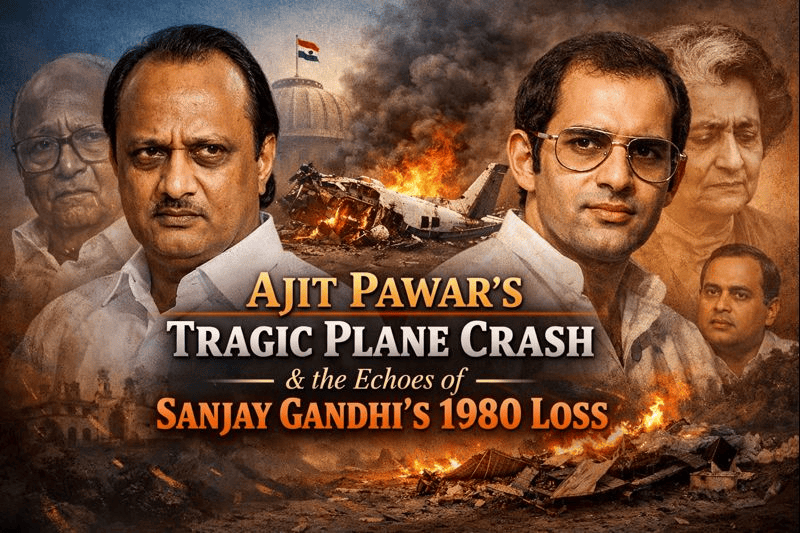
The sudden and tragic death of Maharashtra Deputy Chief Minister Ajit Pawar in a plane crash has sent shockwaves across the state’s political landscape. The incident, which occurred in his hometown, Baramati in Pune district on Wednesday morning, has not only stunned the ruling Mahayuti alliance but has also deeply affected Nationalist Congress Party (NCP) founder Sharad Pawar, Ajit’s uncle and longtime political mentor.
Beyond the immediate grief, Ajit Pawar’s untimely demise has drawn inevitable comparisons to one of India’s most haunting political tragedies: the death of Sanjay Gandhi in a plane crash in 1980. Both incidents unfolded at crucial moments of political transition, altering the course of powerful political legacies.
A Political Setback at a Crucial Moment
Ajit Pawar’s passing comes at a time when the NCP was at a delicate crossroads. After splitting the party in 2023 and aligning with the BJP-led Mahayuti, Ajit had recently shown signs of renewed closeness with Sharad Pawar’s faction. Reports suggested that a reconciliation was underway, further supported by their cooperation in recent civic elections in Maharashtra.
His death now places the future of the NCP in uncertainty. With 41 MLAs in the Maharashtra Assembly, one Lok Sabha MP, and two Rajya Sabha MPs, the party faces difficult questions about leadership, direction, and unity.
Echoes of Sanjay Gandhi’s Fatal Crash
The parallels with Sanjay Gandhi’s death are striking. In June 1980, Sanjay, son of then Prime Minister Indira Gandhi—died in a plane crash in Delhi while performing aerial maneuvers in a small aircraft. The tragedy occurred just months after the Congress returned to power following the collapse of the Janata Party government.
Sanjay was widely seen as Indira Gandhi’s political successor, despite never holding an elected office. His influence during the Emergency period (1975–77) was immense, and his death dealt a devastating emotional and political blow to Indira Gandhi. After visiting the crash site, she reportedly told her personal physician, “My right hand has been cut off,” capturing the depth of her loss.
Political Heirs Lost Too Soon
Ajit Pawar, much like Sanjay Gandhi, was long regarded as the political heir apparent. Before Sharad Pawar’s daughter Supriya Sule rose prominently in national politics, Ajit was seen as the natural successor within the Pawar legacy. Even in recent reunion discussions, speculation was rife that Supriya Sule could take on a larger national role, while Ajit would lead the party’s state-level politics.
History shows how Sanjay Gandhi’s death reshaped India’s political future, forcing Rajiv Gandhi, who had little interest in politics, to step into public life. He would later become Prime Minister following Indira Gandhi’s assassination in 1984.
In contrast, Supriya Sule is already an established political figure. Yet, with Sharad Pawar reportedly considering retirement by the end of 2026, Ajit Pawar’s death has intensified succession debates within the NCP, with multiple contenders emerging within the extended Pawar family.
A Turning Point for Maharashtra Politics
Ajit Pawar’s sudden exit leaves a vacuum that extends beyond party lines. It marks the end of a political chapter and the beginning of an uncertain transition, much like Sanjay Gandhi’s death did over four decades ago. As Maharashtra mourns, the state’s political future hangs in the balance, shaped by a loss that will be felt for years to come.
L. Sadriwala, the Editor-in-Chief at Housiey, is a seasoned writer whose professional journey in content creation began in 2015. With a background rooted in a family of real estate developers, her transition into real estate writing was a natural evolution, bringing together her storytelling expertise and deep industry understanding.
Over the years, she has authored impactful blogs across diverse niches such as food, travel, and lifestyle, before establishing her reputation as a trusted voice in Indian real estate. Today, her work stands out for its clarity, accuracy, and ability to simplify complex property concepts for readers.
At Housiey, every article crafted by L. Sadriwala reflects thorough research, verified facts, and a reader-first approach. From decoding housing policies and trends to offering in-depth builder reviews and project insights, her mission is clear: to empower homebuyers and investors with the knowledge they need to make confident property decisions.
Her writing not only informs but also builds trust, making her one of the most credible editorial voices in the real estate space.
Related Stories